
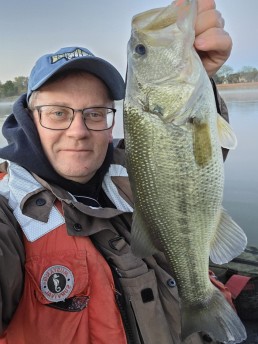
The Dreaded Lingering Season
I’m sitting on the water on October 15th, the water is still 68 degrees, and the air temperature is 77 degrees. What is going on? Get cold already!
This past year was a perfect example. On October 15th, I would normally expect the lakes to be turning over, and they were still in the upper 60s.
Nothing can mess up the fish like what I call a “Lingering Season.” It’s not just fall, but it can be any of the seasons. When they drag out, it just messes up the flow and progression of fish patterns, and in turn make it difficult for fishermen to find or catch them.
The term anthropomorphism is a tendency to attach human motivations and characteristics to animals. Fishermen do it all the time. We interject our feelings like they were the fish’s feelings. For instance, it is October 15th, 77 degrees, and I’m in shorts—so the fish should be acting like it is August, too. Wrong! Fish are fish, and until we can ask them how they like a 77-degree day in October, we must play the season and not the day.
Photoperiodism is another term that biologists use to predict biological processes like animal migration. Fish don’t have a wristwatch or a calendar, but they are keenly sensitive to “photoperiod.” By sensing the amount of daylight vs. night, they know exactly where they are in the yearly season.
Lake Michigan salmon are incredibly water temperature sensitive. They move daily to position near a food source in the water temperatures that are in their comfort zone of probably 52 to 58 degrees. Four-year-old kings will start showing up near shore in late August in 70-degree water! This puzzled me every year until I discussed this with a fisheries biologist. Why on earth would a salmon come into 70-degree water? It’s like someone from Wisconsin entering Universal Studios Orlando when it is 102 degrees. (If that’s oddly specific, it’s because I lived there once.) The answer is photoperiod! Their internal calendar is telling them that it is time to spawn, and they are going into the harbors and up the rivers no matter what the temp is. They will travel “out of temperature” if the photoperiod tells them it’s time to move, even if that’s uncomfortable for them.
So, we have a lot of factors that drive fish movement and positioning. So how do we deal with lingering seasons.
Of all the “lingering seasons,” the two that will punch you in the gut are lingering spring and lingering summer. I will take a lingering fall any year, because that allows me to keep fishing open water into December here in Wisconsin! Lingering winter taxes my psyche more than the fish!
You can be among the first to get the latest info on where to go, what to use and how to use it!
Since this topic was most recent, let’s talk about fishing in a lingering summer. Ugh… my worst situation. If you talk to guys that hate fishing in September, it’s a bad month mostly because of lingering summer years. I’ve had some great Septembers, generally because they were cold or cool. Those years were “October cold” in September and that really got the fall transition supercharged. Conversely, when that summer heat extends into September and even October, fish have no incentive to start that transition. A traditional fall transition would have fish moving deeper, to hard bottoms, and gathering up into concentrated schools. As anglers, we can focus on fall presentations and locations. A lingering summer messes that all up. So, what do you do?
Well, unfortunately, you need to fish both summer and fall locations. And you will find fish in both locations. You can’t just start on some deep structure like it was really fall because some of the fish will migrate due to photoperiod.
You will catch a couple and think that they are all there. If you are in a lingering situation, I guarantee that there will be fish still in a summer pattern as well. This past October, I had several days where I caught half of my fish cranking a Bomber 7A on boulders in 13 feet of water, and the other half of literally on the bank, eating a swim jig in a foot of water.
Here is what to watch for in a lingering summer: Was there a cold spell at all in late September or early October? That would send roughly 50% of the bass migrating to deep water where they will stay. Once that group goes deep, they are insulated from the day-to-day, unseasonable warm temps and generally stay deep. If you don’t get that three- to five-day cold snap, look for only 15% to 25% of the fish to move deeper, and most of the fish to remain in shallow weeds until they do feel the cold. This is why I am telling you that you need to fish like its “summer” and “fall” every day when you are in a lingering summer pattern.
The other dreaded phenomena is a lingering spring. I consider spring from to be from ice-out till the start of the spawn. Wisconsin is famous for rotten, cold springs that seem to last forever. The Easter Bunny had to hide eggs in snow here more often than I’d like to remember.
What really messes with a lingering spring is that the bass and walleyes are waiting for things to get right to spawn. Bass, in particular, are waiting for a magic temperature to start their process. A lingering spring can drag this into mid-May and even June in northern Wisconsin. If you see nothing but small males up in the shallows, that tells you that the pre-spawn females are still waiting. That’s when you need to get out away from the spawning areas and work the first drop off adjacent to the spawning flats. Those bigger females will hang there till water temps get right. They can’t come in “out-of-temperature” or their eggs will not survive.
Weather plays heavily into fish movements and behavior, and we must adjust to changes. A lingering season can really throw you off for weeks if you don’t realize it and don’t make the necessary adjustments. Be ready to pivot!
Did you enjoy this post?
You can be among the first to get the latest info on where to go, what to use and how to use it!