
Paddling for Muskrats
Trapping beavers in the marsh each fall is a much-anticipated outdoor experience, says Tom Berg.
Muskrat trappers have a special love for swamps, marshes and backwater sloughs. The unmistakable scent of the marsh greets us as we move silently through the reeds and patches of cattails. The earthy smell of mud and decaying plant matter is like a tonic for our soul; it rejuvenates us and it excites us.
We also hear the whispering of the wild places. The soft, dry sound of the cattails and marsh grass is somehow soothing to us as the wind blows through them. Ducks are quacking softly in the distance. Huge flocks of blackbirds swarm into the cattail thickets and then take flight again with a subdued roar. The marsh is alive. We know that muskrats are out there, too; we just have to catch them!
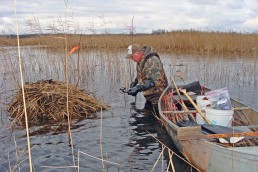
As trapping season approaches, we think about the marsh more and more often. Canoes can slip right through the thickest weed beds and breeze past dense stands of cattails and phragmites.
Trapping muskrats from a canoe can be fun and easy. It removes a lot of the effort of trudging through the marsh, and it allows trappers to cover more territory and increase their catch.
Essential gear
Obviously, the first item on your gear list should be a stable canoe. Any canoe will work, but a stable craft with a fairly flat bottom will work just fine. If you are like me and usually trap alone, a shorter canoe, like a 13-foot or 14-foot model, is the perfect size. If you always bring along a partner, a larger 17-foot canoe will give you more room and allow you to pack more traps and stakes.
The next item on your gear list should be a canoe paddle. Actually, you should have two paddles. You need one paddle for propelling the canoe, and you also need a spare paddle. Hopefully the spare paddle will always remain in the bottom of the canoe and you won’t need it. But if you ever break your paddle (it can happen!) or drop it overboard in deep water and can’t retrieve it before the wind takes it away, a spare paddle can save the day.
A lifejacket is also a required item. Most states require a lifejacket, and if you paddle through deep water, you will be glad you are wearing it if the canoe capsizes for one reason or another.
Insulated waders are another must. Cold water leads to hypothermia very quickly, and it doesn’t make sense to risk your health or your life. Full-length chest waders are definitely better than hip boots for keeping you warm and dry.
Some trappers only bring along one type of trap, but I have found that bringing along different types of traps gives you much more flexibility on the trapline. Leghold traps, body grip traps and colony cage traps will give you the tools for almost any situation.
You can be among the first to get the latest info on where to go, what to use and how to use it!
Trap stakes are must-have items, also. A trap stake can be almost anything: a thin (but strong) tree branch, a wooden slat, even a bamboo pole. The only two requirements for muskrat trap stakes are that they be long enough to push into the bottom and still stick out above the water, and that they are strong enough to prevent a muskrat from breaking them or pulling them loose.
I always bring a pair of rubberized gauntlets (protective gloves). It just depends on how cold it is.
Some trappers do not use bait at all, while others swear by it. I like to bring along two or three apples. I slice them into thin wedges and place the pieces around the muskrat lodge above my submerged traps. The bright, white color of the apple is easy for the ‘rats to see in the moonlight, and the scent of the apple acts as an attractant, too. Some trappers use carrots, while others use turnips or other foods. Bring along a knife to cut the bait into wedges.
You can use a commercial muskrat lure if you like, or you can use something like peppermint extract. Pull a stiff marsh grass stem off of the lodge where you are setting your trap and dip it in the lure. Then push the other end of the stem into the lodge, with the scented end hovering right above your trap.
You will also need a roll of fluorescent flagging material to mark your trap stakes, maybe a small notebook and pencil so you can keep track of how many traps you set (and where), a short length of rope, your cell phone in a Ziploc bag, etc.
The last two items I bring are a pair of 5-gallon buckets. One bucket is absolutely filled to the top with traps. I add a short length of wire to the chain on each of my long spring traps, and I wind the chain and wire around the trap to make a compact package that doesn’t get tangled.
The other bucket holds the small miscellaneous items (gauntlets, bag of apples, knife, lure, flagging, notebook, rope, cell phone) and some extra clothes like a rain jacket, knit hat and spare pair of gloves.
Some forecasts predict that muskrat prices will be slightly higher this year, so this would be a great time to give ‘rat trapping a try for the first time. If you have trapped muskrats in the past but have not tried it in recent years, there will be no better time to get back into it than this fall.
Want to try something new this fall? Find more hunting and trapping insight from the pros in the fall issues of MidWest Outdoors, available by subscribing on our website.

Did you enjoy this post?
You can be among the first to get the latest info on where to go, what to use and how to use it!