
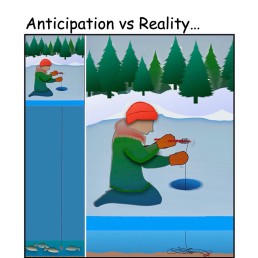
Ice Fishing: Trying or Quitting?
I am totally convinced that both Ernest Hemingway and W.C. Fields were in cosmic alliance with my first attempts at ice fishing! “Before you quit, you have to try,” were words of wisdom offered by Mr. Hemingway. Mr. Fields then set limits on that encouragement when he said: “If at first you don’t succeed, try, try again. Then quit. There’s no point in being a damn fool about it.” My noble adaption of Mr. Hemingway’s words of wisdom quickly surrendered to the realities of Mr. Fields—in one frustrating afternoon in my own, one-act performance of Ice Fishing for Dummies.
As an inner-city Boy Scout in the ‘60s, a highlight of our first winter weekend camping trip was an afternoon of ice fishing on the frozen waters of the Rum River that ran through our Scout campgrounds. A broad band of glass-smooth ice stretched below the steep, snow-covered riverbanks, beckoning our band of young, inexperienced Scouts with visions of dozens of hastily chopped holes; we were anxious to blast through its frozen surface to gain access to waiting schools of hungry smallmouth bass below.
None of us had ever ice-fished before, but anticipation and anxiety ran high; how hard could it be? You chop a hole in the ice, bait a hook, drop a line, reel in a fish—simple, direct and one step closer to that fishing merit badge adorning our sashes; not to mention a sizzling, deep-fried campfire victory banquet at the end of the day.
Armed with hatchet, a few jigs and about 50 feet of monofilament line hijacked from a dusty fishing reel and rewound around a section of broom stick, I abandoned all caution and skittered across the ice to what I envisioned as the perfect honey hole lying beneath a frozen section of Minnesota’s Rum River.
It only took a few swings with my small hatchet to realize that it was not the hole-making tool of choice for hacking through brittle, chip-spewing, frozen liquid. A hand-cranked auger would have been considered “high-tech” at this point.
No discouraged “quitter” at this point, I repositioned my hand around the hatchet and continued blasting with reckless abandon, down through the surface. Each swing of the hatchet sent an explosion of ice splinters skyward into the chilling, 20ºF cold, wintry Minnesota sky. Most of the shards made it no further than a coating of airborne fragments of ice frozen to my jacket, hat and face.
After a 10-minute frenzy of maniacal chopping, I had produced a crater that now was rapidly filling with a frozen slurry resembling a giant Slushie treat. Using a chop-chop-chop, quickly scoop out slush, chop, repeat! method, I was finally able to excavate a rough, bowl-shaped hole through the frozen Rum River.
So far, the “trying” part held firm; Move over Mr. Hemingway; I’ve got some fishin’ to do.
The dark, shimmering ‘eye’ in the ice stared up at me as I knelt over the hole and lowered a small jig down into the blackened depths of the river. The worn lengths of that old monofilament line coiled off my handline stick in an endless spiral as I fed it down the hole. The weight of the jig barely offered resistance, so I could only tell how deep it was going by the number of coils disappearing down into deep, dark depths below.
I soon realized that more of the stick was being exposed as the line unwound; another five feet or so, and I would reach the bird’s nest of a granny knot I had used to tie the end line onto my caveman reel. That would mean that my hole was over a pool about 50 feet deep!
Up to this point, I hadn’t looked beyond the glory hole prospect right in front of me. It turns out that I had hacked my way through the ice about a dozen paces from the shoreline of a small bend in the slow-flowing river. Even for this neophyte ice angler, something was amiss. At its deepest, the Rum might be 10 or 12 feet to the bottom.
Eye-to-eye with that depthless hole, I strained to look down along my fishing line as my eyes adjusted to the limited, sun-lit opening. Through an ever-darkening opening and a diminishing glow seeping down below the icy surface, I saw movement as I delicately jigged my line up and down. A few more tugs on the stick and it all became as clear as the ice I had hacked away.
Ice along that entire frozen section of the river where I had chosen to try my first run at ice fishing was about eight inches thick. Unfortunately, the depth of the water running beneath it was also only about eight inches deep! I had basically blasted a hole through river ice that had formed over a sandbar!
You can be among the first to get the latest info on where to go, what to use and how to use it!
Still trying, Mr. Hemingway, but ‘quitting’ is starting to look more appealing.
Gathering my gear, I started walking back to the foot trail up from the riverbank when I noticed a break in the smooth surface of the river. It resembled a scar-like circle of ice ridges: a hand auger “wound” in the ice. A few strokes of the hatchet assured me that the ice had just recently “healed” over, and I soon cleared a hole in the river again.
Studying my surroundings, I guessed that the steep banks of the river just a few yards away meant that the waters were significantly deeper. I broke a six-foot section of a dead branch from a fallen tree and thrust it down into the hole: no bottom—for at least a half-dozen feet anyway.
No quitter, I dropped to my knees, wound out a section of line and dropped my enticement down into the promising darkness of this hopefully redeeming hole in the ice… and waited…and waited. A half-hour can seem like an eternity, sitting on ice in the middle of winter, holding onto a thin piece of line that hadn’t twitched a micron since it was dropped into the water.
Mr. Hemingway, just how long should I wait before I give up and quit trying? I am on the verge of surrendering to the “quitting” mode.
The spirit of Mr. Fields appeared in my thoughts about the same instant that I realized my lower body had gone numb from the cold. The vision of a bounty of frozen fish scattered around a hole in the ice (I’d seen pictures in Outdoor Life) faded from my memory as I strained to regain my stance on cold legs that had gone to sleep on me. Humbled in the moment, I hobbled back to camp.
Since that first foray into cold-weather angling, I tried to live up to Mr. Hemingway’s character-building advice on several other occasions—to no avail!
A few years later, I was invited to share an augered hole in the backwaters of the Mississippi River. Ten minutes into sitting on that cold, annoyingly uncomfortable 5-gallon bucket “seat,” followed by yet another eternity of zero-line action, the spirit of Mr. Fields haunted me as I finally succumbed and whimpered his mantra between frozen puffs of breath:
“If at first you don’t succeed, try, try again. Then quit. There’s no point in being a damn fool about it.”
Postscript: I’ve since enjoyed ice fishing outings on Lake of the Woods where “trying” means a warm icehouse, fantastic fishing and comfy surroundings. Perhaps those two sages never had that luxury; perhaps “trying” and “quitting,” cycled back and forth, are what makes ice fishing so endearing in the first place.
For more insight and tips on how to make the most of the time you spend outdoors, check out the articles in every issue of MidWest Outdoors, available by subscribing on our website.
MWO
SHARE THIS POST
Did you enjoy this post?
You can be among the first to get the latest info on where to go, what to use and how to use it!