
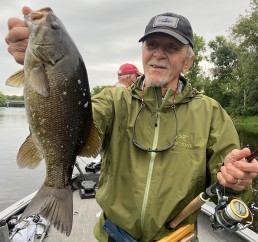
The Usual Suspects at Both Ends of the Line
The lures, and the characters who throw them, for summer river smallmouths
I have a small group of old fishing friends in the Brainerd, Minn. area whom I refer to as “The Usual Suspects.” You’ve probably heard the term in movies when the cops or secret police, “Round up the usual suspects.” Or perhaps seen the classic movie of the same name.
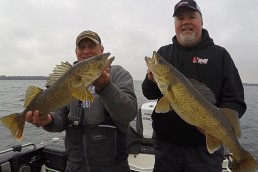
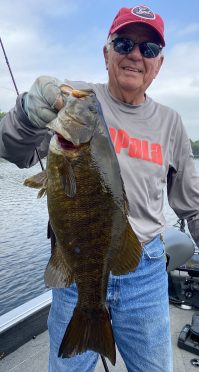 Chances are that if The Usual Suspects gather for morning coffee, some combo of them will fish together, or at least cross paths, on the Upper Mississippi or nearby rivers, in search of big smallmouth bass.
Each has his characteristics, as do each of the lures they throw.
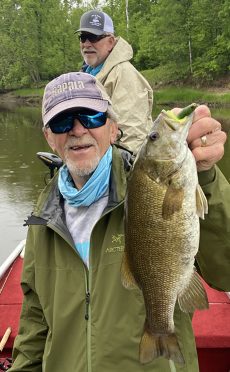
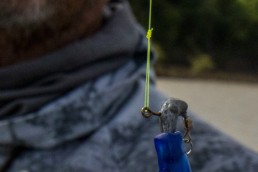
Dan is a man of mystery these days. You’ll never see him on the river, even though he’s out there on a regular basis. He’s disguised, all bundled up incognito in SPF 900+ clothing, gloves, and a buff covering his face to deflect the sun’s rays. Dan, like me, will throw anything it takes to catch fish. Just because he’d rather throw Lure A doesn’t mean he won’t throw Lures B, C, D, etc., ad infinitum, if that’s what it takes.
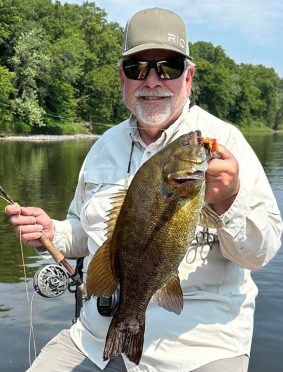
Mickey used to be strictly “the fly guy,” guiding fly fishermen to superb experiences on local rivers. When the group revealed that he and his customers could sometimes catch more and bigger bass using other tackle, he embraced additional versatility. He seems especially fond of a Whopper Plopper surface lure these days—perhaps because it sometimes scares up a muskie.
Gary is best known for “sleeptrolling” a surface lure on a long line behind the boat while taking a break for lunch, or simply a short break from awake. Suddenly, a big fish engulfs his lure, and he’s forced back into action—or consciousness. Hey, they all count.
I mention all this because, even if you have go-to lures and preferences, you need to remain versatile to consistently catch river smallmouths during summer, because: river levels, flows and water color change; weather varies every few days; different forage items come into play, seasonally; and because smallies are moody fish that, at times, show distinct preferences for one or two presentations while virtually ignoring all others. If you’re not prepared—and willing—to try about 10 or 12 different things on the water, chances are that you could come up near-empty.
With that in mind, let’s look at some of our deadly dozen or so techniques to consistently put river smallmouths in the boat. Keep in mind the general rule that when the river level is high, fish closer to the bank; when it’s low, fish more toward midriver current breaks.
The deadly dozen
Topwaters—Topwaters are usually ideal for summer fishing conditions, when smallies routinely rise to snatch bugs off the surface. Cast to shoreline cover during high-water conditions, and shift to midriver shoals, rock points, and current breaks when fish pull off the banks. All forms of topwaters work—propellors, poppers, walk-the-dog baits, buzzbaits. But they’re not always equal. Some days, one form may drastically outperform others. Experiment!
 Spinnerbaits—Boy, it’s hard to beat a 1/2-ounce, tandem spinnerbait for catching smallies relating to flooded, fallen trees and logs along a riverbank during high-water conditions. Cast it right next to the up-current side of tangles, and engage your reel to begin your retrieve just before your lure the lure hits the water, giving it a pump to engage the blades. Either just retrieve it straight, or try to tickle the fringes, crawling it over sticks and branches, perhaps with an occasional, momentary flutter before reeling again. It extracts bass from the tough stuff. Notably, smallies show a preference for spinnerbaits with two, minnow-imitating, willow leaf blades, while largemouths often respond better to the heavier thump of a Colorado-willow leaf blade combination.
Straight-shaft Spinners—These lures were developed for fishing in river current for trout, salmon, and smallmouths, and were expanded in models and sizes to cover other species and conditions. For smallies, I’m partial to a size 2 Mepps, Panther Martin, Vibrax or other spinner, either plain or with a bucktail treble. You may prefer a smaller size #1, or a larger #3; your choice. To run it shallow over shallow rocks or flooded weeds, hold your rod tip high to keep it inches deep, perhaps even bulging the surface, while steering it around obstructions by leaning your rod tip left or right. As the lure runs out over deeper water, lower your rod tip and slow your retrieve a bit to make it run deeper. Try to bump it off the up-current faces of boulders, followed by a momentary pause and flutter that resembles an injured minnow. Pulsing it occasionally with a twitch of the rod tip triggers strike.
Jigheads and soft plastics—Casting and swimming a 4-inch, minnow-imitating, soft plastic paddletail or grub on a 1/4- to 3/8-ounce jighead is fabulous in shallow rivers. Cast it to shore, alongside flooded cover, across shoreline flats, through boulder fields, along current breaks and into eddies—wherever bass swim. It’s great for covering broad, shallow bottoms; remember, river smallies are likely to be quite shallow—a few feet—in rivers. You can even pause your retrieve and drop it into holes as needed, or slow your retrieve to make it run deeper. For colors, everything from clear, to minnow imitations, to bright, gaudy colors works for smallmouths. Experiment.
You can be among the first to get the latest info on where to go, what to use and how to use it!
Swim jigs—Swim jigs are for tossing into flooded wood cover, letting them sink a bit, and then slip-sliding them back out over the limbs. Because you’re probably drifting down the river, you’re not letting the jig sink way down into the brush; rather, you’re looking for a semi-active biter, with minimal snagging problems. Yes, you could anchor or drop a Talon to hold in place while probing a wood tangle deeper with a standard weedless bass jig, but there are miles of riverbank to fish. Keep moving and probing.
Bottom jigs— Way back in the day, Dan Gapen develop the flat-headed, Gapen Ugly Bug jig featuring a soft plastic, larvae-imitating body with rubber legs. Cast it out, scooting or tumbling it across midriver rocks and current, mostly without snagging. Today, a wide variety of lightweight jig combos do sort of the same thing, although they’re perhaps more prone to snag. Ned rigs, 1/8-ounce jigs dressed with 4-inch plastic worms, lightweight hair jigs, etc. are candidates for shallow rock areas swept by current. They are most likely to produce in off-current spawning areas where you can crawl them across bottom and pause, tempting bites from pre-spawn fish. In fall, when smallies migrate downriver into deeper, slack-water areas at the top ends of reservoirs, crawl them across points meeting the river channel.
Shallow to mid-depth wobbling crankbaits—Shallow-running, fat-bodied, wobbling crankbaits like Rapala DT-4s and 6s are bread-and-butter scouting lures on rivers. Just pick up the river bank and go for miles, casting to locate packs of fish. This is particularly important when bass are migrating up-or downriver in early fall. Find ‘em, then catch ‘em. Retrieve the bait down until it starts making bottom contact, then back off a little to scrape, rather than plow. Crawfish patterns are fabulous in rock and boulder areas.
 Neutrally-buoyant minnow baits—Man, we catch loads of smallies in lakes using neutrally-buoyant minnowbaits like #10 X-Raps. Why should it be any different in rivers? Smallies can’t resist the sweep forward, pause to suspend a lure in place. Try hot colors like pink and clown for enhanced visibility in stained water.
Other soft plastic riggings—I’m partial to an unweighted, Texas-rigged, 4-inch, soft plastic forktail minnow. Throw it a few feet upstream of a flooded fallen tree, perhaps with a sun-blocking canopy of algae, and let the current sweep it a few feet under the tree. Twitch it, to come alive, then pop it back out again; chances are that it will be chased by one or more smallmouths hiding in the shade. When they all get excited, one is bound to bite. Also try a Texas-rigged, weightless, Senko-type lure if you want more depth or even a hint of bottom content.
Flyfishing—Flyfishing is both deadly and fun, although it takes a bit of work—especially when it’s windy. Try anything from minnow-imitating streamers, to subsurface insect imitators like Wooly Buggers, to topwaters like frog imitations. Mickey is fond of a brightly-colored subsurface fly with a conehead sinker, bucktail body and rabbit fur tail, which works wonders in stained river water. The nice thing about fly fishing in rivers: You can set up a rhythm, making the same length cast 100 times in a row, inches from shore, while peacefully drifting down the river.
Trolling diving crankbaits upstream through river holes—This may indicate a degree of desperation unless you’re simultaneously also after walleyes. But there are times, especially during low water, when smallies may be lying in the basins of midriver holes; although active fish are usually somewhere nearer the riffle at the head of the hole; it’s OK to anchor or hover, make a few casts, and drift your bait down into the head of the hole.
Weedless spoons—I suppose that you could add a weedless spoon like a Johnson Silver Minnow into the mix, especially when the river is high and smallies are using flooded weeds (which they do a times!) or brush. It’s pretty darned weedless; just hold your rod tip high while swimming it back to the boat, inches deep.
Soaking live bait—The last time I anchored and soaked live chubs in an eddy just off the main river, it produced a load of nice smallmouths when casting traditional lures failed to produce. But I’m not likely to do it unless I’m desperate; I prefer to keep moving, experimenting with a range of artificial lures, to make active fish respond. You may disagree. More power to you. Just have fun.
By my count, if you throw in live bait, that’s a Lucky 13 options rather than a deadly dozen; but hey, who’s counting?
Keep on pluggin’
Importantly, the productivity of lures or techniques often peak and ebb throughout the day. When you sense this is happening, start experimenting with other tactics. While one angler sticks with the previously hot lure to keep ‘em honest, others play around with different lures. You just might find a new hot lure in the process. For instance, if you see insects hatching on the surface in the evening, switching from subsurface to surface lures is probably in order. Observe, react, and catch fish.
These are The Usual Suspects found at either end of the line. Add a feisty smallmouth—or a bunch of them—to the far end of your line, and let the good times roll.
Did you enjoy this post?
You can be among the first to get the latest info on where to go, what to use and how to use it!