
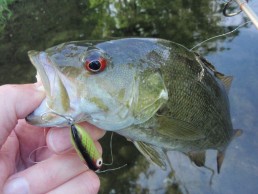
Summer Smallmouths: Tools of The Trade
My days of sitting on the riverbank with a cane pole in one hand, a Pepsi in the other, with a peach can full of worms nearby, are pretty much gone with the wind. Not that there is anything wrong with that laidback style of fishing, but I find myself being more inclined to take the fight to the fish where they live: in the river itself. Consequently, my choice of gear must be limited to what I can carry in my fishing vest or pockets.
Don’t leave home without the following items:
I am going to begin with a good, stout wading staff. This may sound strange, but I consider it almost as valuable as a rod and reel. There have been many occasions where I either slipped and lost my footing or stumbled over a boulder. My wading staff was like an extra arm that I could depend on to save me from a cold, wet dunking in the river. A good staff can be just as fancy and expensive as you wish to make it. Mine is a cut-down broom handle with a hole drilled in one end. A cord goes through the hole and is tied to my waders. I’d hate to step into the water without it.
As you can tell, I like to wade/fish for river fish—smallmouths in particular. During the summer months when the water levels are low, I step into a pair of Cabela’s Caddis hip boots. They are not cheap, but my pair have lasted quite a few years. During early spring or late fall, I pull up a pair of 5mm, chest-high neoprene waders that keep me dry in deeper water. and plenty warm when both the water and air are chilly.
My clothing usually consists of cotton trousers, two pairs of socks, or one pair during warm weather, a tee shirt, or a long-sleeved shirt to ward off mosquitoes, and a good pair of polarized sunglasses. Naturally, I slip a small spray can of bug repellent in a pocket.
Also, a Swiss Army pocket knife. It is invaluable for tightening up a screw on a reel, or cutting a lure off the line.
I never carry a net; it just gets in the way. Even though smallies are hard fighters, they can be landed by hand without much difficulty, unhooked and then released. Just be cautious not to get a hook in your hand.
When fighting a fish, try to keep your legs together, if possible. Smallies are notorious for darting between fishermen’s legs. If that fish has a crankbait in its mouth, a hook could tear a hole in the legs of an expensive pair of waders.
I usually use a spinning rod that is anywhere from 6 1/2 to 7 feet in length, with a fast taper, medium or medium-light action, a flexible tip and a stout backbone. Such a rod is necessary for setting the hook in the hard mouth of a smallmouth. The flexible tip aids in making long casts and helps keep a hard-fighting fish from breaking the line. More often than not, it is an Abu-Garcia rod that is 6 1/2 feet in length.
You can be among the first to get the latest info on where to go, what to use and how to use it!
I like using an Abu-Garcia spinning reel spooled with 8-pound monofilament line. I have experimented with braided line on a spinning reel, and I detest it. I keep my ice fishing reels loaded with braid, but not my river rods. Fluorocarbon line is fine for fishing crankbaits, in-line spinners, jigs, etc. But since it sinks, I don’t like to use it for surface lures. Day-in and day-out, give me a good mono line like Berkley Trilene in either 6- or 8-pound test.
In my fishing vest, I carry a pair of nail clippers for clipping line, a needlenose pliers for unhooking fish, a thermometer for reading water temperature, two plastic lure boxes, a small Zebco De-Liar, a couple of Band-Aids, a chain stringer in case I catch some catfish to keep, and a small packet of toilet paper, which needs no explanation.
While a smallmouth will eat just about anything that falls in, emerges from, or floats down the river, many sure-fire lures garner some good strikes.
My very favorite river crankbait is the Rapala Rattlin’ Rap in either bluegill or crawdad colors. This is a lipless crank that creates a fuss underwater. Its vibrations and internal rattle chambers let the fish know that prey is nearby and that it can be caught and eaten. Other similar selections? The Berkley Frenzy, the Cordell Hot Spot or the Bill Lewis Rat-L-Trap. Fish them fast, or fish them slow, until the fish let you know what they want.
Lipped cranks include the always good Yo-Zuri L Minnow in rainbow trout color, the Rapala Original Floating Minnow in blue/silver or black/gold, and the Storm Wee-Wart in rainbow or yellow sunfish colors. There are many more cranks on the market, but since I have limited space in my vest, these proven veterans go into the box. Experiment with sizes and colors to learn what the fish want.
An in-line spinner is an old river standby. Nearly any fish will hit it, including catfish, sheepshead and carp. There is no better in-line spinner than the Mepps Aglia. A close second is the Blue Fox spinner in silver.
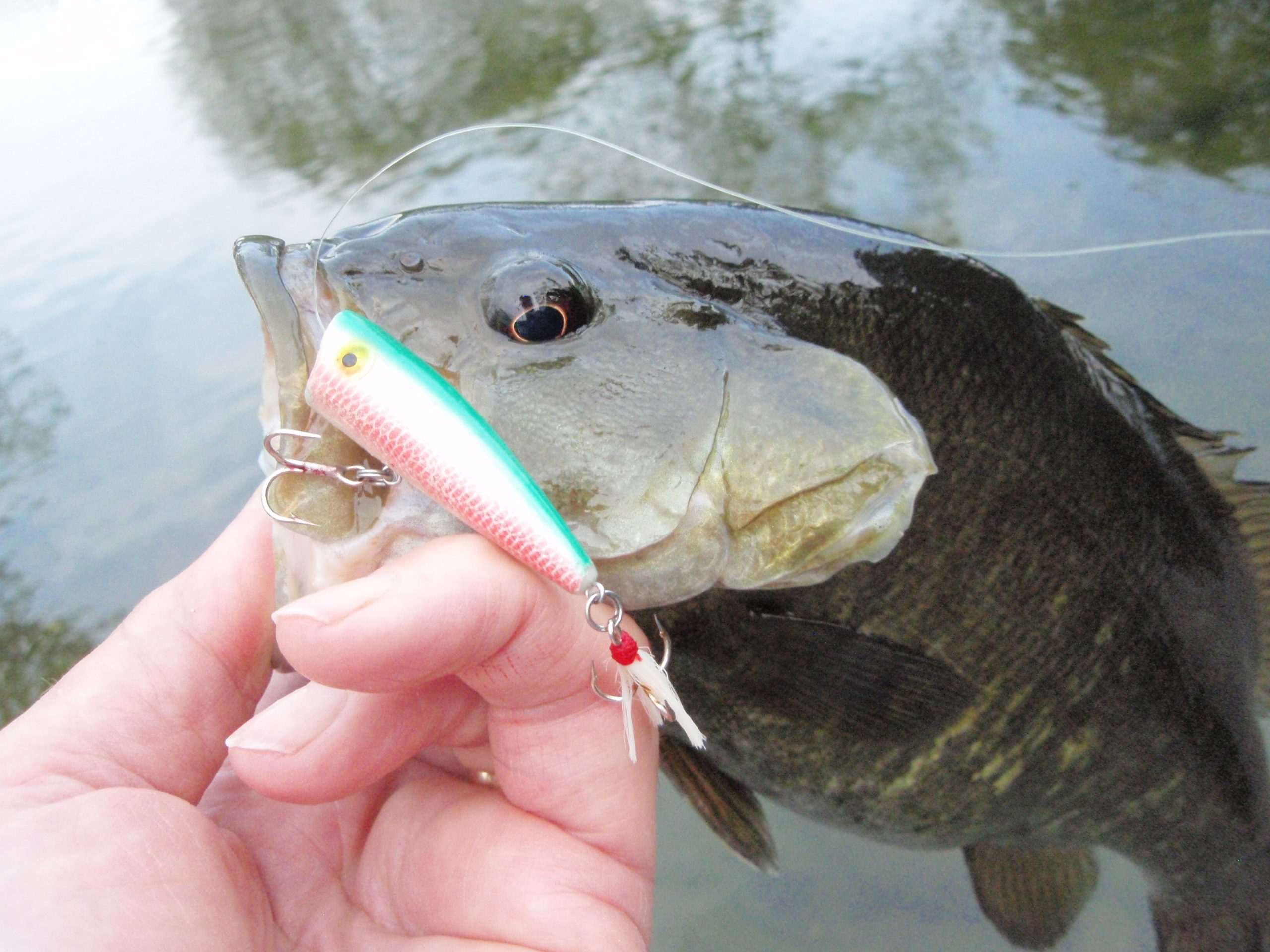
Nothing in river fishing is more fun than having a red-eyed smallie smash a surface bait. My top choice is the tried-and-true Rebel Pop-R in blue/silver or Baby Bass. If you have much experience on the rivers, you will know Pop-R water when you see it. This lure isn’t worth much in strong current, but lay it down next to a fallen tree, under hanging limbs, near an emergent boulder, in slack water near current flow, or in still water near weed beds, let it rest, twitch it a few times, and expect an explosion at any moment. It truly is a dynamite topwater lure.
So is a buzzbait. I have no idea what it is supposed to imitate, but when it comes gurgling across the surface, it drives fish crazy. I don’t pay attention to brand names when it comes to buzzbaits. I just buy the generic lures when they are on sale, and they seem to work just fine.
Don’t forget one more trick of the trade: Make about 98 percent of your casts upstream and retrieve back. That is the direction of the flow of food in the water; and the direction in which the fish will be looking and waiting.

Did you enjoy this post?
You can be among the first to get the latest info on where to go, what to use and how to use it!
