
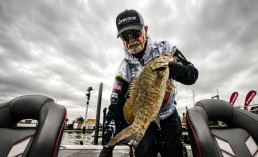
Rick Clunn: Topwater Bass & the Power of the Pause
There are few names in bass fishing that carry the weight of Rick Clunn. Across decades of tournament competition, Clunn has built a reputation not only as one of the greatest anglers in the history of the sport, but as one of its deepest thinkers. His understanding of fish behavior, instinct, and lure presentation has influenced generations of anglers.
Recently, I sat down with Clunn to talk specifically about Midwest bass fishing. From Wisconsin and Minnesota to Michigan and the Great Lakes region, northern fisheries offer a unique blend of largemouth and smallmouth opportunities that create some of the most exciting fishing in North America. While many anglers today are consumed with electronics and live sonar, Clunn still believes some of the most rewarding ways to catch bass remain rooted in instinct, power fishing, and topwater strikes.
For Clunn, the Midwest immediately changes the equation because of smallmouth bass.
“Being a southern boy, especially growing up around largemouth, when you go north all of a sudden you have smallmouth in play,” Clunn explained. “And the further north you go, the more important they become.”
He describes smallmouth bass as entirely different creatures compared to largemouth.
“The largemouth just wants to get in a bar fight,” he laughed. “He has a big belly and does not last very long in the fight. But a smallmouth is an athlete. It is all muscle. It spends time in current. It is built differently.”
That difference changes how Clunn approaches northern fisheries. While modern competitive bass fishing increasingly revolves around forward-facing sonar-driven tactics, Clunn still gravitates toward presentations that are visual, aggressive, and simply fun to fish.
“When I go up north, I start thinking about power fishing,” he said. “Big strikes on wake baits and topwaters.”
Clunn leans into the Livingston Lures BullNose as one of the most underrated bass lures when he’s fishing the Midwest.
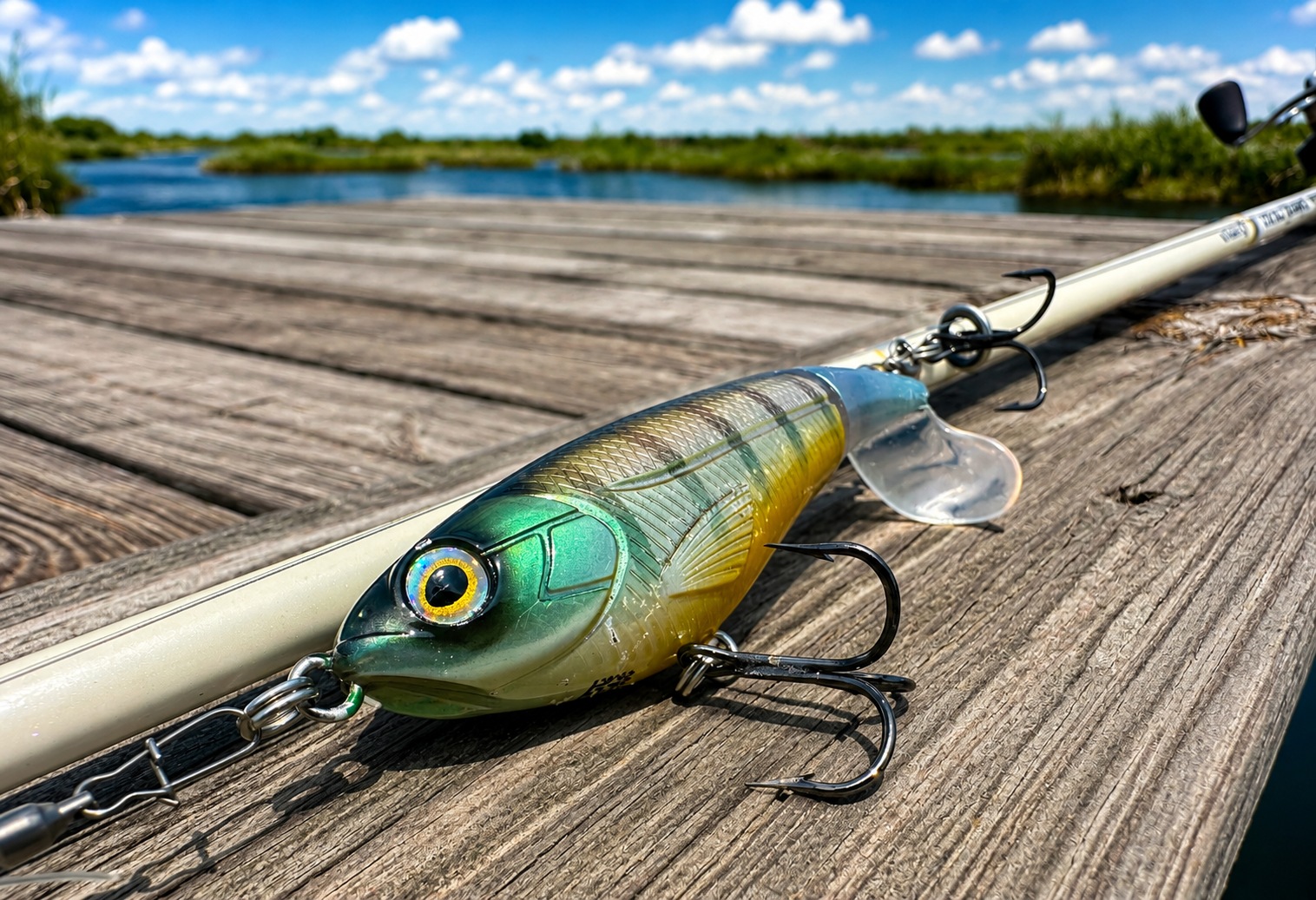 “The BullNose does the same thing burning a spinnerbait does,” he explained. “You can burn it on top and create that wake. But instead of one hook like a spinnerbait, you have two treble hooks. When they hit it, you have ’em.”
For Midwest anglers targeting shallow feeding smallmouth, Clunn believes the BullNose creates a unique combination of visual disturbance and sound that is especially effective in both clear and tannic water fisheries.
“The smallmouth’s dominant sense is sight,” Clunn said. “But the sound system in the Livingston baits adds another layer.”
Clunn specifically emphasized the importance of Livingston’s EBS Technology, particularly during pauses.
“If you pause a bait around smallmouths, especially around beds or roaming fish, they are more likely to come up and absolutely destroy it sitting still,” he explained. “That is where the biological sound system gives Livingston baits an advantage.”
One of Clunn’s favorite Midwest modifications is adding a feathered treble hook to the back of the BullNose.
“Smallmouths are target oriented,” he said. “They are not just attacking the bait randomly. They key in on specific targets. A feathered hook gives them something to focus on.”
His retrieve with the BullNose is surprisingly simple.
“You throw it as far as you can,” Clunn explained. “When it lands, you start it immediately. Rod tip high at first, then slowly lower it as the bait comes back to maintain that wake.”
You can be among the first to get the latest info on where to go, what to use and how to use it!
While many modern anglers obsess over sonar screens and offshore fish positioning, Clunn repeatedly returned to one central idea throughout our conversation: fishing should still be fun.
“I would rather watch one fish hit a topwater than catch ten on a crankbait,” he said.
That philosophy also extends to other Livingston baits Clunn spoke highly of, including his Rick Clunn signature PlopMaster and Walking Boss.
“The biggest smallmouth I ever hooked in my life came on a tail prop bait on Lake St. Clair,” Clunn recalled.
Fishing along a seawall in shallow water, Clunn initially believed he had hooked a musky because of the fish’s sheer length and power. Instead, it turned out to be the largest smallmouth he had ever encountered.
“That fish hit so hard and ran so fast it straightened the hook,” he said.
For Clunn, the PlopMaster is his go-to tail prop lure as it combines simplicity with the triggering power of the pause from EBS Technology.
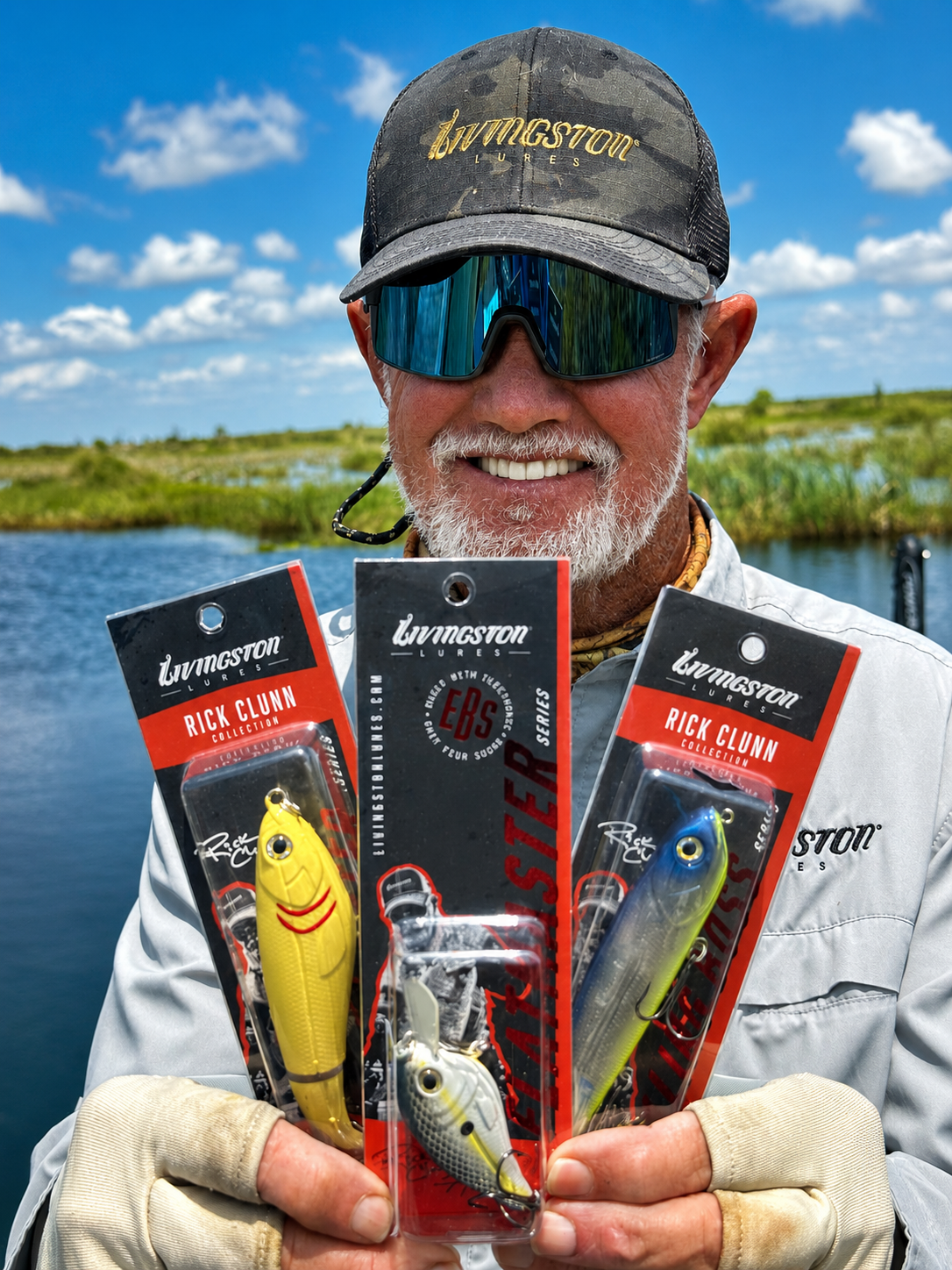 “You do not have to work the bait hard,” he explained. “You throw it out and reel it. Then pause it occasionally. That pause matters.”
In fact, throughout our discussion, the pause repeatedly emerged as one of the most important triggering factors in bass fishing.
“I keep coming back to it because it matters so much,” Clunn said. “A moving bait gets violent strikes. But when the bait pauses, especially with sound still coming from it, sometimes the bigger fish just come up and can’t control themselves. It is a completely different strike.”
That observation mirrors what many experienced anglers have seen firsthand in recent years. The pause often creates vulnerability. Instead of looking like prey fleeing at full speed, the bait suddenly appears wounded, confused, or exposed.
It is one reason Livingston’s EBS Technology continues to stand apart in the topwater category. While most topwaters go silent when paused, Livingston baits continue emitting biologically based baitfish sounds during the stop. For anglers fishing pressured Midwest bass, especially clear water smallmouths, that can become a major triggering factor.
Clunn resists giving overly rigid formulas for exactly when to choose one topwater over another.
“There is no absolute answer. Some of it depends on wind. Some of it is instinct. You have to trust yourself, and trust the power of the pause.”
That instinctive style of fishing remains one of the defining traits of Rick Clunn’s legendary career. Even in a modern era dominated by screens and precision technology, he still believes the best moments in fishing come from visual strikes, aggressive fish, and presentations that simply make anglers excited to cast.
And in Midwest bass country, few things embody that better than a topwater explosion beside the boat.
Did you enjoy this post?
You can be among the first to get the latest info on where to go, what to use and how to use it!
