
Panfish on Ice
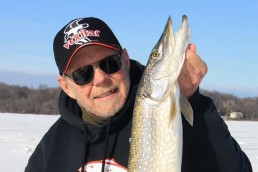
The sun was waning to the west as my cohorts were getting restless. We’d sat on the ice for the better part of four hours with little to show other than a random bluegill and small northern pike from a minnow/tip-up rig. That was about to change with light fading. Unbeknownst to us, the bite on Sawyer Lake in Langlade County, Wis. tends to get better later in the day. It was like experiencing “wish granted” status as our tiny ice jigs were no longer ignored as crappies, bluegills and rock bass were coming to life.
For a several years, a group of guys heads up north to visit a camp founded by our church in the 1960s. This provides us with some fun time together as we travel, fish, eat then retreat to a cabin. Time spent with these guys is like reuniting with siblings that you regret not having spent more time with even if fishing is not their focal point.
Eventually, everyone gets sucked into the fishing action. We’d put a few tip-ups out with lively minnows to increase the chances while keeping our brotherhood of first-timers engaged with a jigging rod. A local friend and former kitchen coordinator, Jake Scheich, brought extra hardware in the form of a portable shanty, electric auger and a sled to tote gear. He would also serve as our de-facto guide as none of us could predict ice conditions with fluctuating temperatures. The lake was solid, but would we incur slush or excessive snow cover? Both? Our guy proved priceless with updates.
Besides the fellowship of friends, there were fish to be found on Sawyer Lake. From experience, we knew it held northern pike, walleyes, large and smallmouth bass, perch, bluegills, pumpkinseed sunfish, crappies and rock bass, all having been caught in the past. It’s a typical glacial lake with mostly sand and rock bottom and healthy growth of coontail and cabbage weeds. Weed lines, rock piles, drop-offs, points and channels formed by the flowage that connects Sawyer to surrounding waterways provide plenty of fish-holding structure and cover. Deadfall trees add nicely to the abundance of cover.
Our journey would begin at the dock area of camp that features much of this, in search of prosperous territory. We were armed with shanties, electric and hand augers, rods, bait, stadium chairs and heaters. Planning for this excursion was never found lacking.
Upon setting out. we followed a known path where the dock runs in warmer weather to locate the weed beds and nearby drop-offs. To aid in our search, we’d scratch a shallow hole, fill it with saltwater (prevents freeze-up in extreme conditions), then place the portable depth finder transducer on the ice surface to scope out a location. After a few attempts, we were on the deeper side of the weed line and drilled several holes contouring the drop-off. Both shelters were set up, heaters installed, then rods were distributed amongst us.
We had spikes (maggots) and waxworms (beemoth larvae) for bait besides the tip-up minnows. Various ice jigs were distributed in sizes 6, 8 and 10 to be tied onto the panfish rods. For anglers set up deeper, a tiny split shot was added to assist in getting baits down to the depths required. A quick peek at the Hummingbird Wide Portable fish finder showed marking fish near the bottom. We had a reference point to start with.
After a few hours and frustration mounting, I changed a few of our jigs to different colors, more so to distract me from the catcalls sent my way due to lack of fishing action. The staple Custom Jigs and Spins Demons, Rockers, Ratfinkee and Widow Maker Jigs were all deployed across the board. Bright colors, glow-in-the-dark fluorescents, and dark colors all came up empty-handed.
Now I was questioning things as we worked up and down the water column using various methods. One guy would be vertically jigging, another had a deadstick, while others would stall at various depths and tap the rod handle with their index fingers to “quiver” the bait. Still nothing. round 4 pm, I was saved when one of the tip-up flags went off, signaling the arrival of a customer. Unfortunately, the fish took the bait but failed to get hooked. We were 0-1 and that didn’t help matters.
You can be among the first to get the latest info on where to go, what to use and how to use it!
But as the sky changed from clear and sunny to fading purple/gray, our luck began to change. To some, a 5-inch rock bass is nothing special, but to seven antsy fishermen, there was promise. Jake was fishing the shallow end of drop as a few others milled about collecting our wares, anticipating we’d be leaving soon. He was marking fish as well now. It was now 4:30 pm and light was fading, but we wouldn’t be denied. Headlamps were being strapped on as all began to work the baited jigs in earnest.
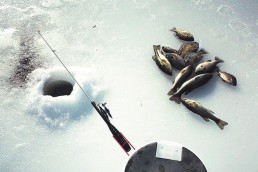
The next rock bass was caught by friend Jesse Willett of Stickney, Ill. Then it got really interesting, fast. Jake managed to catch an 11-inch rock bass just a few feet below the ice instead of near the bottom. Bingo… we were learning things. Our pal Geovanny Gallegos of Palos Park, Ill. moved spots with Jake’s encouragement, getting into the action with his own 5-inch rock bass. Ricardo Rodriguez of Berwyn, Ill. got in on the action next as Jake encouraged anyone nearby to start fishing near him. Similar ice jigs and waxworms for bait were becoming productive. Finally, Nick Cruze was getting bites as well, but it took a few strikes and putting fresh bait on to get him on the board.
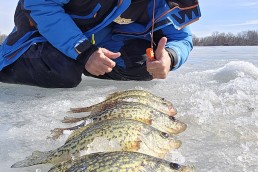
With things developing quickly and the action heating up, we started to get crappies biting our baits. Jake had gone to another pair of holes drilled earlier to check them out and chip away skim ice when he put his flasher unit’s transducer in the water. Convinced he was seeing fish “marked” just under the ice, he played out the hunch. A 10 1/2-inch crappie tried to stealthily slurp his bait in but Jake was on his “A” game. He called Ricardo over and a similar result was duplicated.
After another bite from a rock bass, Ricardo threw down the gauntlet akin to the Triple Dog Dare from the ‘80s movie A Christmas Story. “Brian! You gotta come and hit this honey hole right here! Your buddy Ric wouldn’t steer you wrong, brother!” I was game. Besides, my two holes had produced nada, zilch, nothing thus far. I was happy to see the newbies getting in on the action.
With a crunch of ice below my cleats, walking over to the guys led me to welcome change. It was my turn up at the plate. Jake instructed me that crappies were biting subtly, and with the fading light, it would be harder to watch my line for movement. Even with super-ultralight ice rods. the fish were hard to detect. He agreed to keep the flasher in the hole next to the active one and kept the line from my reel pinched lightly between his fingers as a strike indicator.
It took less than 30 seconds to entice a fish to my offering. I didn’t have to wait for Jake’s instructions to the set the hook. As soon as his hand moved off my line, I snapped my wrist skyward, and it loaded up with authority. The fish bucked and made a few quick runs, but as it changed directions back towards the hole, I stood quickly rather than reel to lift it straight up and out. It was high risk/high reward at best but made sense at the time rather than trying to lip a fish with cold hands. To my amazement, a rather large crappie came out of the water. In one motion, I swung it over the ice just as the jig popped out of its cheek. Whooping and hollering accompanied back slaps as the second-best crappie of my life lay next to me, all 13 inches of it. We decided that it would join the rock bass and a couple other crappies in the frying pan that night to supplement our dinner. Our snacks had faded faster than the sunlight long ago.
After we shlepped our gear back to storage for the next day, we loaded our vehicles and headed back to our cabin. Mark Kemper of Stickney, Ill., our resident fireplace/campfire guru, got the fireplace going again as we unloaded. Jake showed his mastery of filleting our panfish as various other food items hit the oven, grill and air fryer for the evening. We joked with one another about the day’s adventure and our change of fortune as the food cooked.
We had one day under our belts with another to look forward to. Seven of our nine guys who made the trip agreed in unison that this should be an annual event. I couldn’t argue with the logic as it would provide us another opportunity to spend quality time with one another up North in the great outdoors.
Did you enjoy this post?
You can be among the first to get the latest info on where to go, what to use and how to use it!
