
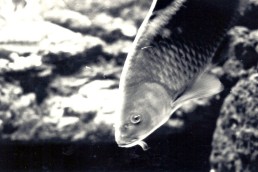
In Pursuit of Buglemouth Bass
Splashing sounds are music to the hearts of bowfishermen. They expose the presence of spawning carp, the primary quarry of bowfishing anglers. Dawn is like apassing storm front, heavy with a gray sky. The fish are active.
Spring is the primary season for most bowfishing. Large “buglemouth bass” (carp) move up into the shallows to spawn, posing ready targets. It is also a great time of the year with the woods coming alive and each sunrise warming the water.
Protruding dorsal fins glisten in the early-morning light. Whether walking along the shore and shooting, or moving quietly through flooded vegetation in a boat, the excitement is the same.
As water temperatures reach 60 degrees, carp begin moving to shallow water. As they get to 62 degrees, spawning begins. Spawning reaches a peak at 65 to 68 degrees. By the time the water temperature is up to 80 degrees, the spawn is over.
The basic equipment is specialized, yet inexpensive. Bowfishing kits containing line, arrow, barbed arrowhead, and bow reel, are available wherever archery tackle is sold. They also contain an instruction sheet for using the equipment. The entire kit is available for a modest amount. The only other thing needed is a bow.
For those who plan to wade, the use of waders is best. You can wade without them, but the water is cold in spring. In either case, be aware of sharp objects underwater that could cause injuries.
Advanced bowfishing anglers use tackle that gets a bit more specialized. Although heavy, solid fiberglass arrows provide better penetration of the water, fish found on or near the surface will succumb to aluminum or even wood arrows. Lighter arrows allow longer shots.
Most shots are short, however. The line attached to the arrow provides all the stabilization needed. Thus, most arrows do not have fletching. On longer shots, some sort of fletching aids stabilization.
A barbed arrowhead is necessary. The barbs keep the fish from coming off the arrow during the time it takes to retrieve it. Barbs can be reversible or with removable heads. Both allow you to remove the arrowhead from the fish with a minimum of damage to arrow and fish.
You can be among the first to get the latest info on where to go, what to use and how to use it!
Many of the reels that come with the bowfishing kits are of a drum design and bolted or taped to the bow. Some of the newer, more sophisticated types of reels feature a spincast reel or other newer, and more costly, “retriever” types designed for bowfishing.
Fishing lines are usually braided nylon line. Some newer fibers and very heavy monofilament lines also work. Regardless, it should be at least 70-pound-test.
Bowfishing for spawning carp is ambush fishing. It allows us to control several factors. Among them are bottom makeup, the angle of the sun, the effect of wind, and cover for concealment. By taking a stand, we cause less fish panic and get more shots. By standing still, we use less motion, decreasing the chances of the fish seeing us.
Carp usually swim upstream during the spawn into tributaries until a dam or similar structure blocks their progress. This concentrates them below dams.
The best bottom material, from the fishing archer’s point of view, is fine, soft sand. Sand has the advantage of improving vision. Dark fish stand out against the light sand. As a bonus, soft sand does not hold arrows that miss their mark.
Fish will spook when shadows are cast over the water. Working from ambush, position yourself with your face toward the sun. Any shadow casts behind you.
Windy water surfaces cause waves and ripples. Carp do not like them, and bowfishermen have difficulty seeing their quarry. Fish tend to concentrate in protected areas where they are also more visible. Polarized sunglasses aid in locating fish as they reduce the sun’s glare off the surface of the water.
Light waves bend as they enter the water, making the fish appear closer to the surface than is reality. Archers must aim beneath where submerged fish appear. How far to aim below the fish is a skill acquired by trial-and-error. With the addition of the Asian species into midwestern waters, the shooting of the jumping fish has added a new element to bowfishing, and an exciting challenge.
Bowfishing for buglemouth bass is entertaining and challenging. It is a simple and inexpensive sport. Why not try it next month?
Did you enjoy this post?
You can be among the first to get the latest info on where to go, what to use and how to use it!