
Most of These ‘Facts’ Are Not Right, But One Idea Worked
When it comes to hunting and fishing, many of us, myself included, are pretty well set in our ways. However, some of the “facts” that we take for granted “just ain’t so.” For example:
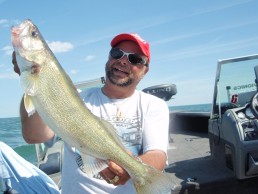
Walleyes are not pike. For most of my life, I have heard the term walleyed pike. Not so. I believe that the error lies in the fact that both species of fish have mouths full of sharp, fang-like teeth.
Both species inhabit the same water, and both have similarly-shaped bodies. But that is where the similarity ends.
A pike’s teeth have serrated edges, which is why anglers often experience “northern pike bite-offs” and lose both fish and lure. A walleye’s teeth are smooth on the side, and only rarely do they cut a fishing line. A strong one might break a line, but they won’t cut it.
Here’s another common misconception: Many restaurants serve Alaskan walleyes. Nope. There are virtually no walleyes in this cold, northern state. You may find this listing on a menu, however. What you are likely being served is pollock, which is a pretty tasty fish in its own right.
Walleyes only inhabit northern waters. Nope, again. Two of the biggest walleyes on record were a 25-pound-plus from Tennessee and a 22-pound-plus from Arkansas.
What a walleye needs to survive is clear, cool or cold water that has some depth to it. Many southern states reservoirs offer just this kind of habitat, and the walleyes thrive.
But you don’t hear much about them, because the glamour fish of the South is the largemouth bass, closely followed by the ubiquitous crappie. Many big walleyes die of old age in these “bass” lakes. A word to the wise should be sufficient. Go after them!
“Trash” fish don’t taste good. Hogwash! The common sheepshead, a.k.a. the freshwater drum, is a tasty fish. However, when an angler hooks and lands one, he or she is usually the subject of many derisive remarks, and the fish is either quickly thrown back in the water or unceremoniously thrown up on the bank where it is left to suffocate.
Not too long ago when I was fishing a local river, I landed both channel catfish and sheepshead. After cleaning both, they were fried in the same skillet over an open campfire. The sheepshead actually tasted better than the catfish.
Why are they scorned? Let me use a story from my late father to answer this. “When I was a kid, fishermen would go to Lake Erie and catch a mess of sheepshead. They would put them on ice, and then drive around through the country selling them. We ate them and liked them, because no one ever told us that they didn’t taste good.” Makes sense to me.
The same is true of cyprenius carpio, the common carp. They not only put up a good fight at the end of a line, but they have white meat that tastes good. Many people like to just cut the meat off of the back and the tail and then fry them like any other fish. Try it and you might just like it.
“Oh, does deer meat have a real gamey taste?” I wish I knew how many times I have been asked what some form of wild fowl or wild animal tastes like.
After over 70 years of dining upon the bounties of nature, I have yet to discover what a “gamey” taste is. Goose tastes like goose, deer tastes like deer, bear tastes like bear, raccoon tastes like raccoon, and no, turtle does not taste like chicken.
Each animal, fish or bird has its own flavor, and most taste pretty darned good. The secret of succulent dining is in the handling of the game after it is deceased, and in the careful preparation of it before it lands on the dinner plate.
You can be among the first to get the latest info on where to go, what to use and how to use it!
Some of the very best meat I ever ate was a black bear that I caused to expire in Maine, and an antelope that ran into my bullet in Wyoming. Both were butchered and the meat was handled carefully, frozen and consumed before it could become freezer burnt.
My very favorite? Common gray and fox squirrels. Son-of-a-gun, are they good! Squirrel gravy is pretty hard to beat.
It doesn’t take much to knock off a squirrel. Phooey! Conventional wisdom holds that all a person needs for squirrels is a 20-gauge shotgun and a handful of #6 shotshells. Not in my experience.
Though diminutive in stature, the squirrel has some pretty good muscles, and a tough coat that only gets tougher as the temperature falls. There is nothing wrong with a 20-gauge, but stoke it with either #5 or #4 shot. You will kill more squirrels rather than watch them run to a hole to die.
The worst gun for squirrels? Hands down, it is the 410-gauge. Why start out a kid on his first hunt with a shotgun that just isn’t up to the task?
Put a 20-gauge or a 16-gauge in his/her hands and increase the odds for success. My favorite is a vintage Remington 870 in 16-gauge with #5 shot.
Now, for the idea. My passion is duck and goose hunting, and I used to have a “honey hole” of a pond that was very productive. Ducks and geese regularly flew into it, and I didn’t even need decoys.
However, once the birds were dead on the water, the task of retrieval was a real chore. The pond had the muckiest, worst bottom that was as bad as any I have ever encountered.
My feet, in chest high waders, became so stuck in the mud that I could barely walk, let alone maintain my balance. On more than occasion, I came out of there muddy, mad, wet and exhausted. There had to be a solution.
I had no access to a boat or kayak, which would have made things easy, so I had to come up with an idea. Eureka, even my dim brain could devise something that would work.
I repaired to the closet in my garage where I store my rods and reels and chose a 7-foot, heavy-action casting rod and a heavy-duty baitcasting reel. Are you starting to get the picture?
After loading the reel with a 14-pound test line, I tied on a big surface lure with three treble hooks. Now, when I have dead birds on the water, I cast, hook them and reel them into the shore.
Does this really work? You’re darned right it does. I have used it for both ducks and Canada geese on open water, as well as skidding them over the ice in the winter.
Surely, I would look pretty funny to someone who saw me casting for ducks, but, hey, it gets the job done, and has saved me many hours of exhaustion and frustration.
I can hardly wait for the next duck season.


Did you enjoy this post?
You can be among the first to get the latest info on where to go, what to use and how to use it!
