
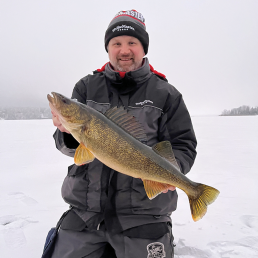
Work the Early Shift for More Winter Walleyes
No one wants to be the first angler on the ice from a safety perspective. But everyone wants to get in on a good walleye bite. Sometimes, there is a fine line when it comes to walleye fishing during first ice.
The best chance to catch walleyes is shortly after the ice locks up. Most anglers wait until there is enough ice to drive a vehicle on it and miss out on weeks of the best walleye fishing that the ice has to offer. During first ice, fish are hungry, active, and there are good numbers on most walleye structures.
During early ice, you don’t have to lug around heavy ice augers, fish houses and gear; you can really keep it simple. A spud bar, electronics and a good fishing rod is really all you need to walk out to a fishy spot. Even the electronics are a breeze to carry with all kinds of good, lightweight lithium battery options on the market.
With safety in mind, smart anglers will travel with rope and companions. Of course, cold-weather gear that floats will give you peace of mind. Many ice suit manufacturers such as StrikeMaster offer models that provide flotation up to two hours, which is well worth the extra cost for warmth and safety.
Venture out to high-percentage spots such as main lake points or sunken humps proven to have a good population of fish during early ice. Sure, lots of places will hold walleyes, such as long breaklines or any place where wind or current pushed bait, but those are hard to find after the ice sets up. The obvious spots are typically good; you just need to get to them before the masses do.
Even semi-modern electronics or your cell phone can provide accurate mapping of many lakes. Remote or smaller lakes may not have 1-foot contour maps, but will still get you close to major lake structure. Utilize this to save time from having to chip or drill holes to check depths. Use the mapping to get you close, then just make small adjustments from there.
Depths from 15 to 25 feet are good choices for clear water, while fishing shallower is possible in stained or dirtier water. This is just a starting point, and each lake may have minor exceptions that deviate from this. The best information is the fresh info that you can learn only on the water or ice. As winter continues, it usually helps to move slightly deeper on clear-water lakes, but start shallower during first ice.
You can be among the first to get the latest info on where to go, what to use and how to use it!
Smaller lakes typically ice-up before larger lakes. Really deep lakes can be exceptions. Lakes with islands or bays can get a jump-start on ice due to protection from the wind. Consider this when researching good options. Smaller lakes make it easier to get out to good structure. Sometimes, it takes good ice to get to the good structure on bigger lakes because walking far out is not really an option, since ATV or snowmobiles may be needed.
Primetime—dusk or dawn—is nearly always the best window to catch fish. Walleyes are less spooky. But be mindful of your noise and movement during first ice, especially if there is no snow cover. The shallower you are, the more it matters, but it still is important to consider if you are fishing relatively deep.
During early ice, you don’t have to be too fussy on what to use because the fish are generally willing to bite. So, use what you have the most confidence in: deadsticked minnows, tip-ups, or spoons tipped with minnow heads. Spoons catch fish and get back down as soon as possible. Spoons such as the VMC Hatchet that are from 1.5 to 2 inches in length are solid choices early on. As winter goes on, switch to smaller-profile spoons, such as a Bull spoon. Don’t overwork your spoon; just keep it about a foot off bottom and wait for the thump!
Make this the year to be part of the good, early-season walleye bite. Before you know it, you’ll have a few fish flopping on the ice next to you.
You’ll find plenty of helpful ice fishing tips in the winter issues of MidWest Outdoors. Subscribe on our website.
MWO
SHARE THIS POST
Did you enjoy this post?
You can be among the first to get the latest info on where to go, what to use and how to use it!