
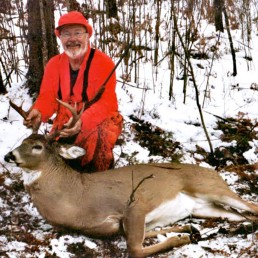
Wolves Taught Me About Preparing to Hunt an Older Buck
While driving to our deer hunting area last fall, I told my grandson Jacob, “More than 90 percent of wolves we have been photographing since last year have been loners, and the only two wolfpacks photographed in our hunting region were very small. This means that wolves were not able to successfully kill adult whitetails in this area this past year. Only large wolfpacks with 10 to 12 wolves can do this. This also means that those three bucks we discovered at the top of that big hill we hunted last November—that yearling, a 3-1/2-year-old and a probable 4-1/2-year-old, should still be alive today.
“Using the same trail we used to get up there last year—the one we’ve been using for years—and the new blind that was a bit too deep into the area where those bucks made rubs and scrapes and fought with one another, didn’t work last year. So, what I have in mind for you this year is a new approach trail through very dense cover to get to a new ground level blind never used before. It’s well away from that site, but within easy shooting range, making it totally unexpected by those bucks.
“What we are going to do first is hike up there to the second corner in our old trail, up the hill to the small spring-fed pond in the center of the opening at which those bucks could approach from three directions—from the left, straight ahead or from the right. From the pond, we will enter the dense woods straight south of the pond and select a natural blind; not at the edge of the woods, but one about 25 to 30 yards back in from the edge, that needs very little or no enhancement to prevent making changes likely to be quickly noticed by an older, much experienced buck. What we want is a natural blind back in the timber with several natural openings through which to fire at a buck west, north or east of the pond. We will make no shooting lanes. I have proven too many times that older bucks readily identify new shooting lanes and shy away from stand sites where they are made.
“Your blind back in the woods must hide you and your movements up to your chin, and while sitting behind it on your backpacked stool with your back against a tree trunk to minimize your movements. You won’t need cover on either side. Your background will be fairly solid timber to make your silhouette indistinct. The skin of your face will need to be covered by the camo head net with the oblong eyehole that I gave you, worn under your cap for safety, and the skin of your hands will need to be covered with camo or dark brown gloves. We will clear leaves and dead sticks and tramp flat grasses on the ground where your feet will be placed so that you can move your feet silently if necessary.
“Next, you will need a completely new approach trail cleared of dead branches for relative silence underfoot, coursing south from your stand, up to 1/4-mile through dense forest cover, to where it finally connects with our old trail coursing up the hill. Along the way, we’ll place fluorescent tacks on tree trunks about every twenty steps apart to guide you to or from your stand in total darkness. About 50 yards from your stand site, we’ll place a triangle of three tacks on the south side of a tree trunk to remind you to thereafter keep the beam of your flashlight pointed at the ground as you approach your stand site with light footsteps. Once there, immediately turn off your flashlight. Doing all this will give you a stand site completely unexpected by any buck and the best odds possible for taking the biggest of those three bucks.”
You can be among the first to get the latest info on where to go, what to use and how to use it!
After about four hours of preparing the above stand site and approach trail, the first thing Jacob said upon rejoining me at the bottom of that hill about noon on day two was, “Grandpa, there were freshly made antler rubs, ground scrapes and droppings made by mature bucks in that opening like last year.”
“Sounds to me you now have a “sure thing,” mature-buck stand site to use opening morning,” I said with a grin (hoping the wind direction will then be favorable for him).
For more insight and tips on how to make the most of the time you spend hunting, check out the articles in every issue of MidWest Outdoors, available by subscribing on our website.
MWO
SHARE THIS POST
Did you enjoy this post?
You can be among the first to get the latest info on where to go, what to use and how to use it!