
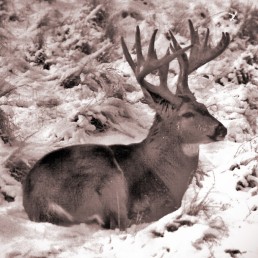
We Must Go Where Winter Deer Go
There are some basic blunders that we bowhunters make that can drive one to the “foolish factory.” With a little thought and preparation in fall it is possible to avoid some of them and be more effective as a winter bowhunter.
Late in the summer we should have tuned the bow, checked all equipment, and practiced shooting from different positions. These are basics of bowhunter preparation. But there is still the mental game. Success is when preparation meets opportunity.
Every time we take to the field it is vital to be aware of the wind currents. Using all sorts of scents and scent eliminators help, but if the wind is blowing from you to the quarry, he will not wait for you to shoot him. The only way to be completely scent free would be to wrap yourself in a plastic wrap. That would make breathing a bit difficult.
This is not to say that scents and scent suits, as well as the scent eliminator sprays, do not work. They do. But they will not take care of every scent that might emanate from your gear or you. The ultimate responsibility for you is to always approach your stand or hunting area from downwind and keep prime hunting areas upwind. Take every possible precaution to reduce your scent as much as humanly possible.
Once in the stand make sure you have shooting lanes available. If necessary, clear limbs and brush during preseason, when you set up the stand. Use a rangefinder to determine the distance to various trees or bushes in your shooting lanes. If you know the outer distance, then it is easier to estimate the distance to game between you and them.
Scouting a hunting area does not end with the beginning of the season. A deer changes its patterns of activity to respond to: hunting pressure, food availability and weather changes. You need to attune yourself to the activity in the woods. You can move your stand if necessary.
Use binoculars to observe game movement. That big buck might be just out of your range as he goes by, but if you know where he is traveling, you can move your stand the next day and get him. The glasses also allow you to see approaching game before it sees you and to make an accurate estimate as to whether it is a “shooter.”
It is helpful to use straps that hold the glasses close to your body or adjust the strap to allow you to place them inside your coat. This keeps the binoculars out of the way of a bowstring or shotgun when it is time for action.
You can be among the first to get the latest info on where to go, what to use and how to use it!
When it comes time to place a shot on a deer all that practice can really pay off. To understand where to place the shot for the most effective humane kill you must study the anatomy of deer. It is important for bowhunters to realize that the deer has a habit of dropping down before running away when alerted to danger. So, the kill zone is about 5 inches lower than when the animal is just standing.
Deer drop their bodies down at the sound of a bowstring or a shot. But with a proper shot it is too late for such evasive action. They often drop enough that the arrow will fly harmlessly over their back. By aiming at the lower part of the kill zone, just up from the bottom of the chest nearest the front leg, the bowhunter has a better chance of taking his prize.
After the shot it is important to remain still and quiet. If you shout to your companions or immediately take up the chase, chances are you will spend much of the rest of the day searching for your quarry. The hunter who remains quiet for 45 minutes to an hour will probably only need to travel a few yards to recover a downed deer.
Arrow hit deer do not run very far unless spooked. Once they recover from the initial shock of the hit, deer usually lay down until they succumb. It is the clean humane way for the bowhunter to ensure his success.
Approach a downed deer with great care. If the animal’s eyes are open, it is likely dead. If not, it may still be alive and could hurt you.
By practicing these essentials bowhunters can avoid blunders that mess up otherwise great hunting experiences.
For more insight and tips on how to make the most of the time you spend hunting, check out the articles in every issue of MidWest Outdoors, available by subscribing on our website.
MWO
SHARE THIS POST
Did you enjoy this post?
You can be among the first to get the latest info on where to go, what to use and how to use it!