
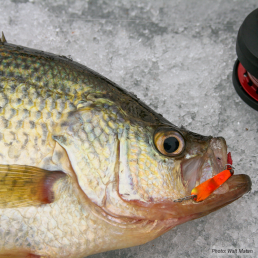
Thoughts on Crappies Through the Ice
previously published in Fishing Facts Jan/Feb 2001
Over the years, I have probably enjoyed chasing crappies during the winter more than any other panfish. Maybe the challenge is greater, so any success is appreciated more. Maybe it is the chance to do a little bragging to your ice fishing buddies, or perhaps it is just the time spent on a frozen lake where they are located in the winter. In this article, I’ll pass along some ideas that have helped me catch crappies over the years.
Master the basics
Hooking a lively minnow through the top of the back on a small jig or plain hook weighted with a tiny split shot is a presentation used by thousands of winter anglers every year. Many never use anything else, and as a result, they catch fish when crappies are active, but get meager results when fish have to be triggered into biting. In any case, when you have some fish located, a minnow presentation is a great starting point.
When working a minnow, I like to use a rod with a spring steel strike indicator attached to the tip. Lower the minnow down to a level just above the fish and watch what the spring steel does. It should move almost constantly, dipping and bending downward slightly. If it is not moving, the minnow is not swimming enough to attract fish. You’ll have to snap the rod tip slightly to keep the minnow active.
Most anglers expect the spring steel to slam downward in a slam dunk type hit when the crappie takes the minnow. This causes the indicator to bend very gently and may pull it down very slowly instead of slam dunking. The best way to catch more crappies with a minnow presentation is to start watching much more closely for hits. I have often stressed how critical it is to watch the strike indicator intently. How hard you fish is up to you. Paying more attention is easy when you begin to see how many more fish it produces.
What happens when they don’t want minnows
I can tell you what happens in many (if not most) cases—the anglers give up and go home! Most ice fishermen cannot believe that a crappie would pass up a lively minnow hanging in front of them. Well, they pass up minnows all the time! I don’t know why, but I know they do. Maybe the crappies are just not active enough. Maybe they were feeding an hour ago and are not presently hungry. Who knows?
If you are fishing a spot that has produced crappies in the past, and your locator indicates that there are fish under your boots, you have to try something different when they do not hit minnows. That should be obvious.
One of the easiest things I try is to downsize immediately when crappies are not very active. Use a tiny spoon or ice fly, for example, dressed with a single maggot. I always have several rods set up and ready for use, so I simply select one spooled with 2-pound-test line (such as Cortland Ice monofilament) to present very light lures. I may add a very small split shot on this line to help it sink faster, but if the crappies are 15 feet down or less, I usually add no extra weight.
Lower this rig down to the level the fish are at and use a very slight quiver of the rod tip to try to entice a bite. Shake the rod tip slightly, followed by a pause as you watch the screen closely. On the newer three-color locators, you can tell when a fish approaches the bait by carefully watching the screen. This is like watching the strike indicator I mentioned earlier, but with very small baits, crappies will almost always inhale the lure and maggot, which does not move the indicator much. Watching the screen on your locator (if it is one of the models specifically designed for ice fishing) will usually let you see the fish approach and hit the bait.
Sometimes you need to use a kind of lure you do not usually think about as a way to induce hits. For example, tiny soft plastic tube jigs weighing 1/16, 1/32 or 1/64 ounce are great baits. I like the hollow body styles because I can place a drop of attractant scent inside the lure. Remember that crappies have to take a lure into their mouths to see if they want to eat it or not. The scent product seems to make them hold it longer and more firmly.
You can be among the first to get the latest info on where to go, what to use and how to use it!
Tiny tubes can be worked upward with a slight quiver for a foot or so, then suddenly dropped so they fall back toward the panfish. This action looks like a minnow or other bait struggling up only to sink again. Crappies often inhale as it falls downward.
In this case, use a high-visibility line so you can watch the way it reacts when you work the lure. As the bait falls, the line should lie on the surface and slowly uncoil while it sinks. If the lure stops sinking before the line has straightened out, a fish probably grabbed the small jig. Quickly tighten the line by reeling or raising the rod tip to set the hook and catch that fish.
Modify your hooks for better results
Many winter anglers continue to use their lures or hooks just the way they come off the shelf in tackle shops. Most of these baits can be easily modified in double or triple the hookups with a few simple steps.
Start by sharpening the hooks the first time a lure is used. Fingernail files having a diamond impregnated style blade work well shaping points on small lures. They are available at discount stores of a couple dollars or less. Five to 10 seconds is all it takes to finish this step.
Develop the habit of carrying a set of needle-nose pliers or one of the folding multi-tools carried on your belt. Use this tool to open the gap between the point and the shank slightly, and to offset the point a little to one side. This step will double your catch.
Finally, use the pliers to pinch the barb flat. This makes the hookset much easier, and lets you run the hook point very lightly into a single maggot or wax worm rather than tearing it as a barbed hook can. A lightly hooked maggot can wiggle enticingly, and this slight movement is sometimes a stronger trigger than a swimming minnow.
The steps I’ve discussed here are basic yet overlooked by many anglers. Some are accustomed to fishing for white bass or perch, which seem easier to catch than crappies. These fishermen often forget to try some finesse when fishing is slow. Use the tactics in this article to boost your catch this year!
Get better results from the time you spend fishing. Use information from the pros found in every issue of MidWest Outdoors, available by subscribing on our website.
MWO
SHARE THIS POST
Did you enjoy this post?
You can be among the first to get the latest info on where to go, what to use and how to use it!
