
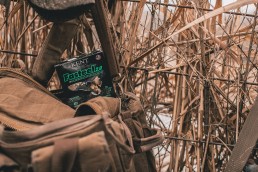
The Right Shotshell Can Improve Your Fall Bird Hunting Success
The 1991, U.S. Fish and Wildlife Service ban on using lead shot for waterfowl sparked a wave of innovation from shotshell manufacturers seeking suitable alternatives. Many hunters will remember the initial products brought to market to comply with the non-toxic mandate had inherent liabilities as a result of trying to duplicate lead performance with steel shot loads. Products attempting to mimic lead shot specifications such as shot size, velocity and payload often resulted in sub-par results in the field. The founders of Kent Cartridge—themselves avid waterfowl hunters—realized these limitations, and in 1997 Kent Cartridge was born with the introduction of Tungsten Matrix. This load, blending tungsten and polymer, mimics the physical and ballistic properties of lead shot to produce excellent results for hunters comparable to lead shot.
MidWest Outdoors caught up with Jeff Barry of Kent Cartridge to learn more about the company’s shotshells and how upper Midwest bird hunters can gain an advantage in the field this fall. Born and raised in the central plains region of Nebraska, he’s intimately familiar with our region’s wingshooting scenarios, and details why the load you choose can make a huge difference in the number of birds you harvest.
MidWest Outdoors: Let’s start by talking about Kent Fasteel 2.0 loads. Born out of the original Fasteel product, waterfowlers everywhere have embraced its characteristics. What sets this shotshell apart from others on the market, in your eyes?
Jeff Barry: Original Fasteel was a revolutionary product when it was introduced in 1998. Kent developed speed technology for steel shotshells that increased velocities to make the load more effective while still maintaining safe pressures in all temperatures. We worked with our powder supplier to create special blends that produced those higher speeds to be effective. A hallmark of original Fasteel was best-in-class velocities of up to 1625 fps, but in addition to that speed it was a very safe load with consistent powder burns, plus it developed a great reputation for pattern uniformity. We used premium components and invested a lot of time in the ballistics lab to fine-tune the results.
MWO: So, what makes Fasteel 2.0 such a big upgrade to the original blend?
Barry: Well, times have changed since 1998. New guns have come to market, manufactured all over the world, so there are a lot of different tolerances. Lots of new semi-autos with different operating systems. New powder technologies have been introduced over the past twenty years. That being said, with all those changes to guns, the ammo hadn’t changed all that much. We started with our hull design, and came up with what we call the “high performance base wad,” which is a little polymer disc at the base of the shotshell. This is not to be confused with the actual wad itself. A lot of guys can be a bit hard on their semi-autos—they don’t get cleaned enough, for example. We modified this base wad to make it more forgiving in a wide variety of semi-autos.
MWO: Talk about the special primer in this shotshell.
Barry: The CX2000 Primer ignites a low-flash, double-base powder, which is a custom-designed blend that delivers very consistent results. Whether you’re firing in zero degree temperatures, on mild days, warm days—it doesn’t matter—Fasteel 2.0 will perform to those velocities that are stated on our packaging. Depending on the load, we top out at 1625 fps.
MWO: The velocities of Fasteel 2.0 really haven’t changed much compared to the original, correct?
Barry: That’s right. A lot of the recipes didn’t change much. We were able to increase the speed of a couple of loads, most notably the 3-inch, 1 ¼-ounce load. That’s a very balanced load and it was 1425 fps in original Fasteel, but with improved powder technologies we’ve been able to bump that up to 1500 fps without a noticeable increase in recoil or decreases in pattern uniformity. The new 2.0 delivers more energy on target without making other sacrifices.
You can be among the first to get the latest info on where to go, what to use and how to use it!
MWO: Provide another example of how your technology has improved these loads.
Barry: Our 3.5-inch, 1 ½-ounce load in Fasteel 2.0. We used to have 1 9/16-ounce in a 3.5-inch load in original Fasteel that was 1300 fps, but by backing that down to 1 ½ ounce, you’re trading 8 to 12 pellets in BB or #2 shot for an increase in velocity to 1450 fps. That added energy hitting the target in exchange for lower pellet count is a good trade-off.
MWO: Let’s switch gears to Kent’s Bismuth shot. What are some of the characteristics and advantages to hunters that choose this product?
Barry: The company invested five years in R & D developing a proprietary Bismuth shot. Bismuth had been on the market for years, but with some serious shortcomings in both its uniformity and its frangibility (deformations in the pellet causing it to fracture). Our R & D process created a very uniform product with a high degree of structural integrity upon being fired. That’s a subtle but meaningful difference in that a hunter who picks up a box of our Bismuth knows that it’s going to perform afield. We manufacture our own Bismuth shot to ensure quality control and consistency in performance. We solved the uniformity and frangibility issues inherent in other Bismuth shot by adding a little more tin to it to make it hold together better than some other Bismuth products on the market.
MWO: Please clarify the advantages to using a Bismuth load.
Barry: The biggest advantage to shooting Bismuth is density; you get 24% more density compared to steel shot, so it’s almost as dense as lead. This pellet density gives you greater retained downrange velocity and energy. For midwestern hunters, this is a huge advantage on those windy days. When you shoot steel shot on those blustery days, your patterns can get blown all over the place and really have a negative impact on your success downing birds. The density of Bismuth allows it to cut through the wind much more effectively compared to steel. I tell hunters who shoot our Fasteel 2.0 all the time: “Pick up a box of Kent Bismuth and save it for one of those windy days when you’re struggling all over the place. You’ll be impressed by the difference.”
MWO: There are some updated mandates on using non-toxic shot for upland birds in the Midwest, especially on public lands, so Bismuth has a place there, too.
Barry: Indeed. It performs very close to lead shot in those scenarios. We produce 12-gauge, 16-gauge, 20-gauge and 28-gauge for our Bismuth upland loads. And while these are very effective on pheasants and other upland birds and branded as an upland load, it’s a good general use load, and they work for waterfowl applications as well.
Are you ready for the fall hunting season? Gain more hunting knowledge from the pages of MidWest Outdoors this fall, available by subscribing on our website.
MWO
SHARE THIS POST
Did you enjoy this post?
You can be among the first to get the latest info on where to go, what to use and how to use it!