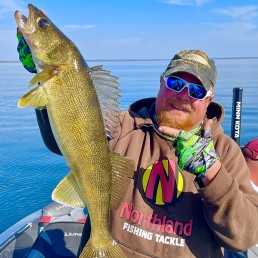
The Fall Walleye Binge
Fall is one of my favorite times to fish for walleyes.
As water temperatures drop below 60 degrees, the elusive scattered “ghosts of summer” school up to feed on minnows. Water temps of 55 to 58 degrees are the sweet spot for shallow migrations, and the action can be so good that you may need a clicker to keep track of the fish you catch.
Weather is also a major factor; strong winds can turn over a lake by mixing and disturbing deeper water. On large lakes, the thermocline breaks down due to wind and waves. Other lakes may go through a turnover process as surface water cools to 55 degrees, becomes denser, and sinks. At this point, the deep water is slightly warmer than the surface, so it rises and mixes. This process eventually oxygenates the entire water column, allowing walleyes to roam throughout the basin.
Water reaches its greatest density at 39.5 degrees. When surface temperatures hit 32 degrees and ice begins to form, the deeper water remains near 39 degrees, providing a stable environment that keeps fish healthy throughout the winter.
It’s not uncommon to hear of walleyes being caught in 50 to 70 feet of water during fall. But I prefer to stay on the shallow bite to minimize fish mortality due to the trauma of bringing them to the surface from such extreme depths. Some years, water temps linger in the 50s, extending the prime fall bite. Other years, temperatures drop quickly, and the feeding window closes just as fast.
Dark to clear water
Summer heat and elevated water temperatures trigger algae blooms that darken the water. In spring, invasive zebra mussels can leave some lakes with 20 feet of water clarity, while summer algae blooms will reduce clarity to 8 feet. The darker water makes walleyes less spooky, allowing anglers to fish closer to the boat and use a variety of presentations, including live bait rigging, spinners, and bottom bouncers.
This brings walleyes into the primary break areas. I use my Humminbird XPLORE to highlight the 7- to 12-foot depth range with a color palette, making those breaklines easy to identify across the entire lake. I cruise the break line at about 7 mph while using Side Imaging to look for key features. I mark the beginning and end of promising features with waypoints, then go back through to fish them with my Fish Armor Pro Pole facing in a forward direction with MEGA Live 2, so I can spot fish ahead before running over them. Powered by Amped Outdoors lithium batteries, I never run out of juice! While fishing, I continue using Side Imaging to mark additional features that I may want to ice fish in a few short months.
When I locate a school of walleyes, I start with a reaction bite presentation: a Northland Deep-Vee Jig with an Underspin, loaded with an Eye Candy Paddle Shad or Grub. My favorite colors are Gold (Walleye) or Sunrise Grubs, Black or Purple for the Deep-Vee Jig, and Smoke, Smelt, or White Paddle Shads. Cast beyond the school and retrieve the jig combo with light strokes, watching to see if the fish follow. If not, change the jig and paddle colors until there’s a reaction from the fish. I also keep leeches and ‘crawlers ready for Scope Float slip bobbers to tempt reluctant fish.
You can be among the first to get the latest info on where to go, what to use and how to use it!
There are many effective ways to catch walleyes. Most of my clients enjoy casting jigs to feel the bite. Some of my fellow guides prefer trolling ‘crawler harnesses and a bullet weight, pitching Puppet Minnows, or casting jerkbaits. Those techniques all catch fish, but treble hooks are a “no-go” in my boat unless I’m wearing full body armor and a helmet.
Chase, or not to chase?
Modern sonar technology allows an opportunity to sometimes see fish and cast directly to them, but just because you can see a fish doesn’t mean that it’s ready to bite. If a pod doesn’t respond after a few casts, just move on to the next group. Some are simply not in a feeding mood. Walleyes that are chased repeatedly might bite, but also leave the area completely if they are overly pressured.
Plastics vs. live bait
Some years, I catch fish on plastics for 80 percent of the season. Some years are only half. No matter the year, I always bring the three basic food groups for walleyes: leeches, minnows and ‘crawlers. By the time the fall bite begins, bait shops are usually stocked with large rainbows, redtails, chubs and sucker minnows that have spent the summer growing. On the large lakes of north-central Minnesota, a fat minnow on a Parrot Tungsten Jig is tough to beat.
Jigging a minnow lets you pause on the bottom, allowing the minnow to naturally fight the jig. That subtle movement draws walleyes in and triggers strikes. Another productive option is a large chub nose-hooked on a 4-foot live bait rig with a bullet sinker and a red Gamakatsu Finesse Wide Gap hook. This setup allows you to feed line on a walleye strike before the hookset.
Bro Pro Tip: When a walleye strikes a large minnow on a rig, don’t rush the hookset. It may take a minute or two for the fish to turn the bait in their mouth before they swallow it. Keep the bail open and lightly pull the line with your finger until you feel the weight of the fish. Get ready… they often take off fast while repositioning the bait, sensing that it was trying to get away. Wait this out as the walleye sucks the bait farther down. Then reel the slack line in until tight, with the rod tip position pointed at the fish. Sweep the rod up to set the hook.
Last fall was an extended fishing season, all the way to Thanksgiving. The water temperature was 34 degrees. The algae bloom vanished as the temperature went below 40, sending the algae into dormancy and leaving the lakes gin clear. Plastics continued to work, but I had to slow down my retrieve and cadence. Minnows worked best in the afternoons and caught bigger fish.
For more fishing insight from the pros who know, check out the next issue of MidWest Outdoors, available by subscribing on our website.
MWO
SHARE THIS POST
Did you enjoy this post?
You can be among the first to get the latest info on where to go, what to use and how to use it!