
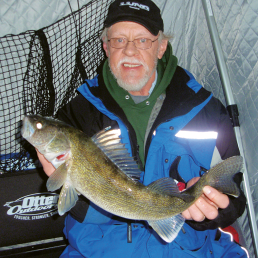
The ‘Abnormality’ of Ice Fishing
This article examines the “abnormality” of ice fishing. Since I was a mere lad, I have been knocking holes through the ice when my dad suggested that we try to catch some fish in our farm pond.
Initially, we used a wood-chopping ax, but that was messy, with ice and water flying everywhere. Then, Dad tried using a chain saw. Once. It spewed ice chips back on the legs of his overalls and made a real mess in the saw.
There had to be a better way. So, being clever, he welded an iron rectangle onto the base of a pretty stout iron bar. Voila, we had an ice spud.
Those were simple days. We had no “real” ice rods or lures. Consequently, we used regular fishing rods, impaled red worms on small bluegill hooks, hooked plastic bobbers to the lines and dropped them into the water.
Our ice shanty consisted of an old cardboard refrigerator box with a window cut into the side. The luxury seat consisted of an overturned bucket.
I don’t recall if we caught anything; maybe a few bluegills, but, hey, we were ice fishing.
Over the decades, I slowly gathered a collection of ice gear. My first rod, which I still have, has a wooden handle and a piece of bent wire on which to wind the monofilament line.
I still used the homemade spud, which still hangs in my late Dad’s barn. And I bought a couple of small, red/white Dardevle spoons to jig up and down through the ice hole. The insanity had yet to begin.
Things pretty much remained the same until I met professional walleye angler and Freshwater Hall of Famer Mark Martin around 12 years ago. We talked after the conclusion of one of his fishing seminars, and I eventually became a member of his media staff. This has enabled me to increase my knowledge of walleye fishing exponentially, and really helped me expand my prowess in ice fishing. It also led to an expansion of my ice fishing gear and tackle.
Annually, Mark conducts what he calls Ice Fishing Vacation/Schools on three inland Michigan lakes; usually Houghton Lake, Saginaw Bay, and Mullet Lake. Last February I drove north to Cheboygan, Mich. to take part in yet another ice fishing adventure on Mullet. And it was quite an adventure. This is where the “strangeness” of ice fishing begins.
Let me describe a typical day. After rising at 4:30 am., I assembled my fishing clothes and hurriedly dressed. Yes, it is cold out on the ice. No, I did not freeze my butt off.
Several years ago, I became the owner of some great Ice Armor clothing from Clam Outdoors, consisting of bibs, parka, gloves (thick gauntlets), hat and very warm boots. I can’t say enough about this clothing which has kept me warm when the actual temperature was -26 degrees.
We all (pro staff, media staff and “students”) meet at 5:30 am. for breakfast. Last year it was at the Best Western River Terrace in Cheboygan, where we scarfed down plenty of carbs for inner fuel when out on the ice.
Around 7:00, we meet at the launch, pack our gear, water bottles, and lunches onto the snowmobiles and under the covers of the ice sleds, and get ready to launch. Finally, everyone shows up, gets mounted on their snow machines and we blast off into the Great White North. Believe me, there is no thrill like riding on the back seat of a snowmobile while it rockets across the snow and ice. What would cause a sane, grown adult to do this?
After a ride of about 7 miles, the GPS on the machine indicates a waypoint where fish have recently been caught. This is usually on a rock pile, a hump or a point that drops off into deeper water.
In a matter of only a few minutes, we dismount, use a StrikeMaster electric auger to drill holes in the ice, and set up the shanty. More and more, I see anglers using Clam ice shelters which are sturdy and comfortable.
You can be among the first to get the latest info on where to go, what to use and how to use it!
Last year, my friend Andrew Hendrickson and I were fishing in 40 feet of water. Yes, this seems deep, but some anglers were fishing at 60 feet and catching fish.
Initially, we were after walleyes, the glamour fish of the North. But being the finicky creatures that they are, they were not biting worth a darn.
Andrew, who is a very good fisherman, said: “Let’s try for some perch.” I’m glad we did.
After setting up a Vexilar fish finder and lighting a small propane heater, the only decision left was to choose something from our arsenal of lures. During the two days that my schedule allowed me to fish, we used a variety of spoons such as Acme Sidewinders, Little Cleos, Do-Jiggers, Northland Rattlin’ Buckshot jigs, and Rapala Jigging Raps. The Sidewinder proved to be the hot ticket.
All our lures were tipped with either whole minnows or just minnow heads. We pinched off the heads and impaled them since the very small perch would just peck away at the tail of a whole minnow.
The Vexilar flasher unit indicated when a fish was coming into the lures. Then it was up to us to jig the lure up and down in a manner that would draw in the fish and cause them to strike.
These were jumbo perch, most of which were in the 12- to14-inch-plus range. We were sitting on a hot spot.
The morning and evening bites were the best because in low-light conditions, baitfish would go on the prowl for plankton and the larger predators, walleyes, and perch would attack the baitfish.
Often, the bite would just be seen as a small dip of the rod tip or felt as a bit of extra weight on the line. Or sometimes, they would just come in and smoke it.
We found that the best tip for success was to wind the fish up like crazy, and not to stop. Any slackening of the line would give the fish leverage to get off the hook.
On Monday, we landed 31 jumbos. On Tuesday, we landed 15 more on the very same spot. Those were the two best days on the ice for perch that I have ever had.
In the evening, we all meet at a local restaurant such as Mulligan’s or the Great Lakes Grill, eat some delicious food, discuss the day’s fishing, and get ready to begin again the next day.
So, what causes a relatively sane person to arise with the birds, spend all day on the ice looking down in an ice hole, and then do it all over the next day?
It is the thrill of the chase, the exhilaration of following a fish in on the electronic unit, the challenge of seeing if you can fool a fish into striking, the fight of the fish on the line and the thrill of catching a strong, wily fish. It’s enough to keep a guy coming back to Mullet Lake year after year, which is just what I hope to do.
If you want to try a different, exciting fish species or technique, you’ll find plenty of suggestions in every issue of MidWest Outdoors. Subscribe on our website.
MWO
SHARE THIS POST
Did you enjoy this post?
You can be among the first to get the latest info on where to go, what to use and how to use it!
