
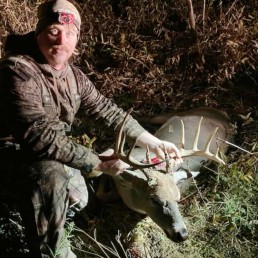
Tactical Thinking for Your Next Deer
Whether hunting on private land or public, it pays to have a strategy in mind. One you can adapt on your feet when things do not go as planned. Your plans often go out the window when the shooting starts.
What you had depended on in the past, those food sources, the rubs and scrapes, the sheds and tracks—each vital to know during the archery season—are the signs of unpressured deer activity. Mature deer that have survived the previous season know what is going on, long before the shooting hours begin.
Signs of deer activity are useful when you have the land to yourself. The deer will be doing their usual, looking for food, and then a place to rest. The key is to limit your presence, so it is not so obvious that you are there.
During the gun season, sitting near rubs, scrapes, and frequently used trails proved not as productive as I once thought. I learned instead to watch escape routes. Deer use specific routes to sneak away. Learn them, and hunting pressure can be used in your favor.
Deer move as much as possible with the wind. Success comes from having a reasonable idea of where they are most likely to go for cover, with the prevailing wind direction at the time. They get away by going to places where the disturbances and smells fade away.
I look for potential routes they use to enter places of cover. Once located, I look for backdrops to break my outline when standing or sitting. I try to stay within shooting range of where I envision them traveling to or from a place they can hide.
Scouting before season is the best way to find escape routes. If time is not on your side, use your phone/computer by narrowing down potential areas with digital maps and aerial photos.
Start by sectioning off the land you will hunt. Are you going to be on farmland with cultivated fields, or in an open pasture? Any unpicked corn around? What about large, unbroken tracts of mature trees? Is there a creek bed lined with trees anywhere near the area you want to hunt?
You can be among the first to get the latest info on where to go, what to use and how to use it!
Each field or plot of terrain has an edge that can serve as a focal point for deer travel. The goal is to be within 1/4- to 1/2-mile of thick cover; that is where the deer are headed. Private property closed to hunting can be just as attractive as thick cover. When envisioning the lay of the land, think on larger scale, in deer distances. They travel farther than we do.
The nastiest places that hunters avoid are the ones that attract deer. Grasslands too, without the nastiness; there, deer can hide in plain sight. Reclaimed coal lands or areas managed for upland birds or waterfowl, for example. At first glance, grasslands may look like terrible deer habitat, but deer will be there, somewhere; not in high numbers, but you only need one to make your day.
A strategy for public land is setting up on the opposite side of the high-use areas. Each hunter entering from a parking lot or similar access point can drive deer toward you, if you set up on the other side where the hunters will be entering the cover.
When pushed, deer follow the lay of the land as a means of concealment. Trees growing in strips along the edges of a field are natural features that limit their exposure out in the open, as are bottlenecks between fields. Deer need nothing more than a low area to attract them, like dry a run, that is just enough to move below the skyline with a sense of security.
These are familiar paths to deer. The routes are passed down from one generation to the next. Watching escape routes from high-use areas is a solid way to make public land pay off. Use the pressure to your advantage.
Looking for more ways to increase your harvest? You’ll find plenty of suggestions in every issue of MidWest Outdoors. Subscribe on our website.
MWO
SHARE THIS POST
Did you enjoy this post?
You can be among the first to get the latest info on where to go, what to use and how to use it!
