
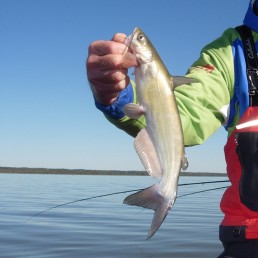
Spring Is Catfish Time
The strong tug at the end of the line says there is a good channel catfish on the hook. The best way to describe a catfish is “a muscle with a mouth on one end and fins on the other.” The tug is the drug of choice for most.
Catfish are probably the most popular single species of fish for eating and catching. Almost every angler has theories on catfish bait and where to get those big ones. Every town has its favorite location for a fish fry, be it a restaurant, church social, civic function or just someone’s backyard.
Never one to win a beauty contest, catfish live extensively throughout the Mississippi River basin.
In addition to the channels the other catfish species, both blues and flatheads inhabit the big river systems of this country. The Mississippi River for instance is home to all three species. Channel catfish are a popular fish for stocking programs in lakes.
The channel catfish is probably the most popular species of fish with anglers and fish frying patrons. They are the fish of the fish farms which dot the lower Mississippi delta area. Channels seek faster water flow and the cleanest of water with sand, gravel, or rock bottoms.
Catfish anglers are laid-back fishers. They tend to prefer a leisurely fishing experience. The rigs are simple, with a weight and hook on a line cast to the probable location of some fish. A forked stick sunk into the bank makes a suitable rod holder. Other variations on this theme occur on boats, but the basics are unchanged. Bait used for catfish is alive or dead and ranges from minnows to leeches, crayfish, catalpa worms, leaf worms, red worms, frogs and cut bait.
For the more sophisticated catfish angler, there are other patterns to fish. One is especially popular on small rivers and streams during the summer. It involves fishing live bait below a slip bobber and allowing it to drift downstream over the larger holes, washouts, undercut banks and beneath brush piles and other dark hideouts.
You can be among the first to get the latest info on where to go, what to use and how to use it!
The idea is to provide a natural presentation of the bait by allowing the current of the water to drift the bait. Bait is set so that it floats just a few inches off the bottom, much the same as any other food source. Good baits for this kind of fishing are grasshoppers, night crawlers and crayfish.
During periods of overcast or drizzle, catfish cruise flats in search of food much as they would at night. One can employ a three‑way rig. One of the swivels attaches to the line going to the rod. The second attaches to a drop line of about 8-inches that has a heavy sinker on it. The third swivel goes to a line of about 3-foot length with a hook at the end. The bait floats off the bottom and presents the live bait, either minnow or leech, in a natural presentation.
Getting back to the more leisurely approach, one need only look at jug fishing and trot lining. Jug fishing occurs in water with slow or no current with little or no snags under the surface. The bait suspends below a gallon milk jug and floats free. Anglers usually use many jugs and they sit back to wait for a jug to move off in a direction that is different from the rest. Some fishers will use a piece of a pool noodle instead of the jug. But the principle remains the same.
Trot lines, on the other hand, consist of a line with a series of baited hooks tied on in intervals along its length. These snells are at varying lengths and baited with cut bait. With varying lengths of snells, the water at all levels from the bottom to the surface cover it with baited hooks. Usually, the line ties to a shoreline object for easy access. Sometimes they go from shore to midstream. The lines remain overnight or for several hours, until collected.
Catfish can be finicky, yet do not require a lot of expensive tackle or boats to pursue. That is what makes them kings.
If you enjoy catfishing, you’ll find suggestions for locations and techniques in every issue of MidWest Outdoors, available by subscribing on our website.
MWO
SHARE THIS POST
Did you enjoy this post?
You can be among the first to get the latest info on where to go, what to use and how to use it!