
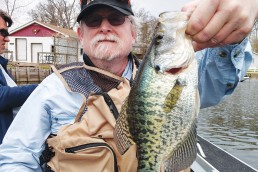
Spring Crappie Fever
This spring, if you want to get out with the family, some friends or someone who is new to fishing, Phil Piscitello says there is no better way than to take them crappie fishing.
Crappies hitting the shallows to feed and soak up the sun are usually found in good numbers and can provide great early-season action after a long winter.
The first shallow movements of crappies after ice-out are feeding movements. Crappies seek the warmest water available with cover to provide protection from predators.
Various kinds of weeds attract crappies. Reeds are found in some lakes and grow on a harder bottom. These provide great cover and food for crappies. Later in spring, they provide perfect habitat for spawning crappies.
Lily pads are not up yet this early in the season, but their roots are attractive to feeding crappies. Phyto- and zooplankton attract minnows and crappies that feed on both.
Cabbage weeds are usually the first weeds to turn green in early spring. Cabbage is attractive to many species of fish, including crappies. Their broad leaves provide excellent cover for baitfish, which attract predators. Cabbage is a major factor for spring crappie success.
Coontail and milfoil are both hardy weed species. They usually stay green throughout the winter months and early spring. Clumps or holes in thicker beds hold early-spring crappies.
Wood comes in all forms and is like magic for attracting early-spring crappies. Standing or fallen timber, wooden boat docks and seawalls all attract fish. Wood helps warm the surrounding water and will outproduce metal until later in the year.
Presentation is quite simple, but key for early-season crappie success. Light- and ultralight-action rod and reels are perfect for crappie fishing techniques. Rods from 5 to over 9 feet long all work for crappies. A small spinning reel in the 10 or 1,000 size, loaded with 4-pound-test monofilament, is ideal. You can go up to 6-pound in heavier cover situations, but day-in and day-out, 4-pound line will outproduce heavier pound tests.
You can be among the first to get the latest info on where to go, what to use and how to use it!
Float or bobber fishing is a primary technique and one of the most productive ways to catch early-spring crappies. There’s nothing more exciting than watching a bobber go down with a fish pulling on the other end.
Bobbers or floats come in all shapes and sizes, in plastic or balsa wood design and a total array of colors. Choose one that will cast well and that you can see on top of the water. The proper size float will barely keep your presentation up without sinking. When a fish grabs the bait, the less resistance it takes to pull the float under, the better.
Then there is the business end of the presentation. You can use a plain hook baited with a small minnow. Hooks come in a variety of sizes and colors. Choose a size just big enough to hook a minnow and have some space or gap to hook a crappie when it bites. Sizes 4 through 10 are the most common for crappie fishing applications. Bronze hooks are standard, but red and sometimes gold hooks really attract crappies and get extra bites. Add some split shot weights to the line to hold the minnow down in the water column without sinking the float.
You can also use a small jig instead of a plain hook if you like. A marabou or hair jig like the Original Pinkie Jig, a small tube jig or a small ice fishing jig all work extremely well. The Cubby Mini Mite is another popular jig that is extremely deadly on crappies. It has a tantalizing plastic tail that really catches fish. You can tip it with a wax worm, spike or small minnow, or on good days you can fish it plain.
When setting the depth of your presentation below the float, set it slightly higher in the water column than the depth of the fish. Crappies’ eyes are located on the tops of their heads and are used to looking and feeding up. With most early-season presentations, you will be fishing shallow, so you can use a fixed float. If you fish deeper than 4 or 5 feet, use a slip float for easier casting.
When searching for fish, you can fish more aggressively. Cast to objects or over weeds. Retrieve slowly, twitching the bobber, giving the bait an erratic action. When you find fish, slow down or anchor up and catch a bunch. When the bite slows, pick up and continue down the shoreline until more fish are located.
Get more helpful panfishing tips in the spring issues of MidWest Outdoors, available now at the newsstand or by subscribing on our website.
MWO
SHARE THIS POST
Did you enjoy this post?
You can be among the first to get the latest info on where to go, what to use and how to use it!