
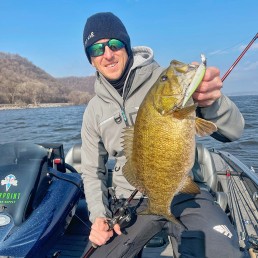
Smallmouth Tactics from Top to Bottom
Smallmouth bass are highly sought after by many anglers, mainly because they are a riot to catch; from lightning-hard hits, to zinging drag off your reel, to then flying out of the water, all anglers love to catch them. The other great thing about targeting smallmouth bass is that you can catch them in different ways, all the way from the top of the water column, down to the bottom. The main reason that many anglers go after bronzebacks is to see powerful fish explode from the depths, to the surface, to take down a topwater plug; then dive back to the depths, and seconds later, erupt back out of the water.
Late summer and early fall are prime time to grab a topwater and fish for smallmouths, as are they putting on the feedbag before the winter ahead. I begin looking for smallmouths on my favorite lakes and rivers that have some form of current present. Current helps position bass so they can grab an easy meal. Many times, a point, drop-off or flat allows smallmouths to ambush their prey, which in big rivers this time of year is primarily shad.
Being that many of these fish will be on or near shallow flats, I’ll position my boat to deploy my Minn Kota Raptors, or engage the Spot-Lock on my Quest trolling motor, to stay in one place and not disturb the area I’m fishing.
The two topwater baits rigged up on my deck include a popper-style bait, like a Storm Chug Bug or Rebel Pop-R, along with a walk-the-dog style plug like a Zara Spook or Evergreen Shower Blow. Smallmouths can be very picky, and I want to be able to present them with the right bait at any given time.
You want to use a rod that has a soft tip so you can give the bait the correct action, along with a limber bend so the rod will give and load up when a big smallie hits and surges to the bottom. I also like to use braided line with this style rod, as braid allows me to make long casts to smallmouth breaking the surface. If I’m fishing around vegetation, I can keep a feisty smallmouth controlled and prevent it from getting hung in the grass. Most of the time, I’ll fish my topwater plus on 40- or 50-pound Seaguar Smackdown Braid in Stealth Gray.
Suspending jerkbaits have developed into go-to lures for smallmouth, especially on bodies of water where fish suspend in the water column. You can fish them in numerous ways and keep your bait in the effective strike zone for an extended period.
One way is to cast it out and just deadstick the bait, then slowly reel it in and deadstick it again. Depending on water temperature and prevailing weather, bass, although hungry, may be sluggish, and a jerkbait just sitting there will tempt them into biting.
The second and more exciting way to fish a jerkbait is to cast it out and work the bait back to the boat by giving your rod a quick jerk. This method requires you to experiment and see exactly what the bass wants in terms of how hard a jerk, how many jerks in a row, and how long a pause. Once you dial in your jerkbait presentation to bass mood on that day, the feeling of jerk, jerk, jerk and then wham will be etched in your memory for years to come.
Some of my favorite jerkbaits include the Rapala X-Rap and Shadow Rap, Berkley Stunna and, of course, the Megabass Vision. Jerkbait color options are vast; some of my top colors include clown, Table Rock shad, white pearl, shad and perch hues. Depending on the time of the year, water clarity, and the forage in the body of water, your fishing will dictate what color bait you tie on.
You can be among the first to get the latest info on where to go, what to use and how to use it!
Proper line selection has a huge effect on how your jerkbait runs. If you are fishing a suspending jerkbait or deadsticking a bait, using Seaguar Fluorocarbon line is very helpful in achieving the desired depth for your bait. Fluorocarbon line also is super-sensitive and is invisible underwater, which are big advantages when fishing in ultra-clear water. If I want my jerkbait to hit a deeper portion of the water column, I’ll spool up with 10- or 12-pound TATSU, whereas if I need to keep my jerkbait up closer to the surface, I’ll use thicker 15-pound Inviz X.
When smallmouths are close to the bottom, inactive, or holding tight to cover, I like to use a drop-shot to entice them into biting. I will fish a drop-shot in anywhere from 6 feet of water all the way down to 15 feet. When targeting rocks—either vast flats with scattered boulders or a rock-lined bank—a drop-shot will entice even the tightest-lipped smallie into biting.
The equipment used while drop shotting is very important to success, because the proper equipment ensures you can present the bait in a natural manner. It is important to be able to feel bites, as sometimes smallmouths just nibble on your offering.
A good drop-shot rod should have a soft tip, so you can give your bait the proper subtle action, but strong backbone that will get that big bass into the boat! Once I feel the bite, I reel up the slack and give my rod a sideways, sweeping hookset.
Even though I’m using spinning tackle and light line, I need a sharp and strong hook, such as the TroKar Pro V Drop-Shot hook. There are endless possibilities of baits to rig on your hook, and experimentation is key to finding out what the bass want that day.
Most times, you are not fishing directly over the area where you are targeting the bass, so cast your drop-shot to the weed line, rock pile or point and let it sink to the bottom. Keep the amount of weight you need to get down there as light as possible, depending on the wind, and if you need to get it through thick vegetation. The length of your dropper will depend on how heavy the cover is, along with how far off bottom the bass are suspended.
Whether they are feeding on top or down in the depths of a deep, clear-water lake, smallmouth bass can be targeted in a wide array. Having several lure options rigged up and ready to go will help you take advantage of the bite when it is hot.
For helpful bass fishing insight, check out the articles in every issue of MidWest Outdoors. Subscribe on our website.
MWO
SHARE THIS POST
Did you enjoy this post?
You can be among the first to get the latest info on where to go, what to use and how to use it!
