
Small-Stream Trout Fishing
Trout fishing in small freestone streams is relaxing and productive. You can easily cast to the opposite shore without entering the water. Therefore, you can cover the entire pool from standing at one spot on shore.
My definition of a small stream is one that is less than 30 feet wide. Small streams have many positive attributes. Every trout is within an easy cast. Also, these streams usually have a limited food supply. Trout must quickly decide to eat potential food or it could disappear by drifting downstream. Another fish could beat the trout to the food. This makes the trout eager to grab your bait or lure.
These streams can be near suburban areas or remote locations in forests. Anglers can drive to some streams in 30 minutes or need several hours to reach a stream. After reaching the parking area in the forest, you might need to hike an hour or more to access the better holes.
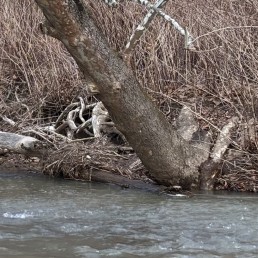
My favorite hole is an undercut, live tree on a stream bend. These holes are not large. The current has eroded the dirt from around the tree roots, creating a cavity that can reach several feet under the tree. Trout love to inhabit this type of hole, and I have been fortunate to catch numerous trout from them. The current brings drifting nymphs to the undercut roots. Trout can easily capture drifting food without having to expose themselves.
Besides the drifting food, baitfish can live among the roots, providing another available food source. The tree roots provide protection for the trout from avian predators like ospreys and the tangle of roots makes it hard for a raccoon or mink to catch a trout. The roots slow fast current from high water created during downpours. Finally, tree roots provide a safe place that is shaded from the sun.
The tree leaves provide shade to the hole and are a terrestrial food source. Ants, caterpillars, and beetles fall from the leaves into the stream.
Because these holes are difficult to fish, many anglers bypass them in favor of larger, easier-to fish-holes. Because anglers tend to bypass these holes, they usually contain trout, whereas nearly all the trout at other locations have likely been caught and released.
Be careful when fishing undercut trees. Your bait or lure can easily become entangled in the roots. Generally, there is a short space between the streambed and the roots. For best results, you must position your bait to drift under the roots and into the cavity. A trout can grab the bait without having to expose himself.
If the bait is drifted at root depth, a snag will ensue. Most of the time, you will lose your hook and need to tie on a new one. Spinners and spoons should be retrieved close to, and parallel to the roots, to avoid hooks becoming embedded in a root. To get my hook beneath the roots, I cinch a split shot onto my line about six inches from the hook. Having the weight farther from the hook will allow the bait to drift higher in the water column, and the bait will drift into and snag the roots. If the roots are nearly touching the streambed, I use a small jig tipped with either a mealworm or two maggots. The jig head has the weight necessary to drift the hook along the streambed under the roots.
I cast my bait into the current leading to the undercut hole. The current carries my bait under the tree roots into the cavity. Maggots, mealworms, and red worms on a size 10 hook are great baits to accomplish this.
You can be among the first to get the latest info on where to go, what to use and how to use it!
When a trout grabs your bait, you must quickly muscle the trout from under the roots, or else it will tangle your line among the roots. Your line must be strong enough to muscle a trout from among the roots before the fish entangles your line. Most of the time, an entangled trout will escape. If your line breaks, you not only lose the fish, but the hooked trout may be restricted in its movements by the entangled line. This makes it vulnerable to predation.
Another favorite hole has a downed tree trunk several feet in diameter resting on the streambed and spanning the width of the stream. Water flows over the log, creating a short plunge pool that’s several feet deep. Trout hide in the haven between the log and the water flowing over it. Trout dart from this haven into the current to capture food. Actively feeding trout typically are found at the tail of the pool. Here, the food drifts smoothly in the uniform current, unlike at the head of the pool. At the head, the food swirls in the different currents. Trout seldom inhabit the swirling water because it takes too much energy to fight the strong current.
I like to cast into the fast water immediately above the log and allow the current to carry my bait to the trout. My preference is to begin by casting to the near edge of the water flowing over the log. On each successive cast, I cast a little farther until I reach the far end of the overflowing water. Each cast is fished until it reaches the riffles at the tail of the pool. At each edge of the overflowing water, an eddy is produced where trout feed on drifting food in the calmer water.
Because most of the pool has fast-flowing water (and little calm water), a sinker is needed to get the bait near the streambed where the current is weakest. I cinch a split shot on the line about 8 inches above a size 12 hook. The bait should occasionally tick bottom. If it is not ticking bottom, an additional split shot is needed. The additional split shot should be placed about 6 inches above the highest split shot. This arrangement allows the most natural drift.
Do not exchange several small split shots for a large one. The concentrated weight often anchors your bait in one location instead of allowing it to drift naturally in the current.
In warm weather, the plunge pool is a good location to catch trout. The water flowing over the log becomes oxygenated. During hot weather, trout migrate from slow-water pools to the higher-oxygenated water in the plunge pool.
You can generally fight a trout in a plunge pool without worrying about it wrapping your line around a snag. Therefore, a greater percentage of trout hooked are landed.
These two holes are my go-to locations to catch trout. While not all trout streams have these holes, they are worth the effort of finding and fishing them.
Thinking of trying a new fishing destination this year? You’ll find plenty of suggestions in every issue of MidWest Outdoors, available by subscribing on our website.
MWO
SHARE THIS POST
Did you enjoy this post?
You can be among the first to get the latest info on where to go, what to use and how to use it!
