
Slow Roll to Catch ‘em When It’s Cold
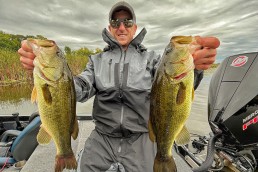
When you head out on the water for the first time this season and the water is cold, Glenn Walker suggests you slow your roll to catch some bass.
When bass anglers eye up that first fishing trip on the horizon, the water temperatures are likely going to be cold. Just like us humans, when the water temperatures are cold, bass are going to be sluggish.
Now, many bass fishermen think you need to fish super slow, and soak a jig, Senko or shaky head to get bites. While all those baits will work, you can still catch bass in cold water with reaction baits; you just need to fish them differently than you would during the warmer-weather months.
The technique of slow rolling a bait excels, as you can present a lure in a manner that allows you to cover water efficiently, while still presenting it at a pace that will trigger an inactive bass into biting. I’ll slow roll any of the three baits I outline below, anytime that the water temperature drops below the 50-degree mark.
Slow rolling a spinnerbait is a tried-and-true presentation that will trigger even the most inactive bass into biting. I will throw a 1/2-ounce War Ear Eagle spinnerbait with a single Colorado blade or a tandem Colorado/Indiana blade combination.
Both blade configurations put off a lot of vibration for bass to key in on. These blades don’t create much lift, meaning you can cast the bait out, let it sink down and then slowly reel it in, just fast enough to keep the blades vibrating away!
Now, if the bass are sitting in deep water and are lethargic, I’ll go to a 3/4-ounce Booyah Covert Series spinnerbait with a single BIG #6 Colorado blade. I’ll cast the bait out, let it fall to the bottom and just slowly reel it in, feeling the thump of that big blade.
You can be among the first to get the latest info on where to go, what to use and how to use it!
Adding a soft plastic as a trailer on your spinnerbait adds weight to the bait, so you can make longer casts and help keep them down in the water column better. The plastic trailer also gives the spinnerbait a bigger profile, which helps a sluggish bass key in on it. I’ll begin with a standard split tail Spinnerbait Trailer from Zoom for my plastic choice. If I really want to increase the lure’s profile, I use a Z-Craw Jr or Z-Swim 3.8.
Many anglers think of a lipless crankbait as a lure that needs to be burned in; however, these baits shine still when retrieved at a snail’s pace. I like to cast out a lipless crankbait, let it sink down to the desired depth and then reel it in slowly. The action and noise that the bait emits will be the same as if you were burning it in; now you are just matching the speed of your retrieve to the activity level of the bass. It is important to keep a good sense of what your bait is doing, as you want to crawl your lipless crankbait over the cover you are fishing.
I’ll switch up between the Booyah One Knocker and Hard Knocker, the difference being the noise. The One Knocker emits a single, thumping noise, which is unlike any other lipless crankbait. This can be the difference maker when bass have seen other baits. The Hard Knocker has a sound profile more like a traditional lipless crankbait, with the bait having multiple rattles inside.
A swimbait is a versatile lure for bass fishermen, from the ways it can be rigged to the speed it is retrieved. I’ll rig a big, soft plastic swimbait on the All-Terrain Tackle Largie Smasher Swimbait head, let it sink to the target depth and then slowly retrieve it. The paddle on these soft plastic swimbaits put off a good vibration for bass to key in on.
My primary gear setup for fishing any of these three presentations begins with the reel. A low-speed gear ratio is needed to keep you from burning that bait back to the boat; therefore, I use a 6.3:1 gear ratio reel, as this will help me slow up my retrieve. I’ll spool the reel up with 12-pound Seaguar Inviz X Fluorocarbon line, as I want my baits to sink down to the desired depth, and fluorocarbon line will aid in this.
If you enjoy bass fishing, you enjoy many of the articles found in every issue of MidWest Outdoors, available by subscribing on our website.
MWO
SHARE THIS POST
Did you enjoy this post?
You can be among the first to get the latest info on where to go, what to use and how to use it!
