
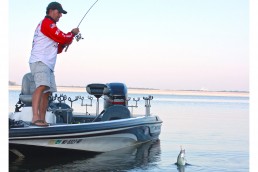
Simple Tactics for Spring Crappies
Author Tim Huffman suggests using simple tactics for catching spring crappies.
Finding the right spots for spring crappies is usually a simpler task than in other seasons. Crappies move around, but are predictable. During pre-spawn, they stage near spawning sites, waiting to move shallower to spawn. Post-spawn crappies will be scattered from very shallow out to adjacent deeper, open areas, suspended in the water column.
A variety of tactics catch pre-spawn, spawn and post-spawn crappies. Keep things simple and fun so everyone from young to old is able to participate.
Jigging and casting are the two most economical crappie fishing techniques when fishing from a boat.
Jigging
Vertical jigging is a one-pole tactic that’s fun and lets fishermen feel the thump of the bite.
The biggest challenge for most fishermen is finding the right spot to catch crappies. Check online fishing reports and ask bait shop owners to learn the depths and general areas where crappies are being caught. Knowing these two factors allows you to find fish.
Spring locations tend to be relatively shallow. Patterns are important, too. When a fish is caught, remember the depth, bait, lure or bait action and anything else that allows you to duplicate what was successful. Catching numbers of fish is often a matter of repetition.
Jigging equipment includes a good 10- to 12-foot graphite jigging pole, a simple lightweight reel, jigs, or for inexperienced fishermen, a slip float and minnow. A 10-foot pole is best for areas with overhanging limbs and waters that are stained or dingy. A 12-foot pole is good in clearer and/or shallow water to get the bait further from the boat to avoid spooking crappies. An 11-footer is a good all-around choice. Rig with 6- or 8-pound test monofilament or 15-pound test braid.
If a jig isn’t working, a minnow or jig tipped with a minnow can be used. Jigs are best when fish are active and when thick cover is being probed. Minnows are good when fish are sluggish. Spring crappies can be slow biters, but in general, they slam baits in springtime.
Presentations should be simple. Inexperienced fishermen often give a jig too much action and they don’t leave it in one spot long enough. A good tip for fishing a jig is to fish it the same as you would fish a minnow—by holding it still.
Invade the crappie’s home. Probe within thick brush, get into the edges of grass, or deep into whatever cover the fish are using. It’s important to get your bait close to them.
Jig fishermen say they enjoy the technique because of the “thump.” Feeling a fish hit, setting the hook and getting it in the boat is a one-on-one experience that allows most cover to be thoroughly fished at any depth—even shallow waters with spawning crappies. A jig & minnow combo makes jigging easier when used with a slip float to keep depth constant and to indicate strikes.
You can be among the first to get the latest info on where to go, what to use and how to use it!
Casting a slip float
The first step is to find fish. A graph, or locator, is important to show depths, contours and cover. Advanced units show more detail and include great mapping, but basic units will do the job. The key is to learn how to use your unit and let it lead you to crappies.
Basic slip float equipment includes any type rod and reel combination rigged with 6-pound-test line. Add a #2 minnow hook, split shot, bobber stop and slip float.
Keep things simple. Drop an anchor to keep your boat away from the cover, but within casting distance. If a brush pile or weed line is being fished, set the bobber stop to put the minnow at the right depth so the bait just above the cover. Cast to a spot where the wind and waves will drift the bait to the cover.
When the float disappears, moves sideways, or lays on its side, take up slack line and set the hook. This is easy if the float is set at 6 feet or less. However, when the bait is down to 10 to15 feet, the line must be reeled until the line becomes straighter between the rod tip and bait, removing slack, before setting the hook.
Easy, fast trolling
A small outboard or a good trolling motor facilitates simple crankbait trolling. A pole is hand-held by each fisherman. Do not mistake this for serious trolling with multiple rods. It is a great way for a quick change of pace and an economical way to pull crankbaits for a while.
Equipment includes a medium- to heavy-action rod with a moderately strong reel. Line should be about 10-pound-test. Heavier line prevents baits from getting deep while lighter lines won’t withstand the jolt of a hit on a crankbait. Crankbaits should be of relatively small size—around 2 to 3 inches in length. They can be of a variety of brands, with Pico INT being great, affordable baits. Having a few different colors is important, too. Different lakes have different “hot” colors. Good starting colors include pink, orange, shad and fire tiger.
Quick and easy trolling requires being in an area with fish. A big flat is often good during pre-and post-spawn periods. Mid-depth channel ledges are good because they have deeper water in the channel and mid-depths on the flat, giving crappies a choice. Channels can be difficult to follow but swinging back and forth across them works. Electronics are very important to make sure the water is deep enough to pull a crank.
Bait depth depends upon the type of crankbait, line length and line diameter. Lines are often set from 50 to 200 feet behind the boat. Make a long cast and guess the amount of line let out. Or, feed the crankbait out by hand behind the boat as you begin slowly trolling, counting the number of pulls from the reel. Repeating a successful line length is very important.
Try trolling speeds of 1.4 to 2.4 mph, with 1.6 being a good starting speed. If the action is slow, try speeding up and slowing down until the right speed is found. Cooler spring waters usually equate to slower speeds.
Holding poles while trolling works. No special rigging is required. It can be a fun alternative tactic. Watch your electronics to find brush piles for the future while enjoying some easy fishing. Best of all, there’s a big adrenaline rush when a fish hits a hand-held pole while pulling a crankbait.
Gain more outdoor knowledge from the pages of MidWest Outdoors, available at the newsstand the first week of each month or by subscribing on our website.
MWO
SHARE THIS POST
Did you enjoy this post?
You can be among the first to get the latest info on where to go, what to use and how to use it!