
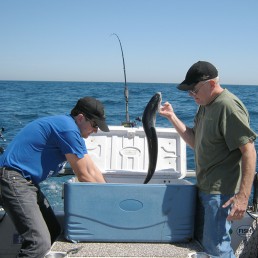
Running One Down the Chute
The first time I ventured out on the Great Lakes to troll for salmon, it was on a small boat with a small outboard. There were three of us; each of us had brought our own fishing rod and a handful of lures that we thought might be attractive to the fish. Other than the required safety gear, and what turned out to be a woefully inadequate net, that was about the extent of the tackle on board.
There were no downriggers, no rod holders—just one guy holding his rod out the right side of the boat, another holding his rod on the left side, and the third person trolling straight out the back. We caught just enough fish to want to come back and try again.
We observed how other boats were equipped, and we weren’t shy about asking what lures caught most of their fish. The next time out went better, but we quickly learned there was more to fishing than just having the right equipment.
One thing we learned was that running a lure straight behind the boat did two things: First, it did catch the occasional fish. Second, about half the time when a fish was hooked on it, the fish would tangle with one of the other lines trailing behind the boat. Catching an extra fish or two were hardly worth the hassle.
So why, these days, if you see me trolling for salmon on Lake Michigan, or for walleyes on Lake Erie, do I often have a rod positioned right off the middle of the stern, trailing directly behind the boat? Am I that bone-headed?
Not really. I’ve added a few other tactics that make running one line “down the chute” possible, and even more productive, than ever. Here’s why.
The tangles on my early expeditions came because we were trying to troll all three of our lures roughly the same distance behind the boat. Realistically, the lures may have been trolling through the water only 6 to 8 feet apart. That meant that the fish only had to pull to the side 3 or 4 feet before it crossed lines with one of the others. An easy chore for the fish; often, a tangled mess for us fishermen.
Not long after that, I learned about planer boards—both the large mast and planer rigs preferred by some big-water anglers, and in-line planers preferred by others. Both types do a terrific job of pulling multiple lines out to the side of the boat 20, 30, or even 100 feet, if desired.
You can be among the first to get the latest info on where to go, what to use and how to use it!
A lure running down the chute seldom tangles if the other lures are being pulled wide with planers. Actually, the chute rod threatens tangles more often when a fish is being caught on one of the other rods, as the fish tracks back behind the boat while being caught.
There are ways to nearly eliminate this threat. The first thing is to use a lengthier rod for the line going down the chute. This means that the amount of line between the rod tip and where it enters the water will increase, and up the chances of being able to bring in a fish caught on a different set under the chute line.
There’s a simple device that makes this process even simpler, called a stern planer. Several companies make them. The one I use is made by Church Tackle and comes in two sizes. Basically, the stern planer pulls hard enough to keep your chute line out of the water, even if you have 150 feet of line out—or more. If you have the lure being trolled on a planer board with 75 feet of line in the water, and the planer is pulling 75 feet to the side of the boat, letting the stern planer out a bit over 150 feet will prevent tangles.
Why do this if it only occasionally catches any fish? I quickly learned that when running chute lines 100 or more feet behind the boat, the amount of fish they caught on most trips added significantly to the daily catch.
Depending on what I’m trying to catch, I often run the chute line using leadcore or weighted steel line to get lines deeper. By the time the lure gets to the fish, it’s forgotten all about the boat that passed by earlier.
The next time you are out trolling one of on the Great Lakes, put one down the chute, and don’t be surprised when that rod slams down at the strike of a fish.
Looking for some new fishing techniques to try this season? You’ll find plenty of suggestions in every issue of MidWest Outdoors. Subscribe on our website.
MWO
SHARE THIS POST
Did you enjoy this post?
You can be among the first to get the latest info on where to go, what to use and how to use it!
