
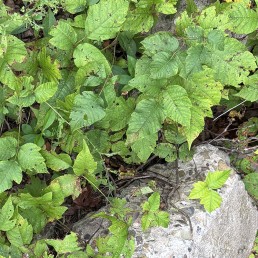
Poison Ivy: Bane of Outdoor Enthusiasts
Poison ivy (Toxicodendron radicans) lives where anglers and hunters practice their chosen sports. This plant has caused me great discomfort many times over the years. I have contacted the plant while scouting, fishing, and hunting. Consequently, I learned to identify the plant quickly before contacting it.
This perennial plant can be found nearly everywhere. I have found it growing in fencerows, along streams, in meadows, and in forests.
Poison ivy has three leaflets on a common stem. The leaves are alternate. The leaflets can have smooth, lobed or toothed margins. Thus, the common adage, “Leaves, of three, let it be” applies. Reddish leaves break out in spring before changing to green. In fall, the leaves turn yellow, orange or red.
Poison ivy can grow in three modes. It can be found growing as a ground cover, as a small shrub, or as a climbing vine with tendrils growing on fence posts or trees. The vine can be identified by the numerous hairlike rootlets on its stem. Clusters of small greenish flowers bloom in May and June. In fall, small, white berries are found in clusters that can last into winter.
A crawling vine can be between 3 and 6 inches high, while the shrub can be 5 feet tall. The climbing vine can reach the crown of tall trees. A climbing vine’s trunk can be as much as 5 inches in diameter. Because it can take different forms, a person can contact poison ivy without realizing it. Moreover, poison ivy growing intertwined with other plants can be difficult to identify. You wonder where you got the rash.
Every part of the plant, including the roots and berries, contains a very sticky oily resin, named urushiol, which can irritate a person. Even in winter, the plant contains urushiol. People usually contact urushiol by touching the plant.
Other sources may include boots, waders or tools that touched the plant. Pets and wild game animals are not affected by poison ivy, but they can have urushiol on their fur. Touching their fur will transmit the urushiol to your skin. To illustrate the persistence of urushiol, people touching tools after several months got the rash.
Urushiol causes itchy, red, fluid-filled blisters (allergic contact dermatitis). The irritating rash typically develops within 12 to 48 hours and lasts two to three weeks. People very allergic to urushiol frequently need to see a doctor to get prescription medication for the rash. In addition, people with a severe rash, or rash near the eyes or genitals, need to see a doctor.
You can be among the first to get the latest info on where to go, what to use and how to use it!
According to the Mayo Clinic website, most people can treat the rash with over-the-counter medicine. Calamine lotion or creams containing menthol relieve the itching. Sufferers can also use cortisone cream or ointment for a few days. Cool, wet compresses applied several times during the day for 15 to 30 minutes can relieve the itching. Scratching the rash will not spread the rash, however, scratching can break the skin leaving it susceptible to an infection. Oral antihistamines can be helpful. During the day, choose a nondrowsy antihistamine like loratadine (Claritin or Alavert). To help sleep at night, an antihistamine that causes drowsiness, like diphenhydramine (Benadryl), can be taken.
To minimize the effect of urushiol, wash exposed skin with soap and water as soon as practical. Of course, wearing long pants and long-sleeved shirts can help to protect skin from contacting urushiol. Leather gloves protect your skin while hunting. At home, contaminated clothing needs to be laundered.
I have contacted poison ivy many times and got the rash. The bothersome rash made me miserable for several weeks each occurrence.
The worst poison ivy rash that I ever got was from planting food and cover seedlings in spring, obtained from the state wildlife commission. These plants were planted on my uncle’s farm to improve the cover for deer and rabbits. I dug holes in the leaf-covered ground and placed the seedlings in the holes. Then I backfilled the hole and tapped the soil with my bare hands. I unfortunately did not realize that the bare ground had severed poison ivy roots in the soil. My hands contacted the damaged roots. Therefore, I contacted the toxic substance in poison ivy. I had to see a physician to get prescription medicine for the rash. My fingers were so swollen that I could not hold a pencil.
Because I get poison ivy rash from the slightest contact with the plant, I am careful when wading through cover. If I encounter a large patch of poison ivy, I bypass the cover.
If you enjoy spending time in the outdoors, check out the articles in every issue of MidWest Outdoors. Subscribe on our website.
MWO
SHARE THIS POST
Did you enjoy this post?
You can be among the first to get the latest info on where to go, what to use and how to use it!
