
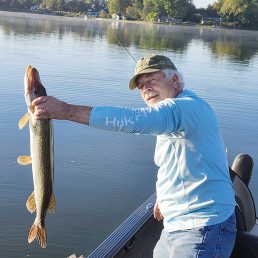
Pike Fishing 2026
Pike numbers have declined over the many decades of my chasing them. This could be attributed to the declining number of marshes and prime spawning grounds. A five-fish limit was reduced to two fish.
For years, I used the Dardevle with a treble hook to catch Pike. At some point, someone suggested replacing the treble hook with a single hook. I don’t know if my hooking ratio went up with the single hook, but removing the hook from the fish became much easier.
You can cast a spoon a mile, and work it fast just under the surface. You can let it sink and reel it in very slowly. You can also cast it out, let it sink partway, and then pop it hard and reel in the slack. The key to me is mixing it up and tinkering with your retrieve based on the fish’s location and their response.
Some days, I add a 3-inch twister tail. When I add plastic, it’s nearly always white. On some days, I might choose a yellow or chartreuse, but 90 percent of the time, it will be white.
Spoons excel in shallower water. My favorite depth is between 5 and 15 feet, and I love weeds. Cabbage weeds are my favorite, but any weeds will work if cabbage is not present.
I also use the Johnson Silver Minnow spoon with a plastic trailer. I love this spoon when fishing thick weeds, wood, or any slop. As a rule, I can fish the Johnson Silver Minnow slower than the Daredevle.
Due to the design, it fishes weedless, or much closer to that than most baits. Throwing this spoon over the top of the cabbage, letting it flutter in an opening, then popping it out, rarely ever gets snagged.
Once I could drive, I spent years fishing a small river near my home out of a canoe. In most rivers, pike use either deep holes, which are relative to the average depth of the river, or wood. Wood could be a stump, a log, or a fallen tree.
Precise casting is required. Unlike a lake, where a pike might travel many feet to strike a lure, in a river, casting tight to the obstacle will produce more fish.
Some rivers are 2 to 4 feet deep, while others might average 6 feet. Regardless, most of our streams are shallow and require caution when running with an outboard motor.
My friend, Joe Bednar, likes trolling Flutter Chucks with a 1/2-ounce weight placed on the line 2 feet ahead of the spoon. During the dog days of summer, Joe is either in the river or trolling the tight contour walls of an inland lake. Deep diver Husky Jerks are his favorite.
Joe loves trolling 1-ounce, bass-style safety pin spinners, using single-bladed spinners trolled 60 to 80 feet back that run 15 feet down at the correct speed. He also enjoys using Deep Diver Husky Jerks. Joe trolls because of the efficiency. You cover the most water in the shortest period of time.
You can be among the first to get the latest info on where to go, what to use and how to use it!
I troll primarily during the dog days of summer. I like a three-way rig with a floating Original Rapala. Often, an inline or rubber-core sinker is set 4 feet ahead of the lure.
Safety pin spinners also work great for casting weeds and working tight drop-offs. When bass are also present, this is a great bait. However, for reasons that I can’t explain, I throw a Mepps Spinner over a safety-style spinner more often.
Early in the season, and especially from Halloween until freeze-over, I love throwing a number 5 Mepps Spinner dressed with squirrel tail. I love the many ways that I can work this spinner.
My friend Dave loves jerk baits. His favorite is the number 11 Husky Jerk. Early in the season, both Dave and Joe search for the shallowest, warmest water we can find. The water can be super shallow—perhaps even just a foot deep. Find the warmest water, find cabbage weed or any weed, and you will find a few pike.
Using a stop-and-go retrieve pattern often drives pike nuts. Especially when a big pike is just sitting there, soaking up the sun’s rays. Cast out, slowly reel in a few feet, pause, reel in a few more feet, pause, and hang on. This is another fine bait from ice-out until, say, early June, and then again from Halloween until freeze-over.
I like using both live bait and dead bait around opening day. Generally, we search for large flats with decaying vegetation and, hopefully, a few perch. We Spot-Lock potential areas with some weeds, whether decayed or fresh, and reasonably close to a drop-off.
We use a slip bobber with a live creek chub. Set your bobber so that the lively bait is a foot or two up from the bottom. Our dead bait is cast out with an egg sinker placed above a small swivel. We leave the reels open with a rubber band over the bail.
When a fish grabs the dead bait, it can take line without feeling any resistance. Frozen smelt is my choice. With a quick-strike rig, I count to five, reel in the slack line, and then set the hook. Ninety percent of the fish are hooked in the mouth and can be released to fight again.
While pike numbers are definitely down as compared to years past, anglers targeting them are fewer as well. When you tire of panfishing and are looking for a reliable gamefish, try for pike. They often bite when other game fish have lockjaw.
If you want to try a different, exciting fish species or technique, you’ll find plenty of suggestions in every issue of MidWest Outdoors. Subscribe on our website.
MWO
SHARE THIS POST
Did you enjoy this post?
You can be among the first to get the latest info on where to go, what to use and how to use it!