
Patience Can Pay Off
The late Buck Perry is considered the father of structure fishing. This article originally appeared in Fishing Facts Magazine in Summer 1995.
Patience is one of the most overlooked parts of fishing process. Fishermen must learn to exercise patience and wait for catchable fish to move within range of their lures or baits. Too many times, I have watched anglers work an area that was potentially productive. After an hour or so of “fishing,” they say, “Well, this must not be a good spot,” and away they go in a cloud of spray to the other side of the lake. They never understand that they may not have given the area enough time for fish to become active—either in the form of movement or, if we are very lucky, full-scale migration.
Lucky anglers find the fish up and moving the first time they fish a structure. Lucky indeed, as this happens only during a small portion of the normal fishing day. Combined with other factors such as bad weather, less-than-perfect water color, marginal interpretation of the bottom or being slightly out of position, is it any wonder that so many people give up on a spot before the fish become active?
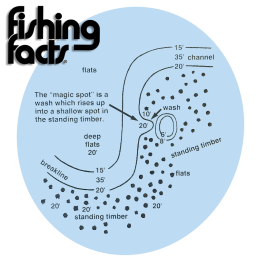
Here is an example. One day, I made a trip to one of the reservoirs in my state. This lake was about seven years old, a flatland reservoir with lots of brush on the drop-offs and breaklines, and plenty of standing timber in the upper end. It got a lot of play from the tournament pros. A local TV station had done a spot on a particular part of the upper reservoir, and the local bass pros in the film were seen catching bass right and left. I happened to recognize the area and decided to go and have a look around. I wanted to see if my guesses about local reaction to the TV show were correct. The illustration accompanying this article shows the so-called “magic spot.”
I arrived at the lake rather late, around 11 a.m. Tremendous cloud cover had been in effect from daybreak, but the sun was now burning it off and a bright, clear blue sky was starting to show through. I expected to see little fish activity. I figured that the fish had probably been up and moving like wild all during the overcast, but with it gone, I also expected the fish to be gone.
I talked to a couple of fishermen who showed me some pretty good fish from the morning’s efforts. Apparently, the fish had been active in the early hours but, as one of the locals put it, “Now they got lockjaw and won’t hit nothin’.” I headed for the selected fishing area and went to work, keeping my eyes open to see what other fishermen did.
You can be among the first to get the latest info on where to go, what to use and how to use it!
The thing that amazed me was the procession of boats to and from the “magic spot” shown on the TV show. All day long, big boats would barrel up into the area and slowly move into “position” (only three were close). The occupants would cast plastic worms for 30 to 45 minutes, and then z-o-o-m, it was off to another spot. During the entire day, I never saw a fish caught out of the “magic spot.” The place was a productive area and the fish did use it—the only problem was that the major migration of fish was over for the day. Since most anglers have only limited knowledge of fish movements, these fishermen didn’t realize that if any activity was going to occur again that day, it probably would be right at dark—and then, most likely, it would be very limited.
I worked the entire breakline on the bends of the submerged river channel all day. Occasionally, I would move over to the “magic spot” for a quick check (three or four casts), then it was back to trolling out on the breaklines. Every so often, I would pick up a fish down on the breakline into the channel, and I do mean every so often. In fact, for the day’s efforts, I got only four largemouth bass (over 14 inches), one 3-pound white bass and a 6-pound catfish that staggered into range of the Spoonplug. Obviously, the pickings were slim.
But as dark began to approach, I moved over to the “magic spot” and waited. It was almost pitch black when I had four quick strikes in a row. I landed two bass (about 6 pounds each); one threw the plug on the first jump, and I accidentally dropped the fourth back into the lake while getting the lure loose. This “movement” took all of six to eight minutes and then the party was over.
On the way home, it occurred to me that most of the lures being fished that day probably never passed in front of a fish. The fishermen were in the right place, all right, and may have been fishing in the right way (using plastic worms with a lead bullet sinker due to the brush), but they were not there at the right time.
For today, let’s ask ourselves the following questions: How are we doing in the exercise of calm, planned mental discipline while on the water? Do we stick to basic structure-fishing guidelines and basic presentation of lures, knowing that these procedures compensate for everything adverse, be it no movement, bad weather, bad luck, few fish, etc.? Do we have enough patience in our personal makeup? Or do we depend on “magic spots” and local hoopla for success?
MWO
SHARE THIS POST
Did you enjoy this post?
You can be among the first to get the latest info on where to go, what to use and how to use it!
