
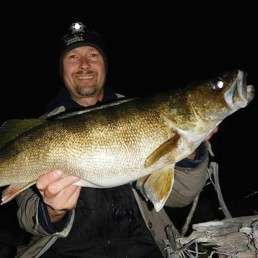
Night Fishing Is a Special Experience
As the afternoon light begins to fade, the sunset seems to set the world on fire, as the stars come out from across the lake. The view is like a painting that changes every hour.
We catch a couple of eating size catfish. But hopes are for the big guys that we know lie below the surface and only feed at night. The recent experience of an angler last week has us primed to catch some big fish. We did not have hopes of eclipsing his 130-pound blue catfish, but did hope to get something in the 30-pound class. Although we do not catch the big one, the experience of fishing at night is special.
Regardless of the species sought, catching fish at night takes changes in tactics as well as special care for safety. If you have the energy to stay up late, you just might find some of the best angling of your life.
The first quarter moon phase seems to be a good time. There is something about this first night light that tells fish to feed, feed, and feed. Shy daytime fish seem to become awesome predators in the darkness. Some people believe warm water temperatures raise the fish’s metabolism requiring it to eat more.
Clear water conditions are a plus. Water temperatures cool at night. Fish are more active in warmer water, but oxygen depletion in the hot water becomes a factor. The dissolved oxygen levels peak toward the end of the day, making fish more active.
Night makes forage fish more active. Free roaming bait fish move to the surface to feed on microorganisms that seek the fading light. Swarms of insects that emerge at night and rest on the surface also draw small fish. It creates a smorgasbord for the predator fish. For the efficient predator the cooler waters of nighttime are less stressful, and food is easier to find.
Night feeding fish take just about any bait normally used during the daylight hours. However, fishing baits can be a bit of a challenge.
During the day, one can see the underwater structure and weed beds. At night one must rely on a feel to find the same locations. Anglers must try to imagine the shape and harness of every piece of structure on the bottom by the way it feels when the lure strikes it. Total concentration is necessary.
When one can tell the difference between a stump and brush, between weeds and wood, and exactly what size rocks the lure is hitting, he is a night angler.
Humps are good locations for night feeding bass and other predators. These unconnected points are like submerged islands. Ones close to deep water are prime locations. Crankbaits and Carolina-rigged plastics work well on humps. The best way to work them is from the top down. If there is no action doing this, then position the boat on top of the hump and fish from the bottom up.
You can be among the first to get the latest info on where to go, what to use and how to use it!
Night fishing is also slow fishing. This means v-e-r-y s-l-o-w-l-y. To most anglers, slow fishing is still faster than most of the pros fish crankbaits and spinnerbaits. Most anglers try to set the hook the instant they feel the bite. In night fishing patience is important. Give the fish a chance to really grab it. Wait for the tension to really stretch the line.
Rhythm is also important. You cover more water if you forget the fancy twitch and jerk retrieves. Make effective use of those fan casts to cover all areas around the boat.
Safety is vital in night fishing. Begin before it gets dark. This allows your eyes to adjust to the dark. Doctors report that it takes about 15 minutes for eyes to adjust to the dark after exposure to bright lights.
Running and anchor lights are important. They must be visible from 360 degrees unless tied to the dock. Spotlights are not necessary, but they are helpful in navigation.
Wear a PFD (life vest.) The dark impairs your sense of balance as is your visibility. It is easy to trip over a rod, tackle box or some other object in the boat and fall overboard.
To minimize that risk, take only two or three rods for the technique you plan to use. Take only the baits you will need for this trip. Have both the rods and baits organized so that you know where they are and will not trip over them. Or perhaps worse yet, sit on them. Keep as few items as possible on the floor of the boat to minimize risk.
Predator fish are feeding machines. They will feed whenever possible. During the hot summer months, they are most comfortable feeding at night. Anglers too are more comfortable at night during the hot dog days of summer. Next to air-conditioned lakes, night fishing is the only way to go during the apex of summer.
If you want to try a different, exciting fish species or technique, you’ll find plenty of suggestions in every issue of MidWest Outdoors. Subscribe on our website.
MWO
SHARE THIS POST
Did you enjoy this post?
You can be among the first to get the latest info on where to go, what to use and how to use it!