
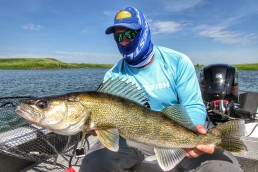
New Trolling Angles for Summer Walleyes
Trolling is an effective method. Jason Mitchell will help you in your pursuit of summer walleyes.
Tighter crankbaits
Many anglers think of trolling as incorporating multiple lines. In some cases, leadcore and snap weights are used to get lures to a desired depth. Inline planer boards are used to spread out lines. Several rods are in rod holders and line-counter reels are a crucial piece of equipment. If there is one overlooked use for crankbaits however, that situation would be in much tighter locations. Small spots that most anglers will either pitch, or run live bait through. In order to fish these locations by trolling, you must get much faster; you can do that by scrapping a line-counter reel.
Even during the hottest periods of the summer, I catch nice walleyes by running and gunning shallow locations that are windblown. Small rock points and fingers, weed lines and sometimes sand. The key, so often, is fishing through locations fast, as these locations are either feast or famine.
Expand your trolling this season by knowing when to troll with spinning rods. If you are in less than 12 feet of water, you can get in the water much quicker with just a cast.
Trolling isn’t rocket science
Over the last twenty years, anglers have become reliant on line-counters and dive curve charts. These are crucial, especially when over deeper water. For so many shallow locations, however, trolling isn’t rocket science. If you bow hunt, you know the difference between ten and 30 yards. If you need to troll back at 30 feet in ten feet of water, cast back 30 feet. By changing the equipment and getting confident in judging distance, you can up your trolling game, because that’s how you really speed up the process of getting in the water and fishing. You pull right up to the spot and it literally takes seconds to set up, versus minutes.
When you dramatically speed up the deployment process, you can more quickly and efficiently fish much smaller locations. A 50-yard rock reef might not seem like a very good trolling spot, but it sure can be when you pull up to it and start fishing in seconds.
When you get to the end, you don’t have to make a big turn to go back through (although I have caught a lot of fish over no man’s land). Simply reel up, turn the boat sharp and cast right back out behind the boat. Because you can get in and out of the water so much faster with spinning rods versus line counter reels, you can fish much more quickly through locations, and hit locations that were traditionally fished with other presentations. These same basic principles also shine after dark or on river systems.
You can be among the first to get the latest info on where to go, what to use and how to use it!
Quicker trolling yields aggression
Whenever you can find walleyes on shallow pieces of structure, this quicker trolling strategy shines. This strategy can also allow you to become much more aggressive when you are trying to hunt down fish. If you do have a 300-yard trolling pass, there might be three or four sweet spots that are high percentage. Instead of trolling the entirety of the pass, you can hop to the sweet spots and cherry-pick your best waypoints. If there are a couple of variables that ignite these shallow walleye bites through the heat of summer, they’re either wind or weeds. Of course, full moon periods after dark often produce stellar shallow water trolling.
Lures close to the boat
Especially over or along weed line edges, don’t be afraid to run lures close to the boat. If the fish will let you get away with being close to the boat, go for it. The shorter amount of line has a big advantage, because you are quicker to clean weeds off due to the nearness of the lure. Also, you’re in and out much quicker. Reel in and cast back out. As a rule, walleyes seem to be less boat shy as the water temperatures climb. I often find that I can drive right over the top of walleye in four or five feet when the water temps are over seventy-five degrees.
Boat mounts behoove you
Trolling with the bow mount also has some advantages, as you can turn sharp and speed up on your turns. When you’re moving slowly, boat control is easy-peasy. When you’re flying by at two and a half miles per hour, or even three miles per hour, it’s a little trickier. You must really know and understand the spot, and be alert.
How fast?
As a rule of thumb, I find that I catch more fish when trolling after dark if I slow down to 1.5 to 2 miles per hour. Come the dog days of summer, however, when the sun is beating down on you, pick up your speed and don’t be afraid to troll up to three miles per hour. I still find it amazing how effective changing the speed can be in changing the results of the day.
For more knowledge on fishing techniques you may not have tried before, check out the August issue of MidWest Outdoors, available now at the newsstand or by subscribing on our website.
MWO
SHARE THIS POST
Did you enjoy this post?
You can be among the first to get the latest info on where to go, what to use and how to use it!