
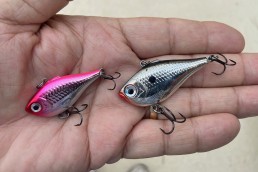
Mini Rattlebaits for Big Panfish
Dave Csanda finds small vibrating crankbaits to be great alternatives for catching summer panfish.
Anglers tend to associate crankbaits with larger freshwater species like bass, walleyes, pike and muskies, but they’re more versatile than that. The recent wave of downsized mini crankbaits also targets fish like panfish and trout. It began with insect and minnow imitations and now includes rattlebaits as well.
Mini rattlebaits like Rapala’s #5 and #6 Rattlin’ Raps are good examples. While good choices for gamefish during cold fronts or when experiencing fishing pressure, they are darned good for panfish all summer, cast, jigged or trolled. Crappies, white bass and even big bluegills respond well to their combination of commotion and small size. Internals rattles and vibrating bodies send out a cacophony of sound and vibration to alert fish to their presence at a distance. Upon closer approach and inspection, their lifelike profiles and paint jobs, action and flash trigger strikes, rather than gentle bites.
Versatile mini rattlebaits are good for casting, vertical jigging and trolling. Pitch one out, let it sink to the desired depth, and reel it back to the boat, be it just above weed tops or brush, or at the right depth level for suspended panfish. Vertically jig one on and off bottom, or in fact at the proper depth for suspended fish—typically at or slightly above the level of the fish. You can even longline troll them behind the boat for fish atop shallow structures or suspended just outside. Heck, you can even troll across basins for fish feeding relatively near the surface—particularly fish like white bass that are noted for feeding in packs, near or breaking the surface.
You can be among the first to get the latest info on where to go, what to use and how to use it!
While both sizes catch loads of panfish and larger species, if there’s any downside, it’s that the #5s are so tiny that white bass and crappies can gobble them down deep in their gullets, where the tiny, needle-sharp hooks can be difficult to remove to release fish. If so, stick with the slightly larger #6s, and save the #5s for bluegill applications where the fish’s smaller mouths tend to prevent them from swallowing the lures.
Looking for more ways to increase your catch rate? You’ll find plenty of suggestion in every issue of MidWest Outdoors. Subscribe on our website.
MWO
SHARE THIS POST
Did you enjoy this post?
You can be among the first to get the latest info on where to go, what to use and how to use it!