
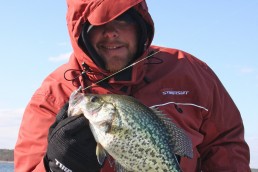
Late-Winter Crappies on Channel Bends
Winter crappies are seldom loners, so Tim Huffman says catching a crappie usually means repeated presentations to the spot will result in more fish.
In general, crappies migrate to deeper water as they cooled in early winter. The fish stay there until the water starts to warm in the spring. No matter the situation, they try to position themselves for feeding and survival.
Chasing crappies in late winter usually means tightly grouped fish that may be difficult to find, but that are packed in big numbers when you find them. Crappies are sluggish, but hungry and willing to take a bait placed in front of their faces.
Depending upon the region of the country, late-winter crappies are still deep. One spot they can often be found is on a channel bend. There is nothing magic about a bend in a creek or river, except that it’s something different to which a crappie can relate. A bend often has brush and little current.
Each bend is different, with some having a quick turn, while others have a long, slow turn. Contour changes can be sharp or gradual, bottoms can be hard or soft, and cover can be thick or absent. Each bend has characteristics that crappies do or don’t like; nevertheless, each bend is worth a close look.
Find and fish
Bends are easy to find with contour maps. Electronic maps are great but paper maps work, too. Simply find a channel on the map and follow it to a bend. It may be out in the middle of the lake, but often they’ll be in obvious places near a steep bank or where a bank makes a turn.
Use electronics to search the bend for cover and fish. Don’t waste time fishing low-percentage spots, but instead target ones with cover and fish showing on the graph.
Vertical presentations are usually best for fishing deep. The fish may be hungry, but slow-moving baits are important. Straight up-and-down presentations can include jigging and spider rigging. Jigging is done with one or two hand-held long poles. Holding a pole is an advantage for feeling light bites and getting a quick hookset.
You can be among the first to get the latest info on where to go, what to use and how to use it!
Baits should be placed in and around cover. Logs, brush and stumps are a few types of cover often found at a bend. Wood can float in during high water with currents pushing them into the bend, where they hang on other cover or stick in the mud. Dropping a jig or minnow in the right spot will lead to good results.
Spider rigging is a multiple-pole technique using long poles placed in rod holders in the front of the boat. A fisherman can use the state pole limit—usually two or three in the North, more in the South—to push baits. A fisherman using three poles, with two baits on each pole, is presenting six baits at different depths, so percentages for a bite increase. Slow trolling can be used to move along a bend or stop baits totally still in cover. Slow trolling is hard work but is a proven technique for deep fish.
Whether a fisherman uses one of the methods mentioned, or another one, it’s critical to properly present baits. Move baits slowly, then slow down some more. Be patient, but always on alert for a light bite. Stick with smaller baits until fish get more aggressive next month. When the bite slows down, try a different bait or color. Also, try moving to another spot for a while and then return when the fish have settled down.
Final notes
March can be a mixture of warm and cold weather. During long warm spells, some crappies may move up to shallower water, especially late in the month. At a bend, this may be just a short swim to a flat. The key for a fisherman is to watch for balls of shad. If shad are up shallower, the fish will be, too. Use electronics to find warmer water and telltale blips of fish.
A final tip is to use a scent product on your lures. The slower the presentation, the more important a good scent will be. A scent is important with jigs, but can help with minnows, too.
Don’t ignore channel bends; use a slow presentation and enjoy late-winter action.
Looking to make some special outdoor memories of your own? Get inspired by reading the March issue of MidWest Outdoors, available now at the newsstand or by subscribing on our website
MWO
SHARE THIS POST
Did you enjoy this post?
You can be among the first to get the latest info on where to go, what to use and how to use it!