
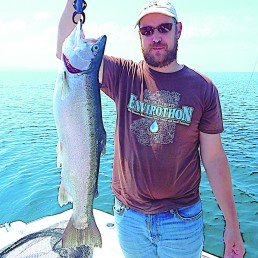
Lake Erie Stocking Enhances Sportfishing
On Lake Erie, several state and federal fish agencies, hatcheries and programs are working to enhance sportfishing opportunities and restore native fish species populations.
Steelhead trout, lake trout, lake sturgeon, brown trout, ciscoes, and sauger have been, are, or will be added to the lake to enhance or restore a more diverse fish community from one end of the lake to the other, on both the U.S. and Canadian sides.
Steelhead trout
The largest effort involves steelhead trout, hereafter referred to as steelhead, a popular gamefish stocked by Michigan, Ohio, Pennsylvania, New York, and Ontario into Lake Erie.
“Steelhead Alley” is the nickname or a 200-mile stretch of streams that go from Sandusky, Ohio to Pulaski, New York.
Since most of the warmwater streams along this section of Lake Erie are not ideally suited for reproductive success, annual stocking of smolt-aged fish is conducted by various fishery agency hatchery staff.
At that stage of their lives, if the timing of their release is on cue, smolts imprint on the stream where they are released.
If stocked too small, they linger in the streams; and if planted too late; they fail to imprint on the stream scent that will guide them back after they mature in 2 to 7 years.
Ideally, they will return to the site of their release to provide anglers with prime sport fishing opportunities when the fish mature and make their annual, but ineffective, spawning runs.
Michigan has long supplied steelhead eggs from the Little Manistee River strain to Ohio and other states to hatch and raise to smolts before their release.
Although Michigan has a very active egg collection effort that gathers eggs that go toward stocking many of Great Lakes streams, they only stock about 50,000-60,000 steelhead in streams leading into Lake Erie.
Places that receive steelhead plantings or attract runs include the Huron River, Paint Creek and North Branches of the Clinton River.
The others—Belle River and Mill Creek—are tributaries of the St. Clair River, and not Lake Erie specifically, because the fish could elect to go north into Lake Huron instead.
Other strains used in Lake Erie include Skamania, Chambers Creek/Washington, Wisconsin, Trout Run, and Shasta Lake strains.
The newest is the Shasta Strain that comes from California. Ohio began trying this one in 2021 in the Rocky River.
Pennsylvania stocks the most steelhead trout into Lake Erie, with a new goal of annually raising 1,000,000 in their renovated Fairview hatchery in Erie. They released about 800,000 into Lake Erie in 2024 and over 500,000 this year.
According to the Pennsylvania Fish and Boat Commission, the average stream steelhead caught is 23 to 24 inches long and weighs 3 to 4 pounds, but some over 32 inches and weighing up to 15 pounds are seen each year.
Streams noted for having the most steelhead are Elk, Conneaut, Cascade, Raccoon, and Walnut Creeks, but the fish are notorious for showing up unannounced in other locations due to losing their bearings. Others include Crooked, Four Mile, Seven Mile, Twelve Mile, Sixteen Mile, and Twenty Mile Creeks, Godfrey Run, and Trout Run.
You can be among the first to get the latest info on where to go, what to use and how to use it!
Ohio Division of Wildlife’s annual goal is to stock about 450,000 steelhead raised at their Castalia State Fish Hatchery, located along a section of Cold Creek as it passes through on its way to the Sandusky Bay.
Castalia has several spring-fed “Blue Hole” ponds where cold groundwater comes to the surface from a rich supply of underground streams.
Ohio streams stocked in 2025 included Conneaut Creek and the Ashtabula, Chagrin, Cuyahoga, Grand, Rocky, and Vermilion Rivers.
In their 2021-2025 steelhead stocking summary table, the ODW cites Shasta (USFWS-WV), Fish Lake (USFWS-MT), Little Manistee River (MI), Trout Run (PA), and “Mixed Wisconsin” strains being used.
They cite that steelhead in Lake Erie exhibit fast growth rates that allows them to reach 25-inches and 7-pounds in 2 summers.
The Cuyahoga River that empties at Cleveland has been dramatically cleaned up since the days before the Clean Water Act was enacted, when it routinely caught on fire due to oily pollutants that covered its surface.
Also, dams that blocked upstream passage for migrating fish were removed in recent years, opening the river to additional miles of spawning and nursery habitat.
Along with steelhead trout, lake sturgeon were also released into this stream in 2024 and 2025, with future plans to add sauger, another species that historically used this river for spawning.
Ontario also has a small role in stocking steelhead in Lake Erie, with about 33,000 per year added there.
Wheatley and Leamington are sites where open-lake trolling is popular during the summer, thanks to the cooler Detroit River flowage and high numbers of baitfish—a good combination for holding more steelhead close to shore than can be reached on the south side of the lake.
Stream fishing accounted for over 90 percent of steelhead fishing efforts on Lake Erie, but creel surveys are inconsistent between the jurisdictions, and open-lake harvests are the only measure of relative catch rate trends.
According to the 2024 Lake Erie Coldwater Task Group report, an estimated 26,637 steelhead were harvested in all jurisdictions combined lakewide by boat fishermen.
The breakdown included Ohio with 14,839 (56 percent), Ontario 9,378 (35 percent), Pennsylvania 2,039 (8 percent), and New York with an open-lake harvest of 378 (1 percent).
Other species stocked for sport or biodiversity
Pennsylvania is said to be stocking 163,394 brown trout in the lake in 2025. Native fish species being stocked in Lake Erie as restoration projects include lake sturgeon, ciscoes (lake herring), lake trout, and sauger.
You’ll find information on what’s happening in the world of fishing in every issue of MidWest Outdoors, available by subscribing on our website.
MWO
SHARE THIS POST
Did you enjoy this post?
You can be among the first to get the latest info on where to go, what to use and how to use it!