
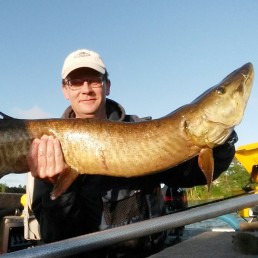
Jigging for Muskies Still Packs a Punch
In October 1977, I read an article in Fishing Facts magazine that forever changed the way I fished for muskies.
It was a piece called “Jigging for Muskies Pays Off” by the late, great Tony Portincaso. The system in general was also being made famous by legendary Wisconsin anglers like Steve Worrall and Gene Curtis. The lure was the “jig and creature.” It was cutting edge, deadly, and to this day, never gained widespread popularity in the muskie world.
It’s had a small, almost secret society of followers since the ‘70s, but most muskie guys feel the need to toss big lures. I think the tactic has even less chance these days as we live in a muskie world of even larger lures… giant lures! This system is the exact opposite of today’s enormous lure craze. But if you are willing to think outside of the box and believe that bigger isn’t always the answer, I promise that this will score you muskies (and probably some of the biggest walleyes of your life!) when other tactics won’t.
The system works from the muskie opener through turnover. For unknown reasons, and after fishing with it for nearly 50 years, its effectiveness drops off after turnover.
Today, the term “creature” generally refers to one of many soft plastic bass baits that is a trailer on a jig and looks something like a crawfish/frog hybrid species. The “Musky Creature” of the ‘70s got its name because the early inventors of the tactic were fusing parts and pieces of soft plastic bass baits together with hot knives and soldering guns. What they “Frankensteined” together were 7 1/2- to 8-inch lizard/Reaper/twister tail creations they called muskie “creatures.” These baits were all home-brew before 1977. By the time I got into the game, Worrall had his version of a creature, and Gene Curtis had the “Curtis Creature,” which featured a blade off the tail.
Both guys had special jig heads made with heavy-duty hooks and made a living in the ‘70s and ‘80s fishing “creatures” on Pelican Lake and North Twin Lake, respectively. They were consistently catching giant muskies on 7.5-inch soft plastics!
My first creature, and still my favorite, is the 7.5-inch Fliptail Lizard. Unfortunately, I don’t believe that they are made in the 7.5-inch length anymore. I heard that the company that bought out Fliptail has the 7.5-inch molds and may make them on special order.
Let’s get to what is available right now, starting with the 8-inch Reaper. These can still be found and work well with this system. Zoom makes an 8-inch Magnum Lizard. Another good-looking option is the Fish Lab Slam-A-Mander. Bait Rigs used to sell fabulous kits containing wedge-shaped jig heads and 8-inch Reaper Tails, which you might still be able to find on eBay. There may be others out there, but what you are looking for is a 7- to 8-inch lizard or salamander representation.
Jig heads should be 1/2- to 3/4-ounce. The hook must hold up to a muskie. Moore’s muskie jigs are still available. Violent Strike is also making a stand-up style muskie jig. There are also a lot of bass “flippin” jigs that will fit the bill for creature fishing. They should be jigs that are made to land on the bottom and remain upright. The hook eye should come out of the front of the head, so it doesn’t catch weeds. They should have a 5/0 to 7/0 stout hook.
The tackle for this system is simple. This is where we may lose some people. This is light-tackle muskie fishing. When this first started, Worrall and Portincaso were heavy spinning rod proponents. That’s still my favorite. Curtis was a bass flippin’ stick guy.
Both are still perfect, depending on what you prefer. But the bottom line is that this is heavy bass tackle, not muskie tackle. Back in the day, we were using 12- to 15-pound mono. I’ve switched that to 15- to 20-pound braid these days. At the business end, you need a light wire leader to attach the jig. I like single strand 0.012 coffee-colored wire to slice weeds.
You can be among the first to get the latest info on where to go, what to use and how to use it!
The system is so easy. There are no sore shoulders, no jerking anything, no heavy rods, no 1-pound plastics. Here is all you do: Cast the creature out and let it get to the bottom. Point the rod and the bait and wind two to four times quickly, stop! Watch the line. When it returns to the bottom, repeat. It looks like a salamander bolting from the bottom then returning to hide. It’s all reel. No jigging, no rod tip unless you are ripping it out of weeds.
The strike will not be a typical, violent muskie strike. Strikes will come when it’s falling back to the bottom. Watch the line! It will jump like a largemouth strike; or when you are waiting for it to return to the bottom, it won’t! In either case, set the hook and you are on. It’s a single hook, and a small lure, you will rarely miss one.
The skill is where you cast this jig. Muskies love deep weed lines in summer and early fall. There may be no better technique for dissecting every intricacy of a weed line than a jig and creature. Don’t make long casts. Use normal length casts to avoid plowing weeds.
Get your boat right on the weed line and work forward, finding that edge and working it parallel. You will get that feel where you made the cast and you got weeds. The next cast you make 4 feet to the right, still weeds. The next cast 4 feet to the right, and its coming in clean… That’s the holy grail. That’s when you are in the zone. The danger zone for that creature!
You can follow a weedline for hundreds of yards doing this, and you will be able to feel when you hit hard bottoms, soft bottoms, rocks, and you will even be able to distinguish weed types. You will go from coontail to cabbage and be able to feel it. I learned more about the lake bottom with a creature than I ever did with electronics.
Other great locations for the creature are mid-lake humps, rock bars, gravel points and clean flats. What I mean by clean flats are weed flats in early summer that have not completely grown in yet. In northern Wisconsin, this can be June and even early July.
Muskies will be all over these emerging weed beds in 3 to 10 feet of water.
It’s an open hook, but don’t be afraid of a little weed. This bait will bust through. The single strand wire will help cut through. I like the stand-up head because there is nowhere for weeds to catch on the eye. A creature busting out of a few weeds will trigger strikes.
It’s almost 50 years since I first read about jig fishing for muskies in Fishing Facts, and a lifetime of success with it since then. It’s such a deadly tactic that I want to keep alive for another generation. If you aren’t afraid to think outside the box, I can guarantee you that jigging for muskies pays off.
If you want to try a different, exciting fish species or technique, you’ll find plenty of suggestions in every issue of MidWest Outdoors. Subscribe on our website.
MWO
SHARE THIS POST
Did you enjoy this post?
You can be among the first to get the latest info on where to go, what to use and how to use it!