
Is the Ice Safe Yet?
For those wondering why it takes so long for ice to form, the reason is pre-existing conditions. Often this means the water in early winter is unstable and not cold enough when polar air arrives.
Water maintains one of the highest heat capacities of the naturally occurring substances on earth. So, when the air is bitter cold, and the water is not, water molecules have to release a considerable amount of energy to the environment. The process is gradual; the time needed for molecules to slow down and solidify. This takes consistent periods of below freezing temperatures.
The density of water is highest at 39.2 degrees Fahrenheit. Between 39.2 and 32 degrees, water becomes less dense and rises toward the surface, which is why a lake freezes at the surface. Mixing, caused by wave action or flowing (rising) water, is not good for ice formation, due to the specific gravity of water.
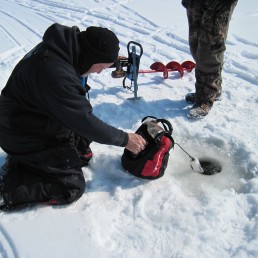
When the ice finally gets a grip, anglers began messaging each other for thickness measurements at their favorite lakes. Useful information, within reason, what kind of ice and where are we talking? You can never be sure of the actual conditions without checking with test holes.
Some scoff at waiting until the threshold thickness reaches 4 inches, thinking they can slip out way sooner. This thickness standard refers to clear ice, sometimes referred to as black ice. This form freezes faster, becomes stronger.
The Minnesota Department of Natural Resources (MDNR) suggests, “Four inches of clear, newly formed ice, may support one person on foot.” They are quick to add, “Twelve inches of partially thawed ice may not.”
Another comment mentions ice does not freeze uniformly. They make an excellent point here, wanting everyone to know, if you find shore ice a certain thickness, do not expect the entire ice sheet to be uniform out to where you want to go. Cutting one test hole at the shoreline is not enough.
A study at York University examined data concerning the quality of ice. The research suggested the quality of lake ice is changing with our changing climate, concluding the number of days with safe ice is decreasing per the average ice season.
You can be among the first to get the latest info on where to go, what to use and how to use it!
In agreement with MDNR findings, York University considered thickness a partial measure of safety for human activity. They too, recognized ice thickness as an indicator, not a stand-alone confirmation. Thickness needs to be supplemented with ice quality for a complete evaluation of ice safety.
Sapna Shama of the York University Faculty of Science, felt the quality of ice was, “equally important and potentially as dangerous as thickness…especially early and late in the season, when ice is forming or melting.”
Joshua Culpepper, leading the ice study, said lakes will be unsafe for longer periods of time if, “more white ice than black ice forms.” He expects white ice conditions to increase as climate temperatures increase.
The experts agree, measuring thickness is no longer a sufficient measure of safety. Ice quality can be checked when boring holes for thickness. Examine the uniformity of the wall, how clear or opaque is it? If you see pockets or layers of white ice, the experts say 4 inches under your feet is not enough. The load bearing capacity of white ice is less than that of black ice.
Some veteran anglers claim to get a feel for ice strength by how difficult it is to cut through. No matter you decide to do it, discretion is the better part of valor when evaluating ice.
For more insight and tips for fishing throughout the year, check out the articles in every issue of MidWest Outdoors, available by subscribing on our website.
MWO
SHARE THIS POST
Did you enjoy this post?
You can be among the first to get the latest info on where to go, what to use and how to use it!
