
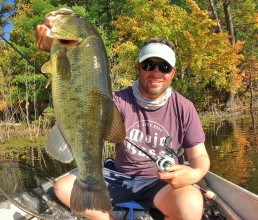
Indian Summer Largemouths
Northwoods guide Andrew Ragas says that Indian Summer provides some of the best bass fishing of the year.
Every fall, there’s always a week or two of disruptive weather delaying fall turnover and season’s progression. High-pressure systems stall overhead, bringing with them bright sun, heat and little wind. Sixty-degree water temperatures that should be cooling into the upper 50s for highs climb toward the 70s week’s end, disrupting fish activity and delaying autumn’s advancement.
Cooling weather in early fall undoubtedly triggers rapid and robust fish activity, driving largemouths to the lake’s deepest green weeds remaining. Warm weather oppositely drives them into the shallowest habitats available, making largemouth feeding and locations even more predictable until fall turnover begins.
Defining Indian summer
“Indian summer” describes an unseasonably warm and sunny patch of weather during autumn. It is typically caused by a sharp shift in the jet stream from south to north, producing calm, sunny conditions with above-average temperatures. Most years in Wisconsin’s Northwoods, it predictably arrives during the last week of September, often making this specific week through the first days of October one of the best trophy fish windows of the year.
By late September, water temperatures are on a gradual cool down. But Indian summer reverses the course. These warming water temps are prone to disrupting the ecosystem, dispersing largemouths throughout the lake.
Warming weather creates spikes in activity level and movements we normally wouldn’t see during autumn. Warm, sunny afternoons bring windows of high feeding activity.
A return to shore
Under these conditions, big largemouths return to the shallows where they take advantage of high forage abundance and activity of juvenile bluegills. Shade from the powerful sun, and cover for ambushing, are the necessary ingredients of these spots.
Weed cover and slop—By late September, shallower weed cover could still be dense, submerged or even topped out on the surface. Most weed habitats won’t be the healthiest and green-looking in appearance but are still capable of holding largemouths. Weeds growing atop the surface, nearby weed lines and lily pads become late-season factors.
Piers—On waters with shoreline development, largemouths utilize piers and boat lifts for overhead canopies and shade. Structures built from wood are better than metal and aluminum. Dock fishing aficionados take advantage of these final skipping, pitching & flipping opportunities of the year.
Wood—Wood cover in the forms of logs and laydowns are most prevalent on heavily-wooded natural lakes with little shoreline development. Near-shore wood extending to the primary break line is best. Bluegills are attracted to the wood for its heat conductivity. Fish cribs and brush piles submerged in shallows are also fish magnets.
Bushes and brush—These are my favorites to fish, and in my opinion hold the lake’s biggest largemouths. In high-water years, flooded bushes and brush offer a canopy of cover. When high water levels surge into these shoreline areas, they flood with big largemouths. The past few seasons, flooded buffer zones have become a focal point to most of my largemouth fishing.
Shaded shorelines—Shade is a common theme of each of these shallow-water habitats. Daylight hours and light penetration decreases in early fall, but high-pressure systems still make it intense. Largemouths position to avoid sunlight. Being in the shade allows them to go undetected by forage species.
You can be among the first to get the latest info on where to go, what to use and how to use it!
Depths of these near-shore regions are commonly 5 feet and less. Don’t be afraid to go shallow—even a foot or less. I can’t believe how many giant largemouths I’ve caught from inches-deep water.
Target shooting strategies
Attacking shoreline cover and habitats is best accomplished with skillful pitching, flipping and skipping strategies. The shallow-water fishing strategies require heavier rod and reel setups with braided lines.
For my target shooting, I work with a variety of St. Croix Rod options. In the heaviest impenetrable cover, I’ll choose my Victory Flip’N (VTC73HMF) paired with a 7:0.1 gear ratio Quantum Accurist 570 PT spooled with 50-pound Cortland Silent Flip, a silky smooth and quiet 16-carrier construction braid. This flipping setup is incredible, as is this throwback reel with flipping switch.
Commonly, shoreline cover won’t require a flipping stick. For all other presentations, my rods of choice are the Mojo Bass Dock Sniper (LBC70HF) and the Legend Tournament Dock Sniper (MJC70HF). At 7-foot lengths and heavy power, these rods can handle pitching, flipping, skipping and long-distance casting duties.
Black and blue 3/8- to 3/4-ounce jigs are synonymous with largemouth fishing, and are the only colors needed in casting, in both pitching and flipping head styles. Freedom Tackle FT Series structure jigs and flipping jigs answer the call. Secondary options are skipping and casting jigs hand-made by Super-K Jigs.
Pitching and flipping jigs in combination with craw and creature trailers such as Bizz Baits Bizz Bugs and Killer Craws, in black & blue and mud craw colors, are phenomenal. Don’t forget to additional creature baits that include YUM Wooly Bugs (bream), Missile Baits D-Bombs (superbug) and Berkley’s MaxScent Creature Hawg. Equip swim jigs with these same trailers.
In slop locations, surface frogs are the best secondary option. They are snag resistant and penetrate cleanly through all near-shore cover. Frogs and other amphibians come out for one last time of the year, too.
Recently, I’ve turned to Scum Frog’s Launch Frog and Pro Series, and Kalin’s Lily Stalker Frog. In my observation, largemouth bass are not particular over colors. Therefore, dark greens, maroons and blacks that contrast best work every time. Recommended frog gear and a personal favorite is the Victory Full Contact (VTC74HF), a 7-foot, 4-inch heavy-action model designed for slop fishing.
Beyond jig and slop presentations, flipping and pitching 4.5-inch tube baits (weightless or Texas rigged), and lizards such as 6-inch Gambler Bacon Rinds are deadly. You can also cast weightless Kalin’s Wac-O-Worms up into the shaded shore with spinning gear.
Taking advantage of the lake’s extreme shallows under these conditions and methods has produced some of my heaviest and largest northern largemouths to date, up to 7 pounds.
If you like fall fishing, you’ll enjoy the information and insight provided in the fall issues of MidWest Outdoors, available by subscribing on our website.
MWO
SHARE THIS POST
Did you enjoy this post?
You can be among the first to get the latest info on where to go, what to use and how to use it!