
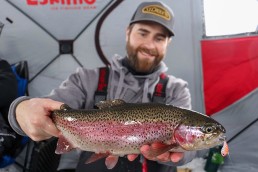
Icing Winter Trout
Blake Tollefson offers simple tips for fishing stocked trout lakes all winter long.
Panfish, walleyes and other gamefish receive the lion’s share of angling pressure throughout the winter months—mainly because they are so accessible. Some more neglected targets during the ice season include trout species usually associated with stream fishing—specifically rainbow, brook and brown trout. Fortunately for ice anglers, several states across the Ice Belt dedicate time and resources to ensure catchable trout opportunities are available.
Trout are stocked across the United States in a variety of lakes and ponds. They are worthy adversaries for any ice fisherman and offer a unique experience. Icing winter trout isn’t always an easy task, but the right combination of preparation, location, and presentation can lead to success.
The preparation
Preparation for winter trout starts during the open-water season—mainly in the form of tracking down prime ice locations. A lot of small, stocked lakes and ponds are unmapped or have significantly outdated bathymetric maps. Relying on current technologies can give you an easy advantage when the lakes are finally locked up in ice.
If the body of water is accessible during the warmer months, use a kayak or boat to do some preliminary scouting. For uncharted waters, a custom mapping tool can pay huge dividends during the hardwater season. These tools allow anglers to create a map of a body of water directly on their unit. Most of the major electronics manufacturers have this technology built in to their upper end models.
Google Earth is another valuable scouting tool for locating structure, cover or depth changes—especially in shallow areas or clear-water lakes. With high resolution, up-to-date aerial imagery, anglers can pinpoint locations that are ideal starting points. Document the coordinates of these spots and upload them to your phone or GPS unit.
No matter how you scout, investing some time in advance of the ice season can lead to more promising results come hardwater.
Location
Mobility is important for targeting fish species during winter—especially panfish. Trout, however, are a different animal; they are constantly on the move. A sit-and-fish of winter angling will often lead to more positive results—mainly because trout are so easily spooked. Since trout are so active, finding the right ambush point is one of the most important factors to winter trout success.
Being that trout are cold-water species, winter temperatures help kick their activity levels into high gear. While many species move deeper during the winter months, trout tend to move shallower. Trout can be found in nearly every area of a body of water. However, they tend to stay in the upper portions of the water column. They inhabit both deep and shallow areas and rely on numerous cover and structure types to track down their prey. Nevertheless, there are key areas that ice fishermen should put their focus on for increased success.
During lowlight periods, trout spend much of their time cruising shallow areas. It’s not uncommon to find trout in as little as two to three feet of water, especially at dusk and dawn. Shallow flats with nearby cover are prime locations to start the search. Areas adjacent to weed lines or submerged wood can create the ultimate ambush point, as trout are constantly checking these spots in search of their next meal.
During the day, trout tend to venture into deeper waters. Many stocked trout lakes are relatively deep, so locating suspended fish over 50 to 80 feet or more is typical. Focusing on structure-oriented locations, like points and steep breaks or drop-offs, will lead to more mid-day success.
You can be among the first to get the latest info on where to go, what to use and how to use it!
If preliminary scouting is not possible and the areas are unmapped, rely on shoreline features to help determine a location. For example, trees that overhang into the water can be an ideal spot to wait out some trout.
Regardless of depth and location, holes should be drilled well in advance of actual fishing time, so account for this in the schedule.
Presentations
Presentations for winter trout bear great similarities to those of winter panfish anglers. Any ice fisherman who spends time targeting panfish will likely have everything they need to get started trout fishing.
Light to medium-light rods pair well with winter trout techniques. Rods should be stout enough to effectively handle the baits and fish, but sensitive enough to detect bites.
Reels in the 500 to 1000 class are appropriately sized for winter applications. Due to harsh winter conditions, ensure the reel has a good quality drag system. Spool reels up with 3- to 5-pound fluorocarbon. Fluorocarbon line is preferred for these applications because of its nearly invisible nature and highly abrasion-resistant characteristics.
Panfish-sized lures are ideal choices for winter stream trout. Lipless crankbaits, spoons and small jigs all have their place in the lineup. Aggressive presentations, like lipless crankbaits, are effective at calling fish in a from a distance. For example, consider Eurotackle’s 1/16-ounce Z-Viber. Coming in at one inch in length, the bait features internal rattles and a free-swinging, single hook—which can be paired with a soft plastic or live bait for added attraction. The single hook keeps fish pinned, but also makes for quick and easy removal to get fish back in the water.
Sometimes, less-aggressive presentations are required to coax fish into biting. Small spoons and tungsten jigs tipped with wax worms, spikes or dead/preserved minnows (where legal) can certainly help close the deal. Because trout are constantly on the move, work your baits throughout the entire water column. Focus primarily on the upper half of the water column. Trout have no problem chasing a bait and will rise great distances to strike a lure.
On certain days, deadsticks or tip-ups can account for numerous trout catches. Set lines should be paired with light fluorocarbon leaders and small hooks. Bait selection is dependent upon forage base, but small crappie and fathead minnows are top choices for trout.
Trout provide anglers a nice change of pace when it comes to ice fishing. With the right planning, setting and tools, ice fishermen can surely put some trout on the ice.
Need that perfect gift for the outdoorsman? Give the gift of MidWest Outdoors by subscribing on our website.
MWO
SHARE THIS POST
Did you enjoy this post?
You can be among the first to get the latest info on where to go, what to use and how to use it!
