
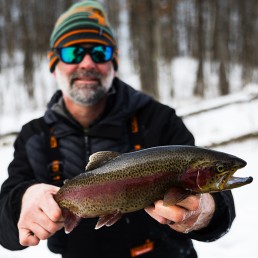
Ice Fishing for Trout
Species like rainbow trout, brook trout, and brown trout are located throughout the Ice Belt, but generally receive much less pressure than panfish, walleyes, and pike. While they’re accessible, it takes a little extra legwork to track them down. Trout are worthy adversaries for any ice angler and offer a unique experience for those who seek them out.
Plan of attack
Proper planning is important to success. In the modern age, anglers are blessed to have tools that take a lot of the guesswork out of the equation. Take onX Fish, for example. With just a few taps, users are provided with a map and list of lakes that have a history of holding trout. The app relies on actual fisheries data, so there’s no question on its legitimacy. Additional details like size structure and stocking history help narrow down the lakes you want to fish. Key features, like access points, land ownership data, and driving directions, ensure smooth navigation to and from the lake.
As for waters are unmapped or have significantly outdated bathymetric maps. New age mapping technologies like AutoChart or Quickdraw give anglers the ability to create maps on the fly. By visiting these areas in the offseason, anglers can create customized maps and pinpoint key structural elements that can pay huge dividends during the hardwater season.
An ambush point
When it comes to trout, movement tends to be a little counterintuitive. Despite common belief, fish are constantly on the move, and trout are no exception. In fact, they tend to move more fluidly and rapidly than many other species. Generally speaking, a more stationary approach will yield more promising results for winter trout.
Being that they’re a cold-water species, winter temperatures tend to kick trout activity levels into high gear. While many species move to deeper water during the winter months, trout tend to move shallower. Trout will utilize nearly any portion of the lake, but generally tend to stay in the upper portions of the water column. They can be found in deep water, shallow water, or anywhere in between. That being said, fishermen should focus on key areas to increase their odds.
During the day, trout tend to venture to deeper waters. Many stocked trout lakes are relatively deep, despite their overall small sizes. Trout often suspend over the deepest areas, like 40 to 80 feet. Structure-oriented locations, like points, drop-offs, and steep breaks, typically offer the best success.
During lowlight periods, trout cruise shallower areas. In some locations, it’s not uncommon to find them in a little as 2 to 3 feet of water. Shallow bays and flats near cover are prime locations. Weed lines and submerged wood in these areas can create the ultimate ambush point.
If preliminary scouting is not a possibility and the areas are unmapped, you can usually rely on shoreline features to help determine a location. For example, trees that overhang into the water can be an ideal spot to wait out some trout.
Regardless of depth and location, holes should be drilled well in advance of actual fishing time, so account for this in your schedule.
You can be among the first to get the latest info on where to go, what to use and how to use it!
An adequate setup
Generally speaking, if you target panfish through the ice, you’ll likely have everything needed to start trout fishing. Light to medium-light rods are well suited for winter trout techniques. The goal is to find something sensitive enough to detect bites, yet stout enough to effectively handle the baits and the fish. In my opinion, St. Croix Rod’s CCI Perch Seeker is the best rod for these applications. With a blank that combines both glass and carbon, it’s extremely lightweight, yet still has the properties to keep fish pinned.
On the reel side, functionality is the most important consideration. Due to the harsh reality of winter conditions, high-quality drag systems are instrumental. Typically, reels in the 750 to 1000 range fit well with winter applications. Spool reels should with 3- to 6-pound line. Fluorocarbon is a must-have due to its abrasion-resistant qualities and near invisibility in the water.
Lures of the panfish variety are great starting points. Everything from lipless crankbaits and spoons to small jigs or hair jigs all have their place in the lineup. I generally rely on the more aggressive end of the bait spectrum. Take lipless crankbaits like the Eurotackle Z-Viber, for example. Coming in at 1 inch in length and 1/16-ounce, the compact design is great for calling fish in from a distance. It features a single, free-swinging hook which is great for keeping fish hooked and makes for easy removal. In certain instances, subtler presentations are necessary to get bit. Tungsten jigs tipped with a wax worm or plastic and small hair jigs can close the deal when nothing else is working.
Since trout are constantly on the move, work your baits throughout the entire water column. Focus primarily on the upper half of the water column. Trout have no problem chasing a bait.
On certain days, deadsticks or tip-ups can account for numerous fish catches. Set lines should be paired with light fluorocarbon leaders and small hooks. Bait selection is dependent upon forage base, but small crappies and fathead minnows are top choices for trout where use of live bait is legal.
There’s no question that sonar systems are valuable tools for ice fishing—and trout fishing is certainly no exception—the advent of forward facing sonar technology has changed the game. With the ability to see great distances, its particularly advantageous in for trout, especially in shallow water.
Trout offer anglers a nice change of pace. It’s likely that most anglers already have everything necessary to get started. With the right planning, setting, and tools, ice fishermen can surely put some trout on the ice.
If you want to try a different, exciting fish species or technique, you’ll find plenty of suggestions in every issue of MidWest Outdoors. Subscribe on our website.
MWO
SHARE THIS POST
Did you enjoy this post?
You can be among the first to get the latest info on where to go, what to use and how to use it!
