
Get to Know your Neighbors
It’s that time of year. All the football games are over, the ice fishing has turned from cold to mushy, the kids are getting snarly, and the spouse is… well, never mind. The walls are closing in on you, there’s two feet of snow outside, and the in-laws are coming over all too frequently. If all this sounds familiar and you’re looking forward to Saturday because you can spend some time organizing your sock drawer, then it’s time for a change.
The key is that two feet of snow outside. Now is the time to begin planning for next fall’s hunting—whether it is for deer, turkeys, quail, partridge or whatever. Winters snow gives you an ideal way to observe elusive animals without having to have the animals immediately present.
Equipment is simple. Most people know that wearing many layers of clothing is better than one thick layer. These layers should be easy to take on and off as your exertion and heat levels change. I usually use four layers plus a vest. While it seems extreme, each layer is relatively thin, and I can instantly add or subtract so that I do not sweat, which is something you do not want to do in winter. If you are just bird watching, cross-country skis might suffice, but for tracking an animal over hill and dale and through brambles and briars, snowshoes or just good boots work best.
I always carry a compass and mini-emergency kit. On cloudy days, you can get lost, even in familiar woods, if your head is down watching tracks most of the time. While you might not have to survive for days in the woods, you never know when you might twist an ankle or something, and must keep warm for a couple of hours until help comes. A large garbage bad works as a dry seat. And don’t forget snacks and lots of water, as dehydration is as much or more of a problem in winter.
The other thing you need is a knapsack full of field guides. While your focus might be on a particular game animal, you should not ignore the many non-game animals and plants that make up the intertwined system of woods and fields. Knowledge about plants and animals that make up your area add additional enjoyment to your outdoor experience, and might even help you bag some game by being able to identify potential food sources.
I have five types of guides that I carry with me on my winter excursions: animal tracks, animal scat, weeds in the winter, trees in the winter, and birds. There are many good field guides, with the Peterson Series probably being the best known. The Stokes Nature Guide Series, while not as good on identification, is better on the natural history of the more abundant flora and fauna that you are likely to see when you’re afield.
Trees that you know so well by their leaves in summer are strangers in winter. Shape, bark and buds are the primary ways of identifying winter trees. Trees without leaves also give you a different picture of a forest. It is easier to see some of the relationships between trees and shrubs that are often hidden by the foliage of summer. You can begin to see a bigger picture of an area as to what grows where and the interrelationships between trees and the surrounding land.
Herbaceous plants also take on a new look in winter. Most people learn to identify herbaceous plants by their flowers. Fewer bother to learn these same plants by their foliage, and fewer still can name plants by their seed stalks. Being able to identify potential food plants in winter make it easier to predict where game animals might be next fall.
Animals also change in winter. During most of the year, it might appear that there are few animals around. During hunting season, we are often limited to a small area and therefore miss many animals. Also, many animals are nocturnal, and even those that are diurnal are safely hidden by the thick growth of summer.
In winter’s snow, we can observe the wanderings of many different animals without ever seeing the animals themselves. Old snow gives you an overall history of what is where, and even a rough count of the number of animals. New snow can give you an intimate look into the goings-on of a particular animal. If you find a fresh track, follow it backwards to see what the animal was up to during the night. Follow it forward, and you might find its daytime home.
Tracks only tell you the motions of an animal. Look for twigs and bark that has been gnawed to see what it eats. Rabbits cut twigs as if with a scissors, whereas deer tear twigs into jagged ends. An animal’s scat can also tell you what it is feeding on.
You can be among the first to get the latest info on where to go, what to use and how to use it!
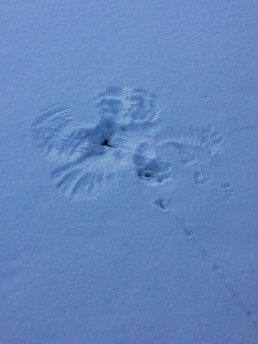
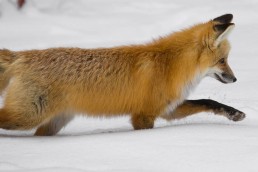
About the only way to “observe” an owl is to find an owl pellet at the base of a tree, or if you’re lucky, to find its wing prints made in the snow as it plummeted unto some fortunate or unfortunate prey. Tufts of rabbit fur tell you about the success of a coyote or fox.
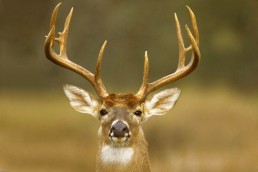
This is also the time to collect that trophy that you missed during hunting season. Bucks lose their antlers in late January/February. If you are observant and very lucky, you can take a 10 or 12 pointer home, or at least half of it, by shed hunting.
Another way to collect trophies is making casts of tracks with plaster of Paris. Materials are simple: plaster of Paris, thermos of water, spray shellac or spray plastic, mixing containers, cardboard strips about two inches wide and a foot long, a couple of paper clips, a spray bottle of water, plus a little salt and vinegar. The process is simple:
1) Look for a good track or tracks in soil or snow.
2) Clean the track of debris and spray it with shellac or plastic. If it is in snow and well below freezing, water will work. This second step is to solidify the track so that it doesn’t collapse when you pour the Plaster of Paris in it.
3) Place the cardboard collar around the track. Place this firmly into the ground or snow so that it is sealed all around the bottom. Mix the plaster of Paris as per the instructions (You may want to try this at home first to get the feel of it.) until it is smooth, like pancake batter. A few drops of vinegar slow the setting time; salt will speed it up, depending on how much time you need.
Pour the plaster of Paris into the collar, tapping it gently to remove any air bubbles. Place a paper clip at an angle into the plaster if you are planning to hang the cast. The cast should be set in 20 to 30 minutes, although cold condition can extend this to an hour.
4) When the cast is set, carefully cut it out of the soil or snow.
5) A mold can be made (so you have an exact replica of the sunken track) at home by coating the cast with a thin layer of petroleum jelly, placing a cardboard dam around the cast, and filling it with plaster. As the plaster hardens, place small eye screws in the plaster for hangers.
6) Once the mold or cast is set (about a day), touch up the surface with sandpaper and an Exacto-knife.
If winter is seeming endless, then it’s time to energize yourself and head out for a day in the woods to “see” more animals than you might otherwise encounter, and to get a jump on next fall’s hunting season.
Did you enjoy this post?
You can be among the first to get the latest info on where to go, what to use and how to use it!