
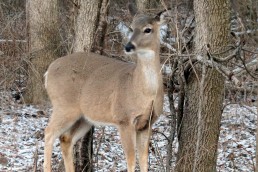
Hunting Winter Whitetail Deer
Don Gasaway gives reasons why late-season deer hunting can actually up your odds for success.
To the hunter willing to forgo some comfort, late-season deer hunting can mean opportunities not available earlier. For instance, there is a lack of hunting pressure. Gone is the opening day Johnny, who hunts only opening day each year and spends the rest of the hunt in camp. Gone too, is the guy who hunts for meat, because he has probably taken his deer. The less experienced hunter has usually gone home in frustration over the fact that it is more difficult to hunt deer than he thought.
Another benefit of late-season hunting is the experience of being in the woods when the snow falls. The snowscape of winter can be a joy to behold. Snow also means it is easier to track the quarry. In snow a skilled hunter can tell much from the tracks. Late season is the trophy hunter’s time to shine.
Old herd bucks have a very definite track that shows up vividly in snow. The old guys will walk with their front track angled 30 percent from center on the hind feet. In addition, he does not place his hind feet in the track of his front feet. When watching an old buck from a distance, it is easy to spot him from the way he walks. He looks like he is doing the shuffle. Does and young bucks are more graceful and spritely. The old buck cannot carry his neck and head the way a lesser buck or doe will do. The swelling of the adrenal glands in his neck, during and just after the rut, causes him to carry his head low like he is sneaking through brush.
Old bucks travel on their own trail and not on the herd trail late in the season. The herd trail is usually wide and well beaten down from extensive use. The old guy’s trail will seldom be 5 inches in width and not well traveled. It is used one way going to the feeding area and a different trail is used in moving from the feeding to bedding area. The buck’s trail also doubles as an escape route. Knowing this, the hunter can wait in ambush on each trail, depending upon the time of the day.
Deer move to feeding areas in the late afternoon and to bedding areas in the morning.
The weather just ahead of a front in the late season usually is cloudy and often snowy. Deer will feed heavily just before a front and tight after it passes. They will lay up for long periods of time, waiting for the front to pass. On a cloudy day, they will feed in the open and lay up in the edges of cover surrounding them. On the days of the really bad weather, they will head for the heaviest cover they can find. Such cover is the forest, swamps and sloughs.
You can be among the first to get the latest info on where to go, what to use and how to use it!
A light snow or drizzle will cause deer to move around a lot as they feed and bed down frequently during the day. This is most likely because as their fur gets wet, it loses some of its insulating capacity. They move to get water off the coat and to feed so that they can take in more calories to help maintain body temperature.
Late-season hunters are wise to not pass up small brushy or marshy areas in the middle of otherwise open country. The area may be only big enough to hide a single buck, but chances are he is a big one
Another spot for late-season bucks is the brushy tangles connecting one thick wooded area with either another brushy area, thick slashings in a clear cut, heavily wooded areas, flooded pond areas, or cedar swamps with heavy cover on the border.
Swampy areas in or near public hunting properties are often overlooked by hunters who do not want to take the trouble to explore. One can set up on some of the open game trails and lay in wait.
The late-season hunter willing to be imaginative and pay attention to detail will do well. He should not overlook a single patch of habitat. Hunters need to study the habits of their quarry and learn to recognize quality habitat when they see it.
If you want to learn more about prime hunting conditions, read the fall and winter issues of MidWest Outdoors, available by subscribing on our website.
MWO
SHARE THIS POST
Did you enjoy this post?
You can be among the first to get the latest info on where to go, what to use and how to use it!