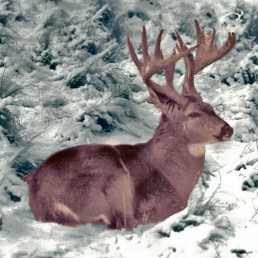
Hunting Whitetail Deer in Winter
As the snow whispers against my blind, it keeps erasing the tracks of my quarry. The cold is bone deep. But the snow is soft, silent, and cleansing.
Late season deer hunting is not for those less than fully committed to the sport. Weather conditions and fewer deer make for hard work. To a hunter willing to forgo some comfort, this time can mean opportunities not available earlier.
There is a lack of hunting pressure. Gone is the opening day Johnny, who hunts only opening day each year and spends the rest of the hunt in camp. Gone, too, is the guy who hunts for meat, because he has probably taken his deer. The less experienced hunter has usually gone home in frustration over the fact that it is more difficult to hunt deer than he thought.
Another benefit of late season hunting is the experience of being in the woods when the snow falls. The snowscape of winter can be a joy to behold. Snow also means it is easier to track the quarry with the most current sign. In snow a skilled hunter can tell much from the tracks. He can find the old herd buck that is often the wall hanger. Late season is the trophy hunter’s time to shine.
Old herd bucks have a very definite track that shows up vividly in snow. The old guys walk with their front track angled 30 percent from center on the hind feet. In addition, he does not place his hind feet in the track of his front feet. When watching an old buck from a distance, it is easy to spot him from the way he walks. He looks like he is doing the shuffle. Does and young bucks are more graceful and spritely. The old buck cannot carry his neck and head the way a lesser buck or doe will do. The swelling of the adrenal glands in his neck, during and just after the rut, causes him to carry his head low like he is sneaking through brush. Many believe that he is hiding his horns or smelling the ground in search of a doe that has recently passed that way. He could be but it is more likely that this way he is more comfortable.
Old bucks travel on their own trail and not on the herd trail late in the season. The herd trail is usually wide and well beaten down from extensive use. The old guy’s trail seldom is 5 inches in width and not well traveled. He uses it one way going to the feeding area and a different one in moving from the feeding to bedding area. The buck’s trail also doubles as an escape route. Knowing this, a hunter can wait in ambush on each trail, depending upon the time of the day.
Deer move to feeding areas in the late afternoon and to bedding areas in the morning.
Hunters who work with the fronts of weather that pass through improve their chances. The weather just ahead of a front in the late season usually is cloudy and often snowy. Deer feed heavily just before a front and tight after it passes. They lay up for long periods of time, waiting for the front to pass. On a cloudy day, they feed in the open and lay up in the edges of the surrounding cover. On the days of really bad weather, they head for the heaviest cover. Such cover is the forest, swamps, and slews.
You can be among the first to get the latest info on where to go, what to use and how to use it!
A light snow or drizzle causes deer to move around a lot as they feed and bed down frequently during the day. This is most likely because as their fur gets wets, it loses some of its insulating capacity. They move to get water off the coat and to feed so that they can take in more calories to help maintain body temperature.
Deer in populated areas take advantage of small islands of habitat often overlooked by hunters. Late season hunters are wise to not pass up small brushy or marshy areas in the middle of otherwise open country. The area may be only big enough to hide a single buck but chances are he is a big one
Another spot for late season bucks is the brushy tangles connecting one thick wooded area with either: another brushy area, thick slashings in a clear cut, heavy wooded areas, flooded pond areas, or cedar swamps with heavy cover on the border.
Hunters often overlook swampy areas, in or near public hunting properties. One can set up on some of the open game trails and lay in wait.
The late season hunter willing to be imaginative and pay attention to detail does well. He should not overlook a single patch of habitat. Hunters need to study the habits of their quarry and learn to recognize quality habitat when they see it.
With luck and having done the homework, the late season hunter probably stands a better chance of meeting up with that old master of the herd. Whether he takes him or not depends upon his ability with the weapon of choice. But that is the subject for another article.
Looking for some new hunting techniques to try this season? You’ll find plenty of suggestions in every issue of MidWest Outdoors. Subscribe on our website.
MWO
SHARE THIS POST
Did you enjoy this post?
You can be among the first to get the latest info on where to go, what to use and how to use it!