
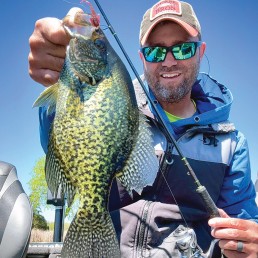
How I Learned to Fish Crappies
As waters warm and stabilize, crappies orient to emerging weed edges. Fresh weeds attract life—small minnows, insect larvae, and other forage species gather in the green cover. They follow the food, which in this region usually means cabbage weeds. As weed growth expands, crappies push farther out, often gathering in shaded pockets formed by cabbage or coontail. These darker lanes and canopy edges provide security and concentrate baitfish, creating natural feeding corridors.
Post-spawn crappies initially make small moves, sliding out of spawning habitat and positioning along the outside weed line, where they often hold for much of the summer. They may venture shallower during low-light periods like sunrise and sunset. As they move deeper, pitching jigs or using slip-bobbers can become more effective than traditional bobber rigs.
In waters lacking significant weed growth, crappies adjust by relating to submerged wood, stumps, or rock extensions tapering from shore. Rock protrusions that form inside turns or small cups give them an advantage over roaming baitfish, funneling forage, and allowing them to ambush rather than chase.
Lessons from Dad
Fishing with my father taught me patience and quiet presentation. We used 12- to 14-foot cane poles, monofilament line, and a small bobber. Our go-to was a 1/16-ounce feather or rubber jig tipped with a fathead minnow—ideal for this style of fishing.
We drifted slowly, lifting the jig ahead of the bow so it settled naturally into the strike zone. Often, the bobber disappeared before we were several feet past the spot. Dad emphasized watching closely and reacting without hesitation.
What I remember most was the quiet. No banging lids. No sudden movements. Boat control mattered then, just as it does now. Those mornings shaped how I approach crappies today.
Distance and stealth
Modern rods make life easier, but the principle is unchanged. I use 12- to 14-foot spinning rods with lightweight reels and 4-pound-test monofilament. Longer rods allow precise placement while keeping the presentation away from the boat.
In clear water, crappies spook easily from hull shadows or noise. Distance and stealth are critical. Some anglers prefer fluorescent line for bite detection, but I stick with clear monofilament; it’s less visible and more effective in bright conditions.
You can be among the first to get the latest info on where to go, what to use and how to use it!
Rod holders help maintain distance and steady presentation during slow trolling or easing along weed edges. One detail many anglers overlook is depth. Post-spawn crappies often suspend off the weeds. Keeping your bait roughly halfway between the surface and bottom usually intercepts them. Fish too deep, and you’ll miss these suspended biters entirely.
Casting the edge
Casting remains highly productive. Position the boat just outside the weed edge, and cast a small jig and minnow into pockets or along inside turns. A 6 1/2- to 7-foot spinning rod with a lightweight reel works well.
Plastic- or rubber-bodied jigs sink slowly, giving crappies extra time to inspect the bait. A 1/16-ounce jig is usually ideal; heavier baits drop too fast, missing suspended fish. Jig color matters, too. Yellow with a red head offers contrast, while white or blue can shine under low-light conditions. Observing shade and adjusting accordingly often makes the difference between bites and blanks.
Common mistakes
Common issues include fishing too close to the boat, moving too fast along the edge, using heavy jigs, and ignoring light and shade. Slow down, watch your depth, and respect cover; that’s often the difference between catching and missing fish.
Technology and tradition
Side-scan technology helps locate weed edges, inside turns, and suspended schools of crappies. Modern electronics can make finding schooling crappies along weed lines much easier—and once you locate one school, there are often more nearby.
Electronics are helpful, but they can’t make crappies bite. No screen replaces boat control, quiet movement, and understanding seasonal behavior. Success still comes down to patience, positioning, and presenting naturally. These principles remain unchanged from those early days with my father: Find the food, fish the edges, stay quiet, and let the presentation do the work.
You’ll find plenty of helpful summer fishing tips in the summer issues of MidWest Outdoors. Subscribe on our website.
MWO
SHARE THIS POST
Did you enjoy this post?
You can be among the first to get the latest info on where to go, what to use and how to use it!
