
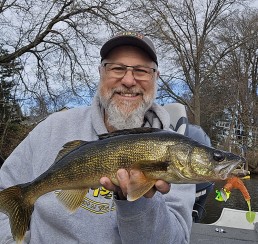
Hot River Walleye & Sauger Action
River rats know that this is the month for hot walleye and sauger action on most every river in the Midwest. All the big rivers will be giving up hawg fish as well as limits for anglers in the know. I’ve fished them all over the years: Illinois, Detroit, Wisconsin, Mississippi, Menominee, Oconto, Peshtigo and St. Croix. While fish spawn in these rivers at different times due to their locations, they all hold fish that approve of these hot baits and techniques!
Of course, vertical jigging with minnows works great, but here are some other lures and methods you should give a try this month.
Crankbaits
Top walleye cranks are either minnow-shaped or shad-shaped, but don’t be afraid to try a big, fat, bass model either. Crankbaits should land softly so they hardly make a splash. Cast right up to the edge of the shore, since walleyes will sometimes get super shallow—especially at night, which is prime time! At night, thin-profile minnow baits really shine for shore anglers and waders.
A longer spinning rod spooled with 10-pound Fireline, with a 10-pound fluorocarbon leader, allows you to get the most distance with your cast from boat or shore. A stop-and-go, fast-and-slow, twitch-and-pause retrieve is great during the day, while a slow, steady retrieve is preferred at night. If you put too much action on the bait after dark, an attacking walleye or sauger might miss it.
Trolling cranks work great, too. I’ll troll upstream with Berkley Flicker Shads, Salmo Hornets and Cordell Wally Divers. At night, be extra stealthy and use a thin minnow-imitator like an original floating Rapala.
Blade baits
Thin, metal wobblers like BFishN Tackle’s B3 Blade and Wolf Tackle’s Big Dude have been staples for river rats for decades! They cast like a rocket and sink like a rock. You would think that this would spook shallow walleyes, yet it seems to attract them. Blades are reaction baits; fish have a split second to react to them. They resemble a fleeing baitfish in both size and shape; fish choose to attack. If you’ve never tried one, pick up a gold-colored blade; you can’t go wrong with gold.
Never tie directly to a blade bait. Some models have three attach points or holes at the top (which give wider or tighter wobbles), and it is best to use a snap on top to prevent line cutting. I use a 10-pound-test, hi-vis braid tied to a small swivel, with a three-foot leader I make from a 14-pound-test Trilene XT line tied to a snap. To prevent snags in stumps, fallen timber or rock bottoms, cut off the front barb of the front hook. This definitely keeps snags to a minimum and doesn’t affect the hook-up-to-fish-catch ratio.
Skipping is a shallow-water trick that I like to employ on blades or any bait I’m fishing. A sidearm cast low to the water, made with a snap of your wrist, gets the lure to skip along the surface, which resembles fleeing bait. Couple that with a fast-moving reaction bait and blammo…fish on!
A slow, steady retrieve of a blade is most popular, but you should also vary with a stop-and-go and a high-speed retrieve. I also like to pull the blade up with a fast rip of the rod, followed by a slow reel to pull up the slack. In the boat, I’ll vertical jig it, troll it slowly forward or slip downstream, jigging periodically until I figure out what works best.
You can be among the first to get the latest info on where to go, what to use and how to use it!
Ringworms, paddletails, swim baits
Longer-length plastics have grown in popularity over the old faithful, jig-n-twisters in the past dozen or so years. I’m sold on BFishN Tackle’s AuthentX Moxi and Pulse-R plastic. They have a lot of thump, vibration and attraction, and walleyes really slam them, especially in rivers when the water is cold.
The retrieve is heavily affected by the weight of the jig. A heavier weight allows you to drag or grind the bottom. Heavy weights also work for rip-jigging, which is a rip of the rod, followed by a pause.
With a lighter jig, you can cast slightly upstream and let the worm tumble down in a controlled drift on a tight line. This is usually my preferred way of fishing AuthentX Ringworms. I’ll use a jig just heavy enough to tick bottom once-in-a-while. Since there are different current speeds in different sections of the river, I have three or four rods rigged with different colors and styles of Ringworms and Paddletails on different weight jigs. Then it is just a matter of refining the presentation of weight, color and style.
Dubuque rig hacks
Dubuque, or three-way rigs, consist of tying your main line to a three-way swivel, and then to a heavy jig on bottom and a lighter jig trailing off behind. You can use two jigs with minnows the way the old timers have always done, or you can mix things up.
I’ll put a large AuthentX Moxi on my heavy jig and run a Ringworm off the lighter trailing jig. Sometimes, I double up by adding minnows to the jig-n-plastic combos. I’ll even run a Rapala floater as a trailer or a deep-diving crankbait instead of the heavy jig.
You can pull a Dubuque rig upstream or downstream, or run across a wing dam on the Mississippi River. There are so many options and tweaks with a modified Dubuque rig that I’m surprised that more anglers don’t rely on this option more often.
The time to hit the river is right now! It’s when the biggest walleyes and sauger are actively feeding, and you’ll catch the trophy you’ve been dreaming of—or at least get dinner!
Looking for some new fishing techniques to try this season? You’ll find plenty of suggestions in every issue of MidWest Outdoors. Subscribe on our website.
MWO
SHARE THIS POST
Did you enjoy this post?
You can be among the first to get the latest info on where to go, what to use and how to use it!