
Hedging Your Bets on Eastern Lake Erie
While walleyes, bass and yellow perch are the primary targets, the eastern Lake Erie offers a variety of fish not often found in the west. Unlike the shallow Western Basin where depths average about 24 feet, and the Central Basin where the average depth runs about 60 feet, the water gets deep fast in the Eastern Basin. Within a 30-minute ride from Dunkirk or Barcelona, you can be in water in excess of 120 feet, adding target species that go for the colder, deeper zones. That includes steelhead, lake trout, and king, pink, and coho salmon.
Jim Brauer operates Bend-a-Rod Charters in western New York. He runs a 20-foot Lund powered by a 115 hp Yamaha. When we fished in August, it was hot and sunny; thankfully, he also operates with a bimini top when needed. Jim’s serious about putting his customers onto fish. That’s why he hedges his bets by spreading lines out with trolling boards, which virtually all trollers do. Brauer uses individual boards instead of large double-boards attached to a mast. When working off a 20-foot platform, simplicity is key to a good day on the water, and running multiple small boards is easy.
“You have to modify what you’re doing to create your best scenario,” Brauer said, reciting the surface temp of 75 degrees from his Lowrance screen; and a list of fish he was looking at, and what depths they were swimming at. He then figured out how much leadcore and monofilament line to put out on a pair of small boards on either side of the boat. “It’s about a football field, give-or-take.”
Brauer ran a program to cover all his bases with a pair of boards port and starboard, each running between about 45 and 50 feet deep in 75 feet of water. Those numbers could be readily adjusted based on fish he sees on-screen. On those lines, he offers of Spro Yaleye crankbaits, trolling between 2.1 and 2.2 mph. And from the outside in, more boards.
Straight off the transom, he runs a pair of Dipsy Divers about 145 feet from the boat at whatever depth needed, based on where fish are marking on-screen. This day, it was about 40 feet deep. And although Yaleye lures are consistent performers, on this pair of Dipsys, Brauer runs worm harnesses. On some trips, he runs a full three rods per person, which could mean a dozen lines in the water.
“That’s not a lot; it’s not too much,” Brauer said. “It’s keeping the boat straight and having customers in the boat that know what they’re doing. If we get tangled, it’s no big deal; we just untangle and keep on going. That’s why everybody has 14, 15, 16 rods on a boat. I’ve got two sevens, two eights, and two Dipsy rods.
If I was on a charter, I’d be running a six, eight, ten. And on this side, I’d run a five, seven and nine, because that way, I have the entire water column covered. But because I just fished the other day, I know what’s hot right now and what’s not. So, I took those rods off the boat. Other than that, we’d be tripping over rods on this boat.”
Mostly, Brauer’s clients hope to land walleyes. And they do, with a steady diet of 18- to 20-inch fish, to the occasional 22- to 24-inch fish or larger. On this trip, fish ran the gamut from 18 to 24 inches, all coming on a combination of crankbaits and worm harnesses. There are a handful of throwbacks too small to keep, but a great sign for the future. After four hours, the box was full with a limit.
Occasionally, Brauer said, a steelhead or lake trout comes aboard. But in eastern Lake Erie, like everywhere, trout and salmon are found mostly in deeper, cooler waters.
“They can make feeding forays above the thermocline,” said New York DEC fisheries biologist Jason Robinson, who leads the Lake Erie fisheries unit. “But when we’re setting our nets for lake trout, we tend to target waters that are 50 degrees or lower for our surveys.”
He said that, while lake trout are wide-ranging, they tend to stay in the east, occasionally making runs into the Central or Western basins of Lake Erie, where they delight walleye anglers. And they get big.
You can be among the first to get the latest info on where to go, what to use and how to use it!
“This is a world-class lake trout fishery. You can catch a lot of them, and they get really big, Robinson said. “The state record comes from Lake Erie, at 41 pounds, in Chautauqua County.”
And that’s why Captain Jim Steel, who operates a 31-foot Tiara out of Dunkirk, often drops a few lines off downriggers when he’s walleye fishing. While Dreamcatcher Sportfishing targets mostly walleyes, clients are never sad when they hook onto a massive lake trout or a big steelhead.
Before setting up, Steele sends down a FishHawk probe on a downrigger to check water temps, which he’ll use to set trolling speed. He’s looking for warmer water for walleyes. On this day, the surface water was 76 degrees under the hot sun, but just 30 feet down it was 44 degrees. He’s really looking for 60 to 62 degrees for walleyes. He ran about five miles offshore, heading east from Dunkirk.
Like Brauer, Steel covers all the bases with boards and flatlining Dipsys. But in addition to running baits at various depths with boards on both sides, he’ll drop a couple lines running deep, with 16-pound lead torpedo weights. The master plan has been set in motion: trolling for walleyes, steelhead and deeper, cold-water lake trout.
Keeping an eye on the screen, Steel adjusts bait depths on rods. Like Brauer, he runs shallower baits on the outside rods, so that when a fish is hooked, it can be reeled in without disturbing the deeper lines running toward the center of the boat. Shallower lines on the outside, Dipsey Divers toward the inside, and downriggers directly off the transom on either side. All bets are covered.
Steel locates prime water and while sets up. And then the catching begins: a 24-inch walleye on an orange Bay Rat bait. A couple fish on pink and purple Yaleyes. And then finally, as my friend Dave Figura and I were hoping for, a mind-blowing hit on one of the downriggers. The tip of the rod was nearly in the water.
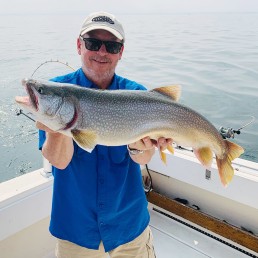
After a 15-minute tug-of-war, Steel leaned down and netted a 25-pound lake trout. While I will never disparage a walleye, there’s nothing that compares to pulling in a lake trout from 100 feet of water, from a hooking distance of 300 feet or better. By the time he leaned in and netted it, my arms were like jelly. It was big, meaty and beautiful. We snapped a couple photos and released it.
Having fished with two captains who cover all the bases, it’s likely that if you fish with them or follow their programs, you’ll catch fish in eastern Lake Erie when you hedge your bets with various baits at various depths. And according to Steel, when it comes to trolling baits in deeper water, color isn’t the main factor due to low-light conditions. Action and sound account for attraction, he said.
Thinking of trying a new fishing destination this year? You’ll find plenty of suggestions in every issue of MidWest Outdoors, available by subscribing on our website.
MWO
SHARE THIS POST
Did you enjoy this post?
You can be among the first to get the latest info on where to go, what to use and how to use it!
