
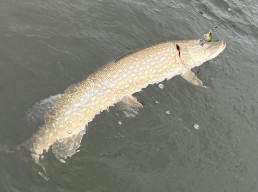
Winter River Rockets
It was an unusually calm and quiet winter morning. I could hear the tickle of the twitch bait’s rattles as I worked it slowly, with short tugs and pauses, in the cold river below. Then suddenly, a louder rattle, though not from my retrieve. There was just slack, and I knew what happened: Another river rocket had slurped in the bait! The fight was on, and soon a fat, healthy river pike was surging under the kayak.
Winter pike are loads of fun, yet like most Midwesterners, I’ve tended to see winter fishing as a hard-water sport requiring an auger and tip-ups. I’ll always love the excitement of tip-up flags popping, but many winter weeks, other than very far north in our region, haven’t had much safe ice in recent years, and my days of enjoying the thrilling danger of 2 inches of iffy ice with slush on top are past me now. When ice conditions are weak, give me the thrills of a kayak or small canoe on a cold river instead.
Some in the upper Midwest may only have this opportunity in early or late winter, but it can still offer great fishing during those otherwise discouraging lulls without good ice. So, for those of you who haven’t tried this underrated and exciting winter pike approach, here’s a primer.
First, keep common sense safety precautions in mind, which are far more critical in winter. I’m fortunate that, after decades of small-river fishing, my first complete capsizing and lost gear catastrophe was in summer, in water where I could stand up. I had grown complacent—not even a dry box secured for keys, phone, and wallet. And I commonly stood to fish in even questionable situations, believing I was gifted with Ninja balance after lots of experience with river obstructions over the years. I was dead wrong, of course, and probably a goner had it been in a winter river situation since I was far from my vehicle or help.
That mishap was in a canoe without the solid, tip-resistant design of my kayak’s hull, which is now my preferred winter river vessel. So, a stable vessel is best. Also, despite the sore back and hips after enough hours, stay seated. You can always go ashore to stand up a bit for relief. Of course, the best clothing possible, including safety flotation, is advised; I have a float-coat I’ve been getting used to despite its bulk, to make myself wear flotation, since I otherwise tend to not wear it, foolishly, even in winter.
Choosing suitable conditions for winter river fishing is as important as the gear, though. I’ve tried it in below-freezing temps enough times, with sufficient headaches, to not bother anymore, including broken reels and rods from freeze-up issues, and no doubt more danger, though I fortunately didn’t have any major mishaps.
Well-above freezing, but after a hard, cold snap, still may not be wise, depending on particulars. Most notably, at least on small rivers, are floating ice chunks—some of them more like icebergs—depending on the prior freeze- and break-up. I’ve fished in this situation some and gotent away with it simply due to dumb luck, though I found out how floating ice can pin you in a bad position. I’ve been able to claw my way over it, dragging the kayak over the top while staying mostly seated, but it’s not a reliable strategy to keep on fishing fish to a ripe old age.
In any case, use your common sense and it’s every bit as safe as most other outdoor pursuits. Don’t let these words of caution deter you from trying it.
During winter, river pike locations are generally similar to the rest of the year, though with some differences. They’ll avoid direct, stronger currents all year, but the brisk sections that may still hold them in summer, at least in tight holding spots adjacent to the flow, are very unlikely to hold them in the coldest months. They don’t want to navigate fast water to set up in those places. So, sustained slower sections, ideally with outside bends for depth, are the prime areas, and usually feature downed timber on small rivers.
You can be among the first to get the latest info on where to go, what to use and how to use it!
I had been too fixed on those areas a long time, though, only to discover that, at least on rivers with good pike populations, there are still pike in relatively shallow-cover areas as long as they offer little to no current. It was tough to get my mind thinking of pike in 1 to 2 feet of river water in December or February, but it happens consistently. Wide, flat, slow river sections that don’t look very appealing can still have nice pike behind logs or whatever cover is there; often, it’s small, washed-out depressions adjacent to wood deadfalls. So at least cast to these ambush spots when passing through on your way to deeper areas.
Probably the best winter pike fishing in rivers is during late winter as they move and stage before spawn, which is earlier in the spring season than any other gamefish. Pike tend to congregate adjacent to or just downstream from spawning areas such as incoming creeks that have marsh estuaries. But the optimal situation is a dam, such as a mill pond dam on a small river, where pike collect in the best areas below it during their pre-spawn wanderings. Not necessarily immediately below it, depending on current strength and features, but within a mile or two downstream.
I’ll bet that most of a given river section’s pike population will congregate in areas like that in late February into March or April. On a strong fishery, it can seem like practically every decent holding spot in a prime stretch has a pike. Talk about fun! There’s exciting suspense with each and every cast if your state’s pike season is open part of this time.
What baits to cast? In my experience, there are noteworthy differences from the rest of the season. Granted, successful lures at any time of year can be a self-fulfilling prophecy since we end up using them the most. But hands-down, for me, has been suspending minnow or twitch-bait type lures worked in very slow, twitch fashion. More buoyant baits that float up when paused, especially rapidly, get nowhere near the response as a lure hanging there in a neutral balance between tugs.
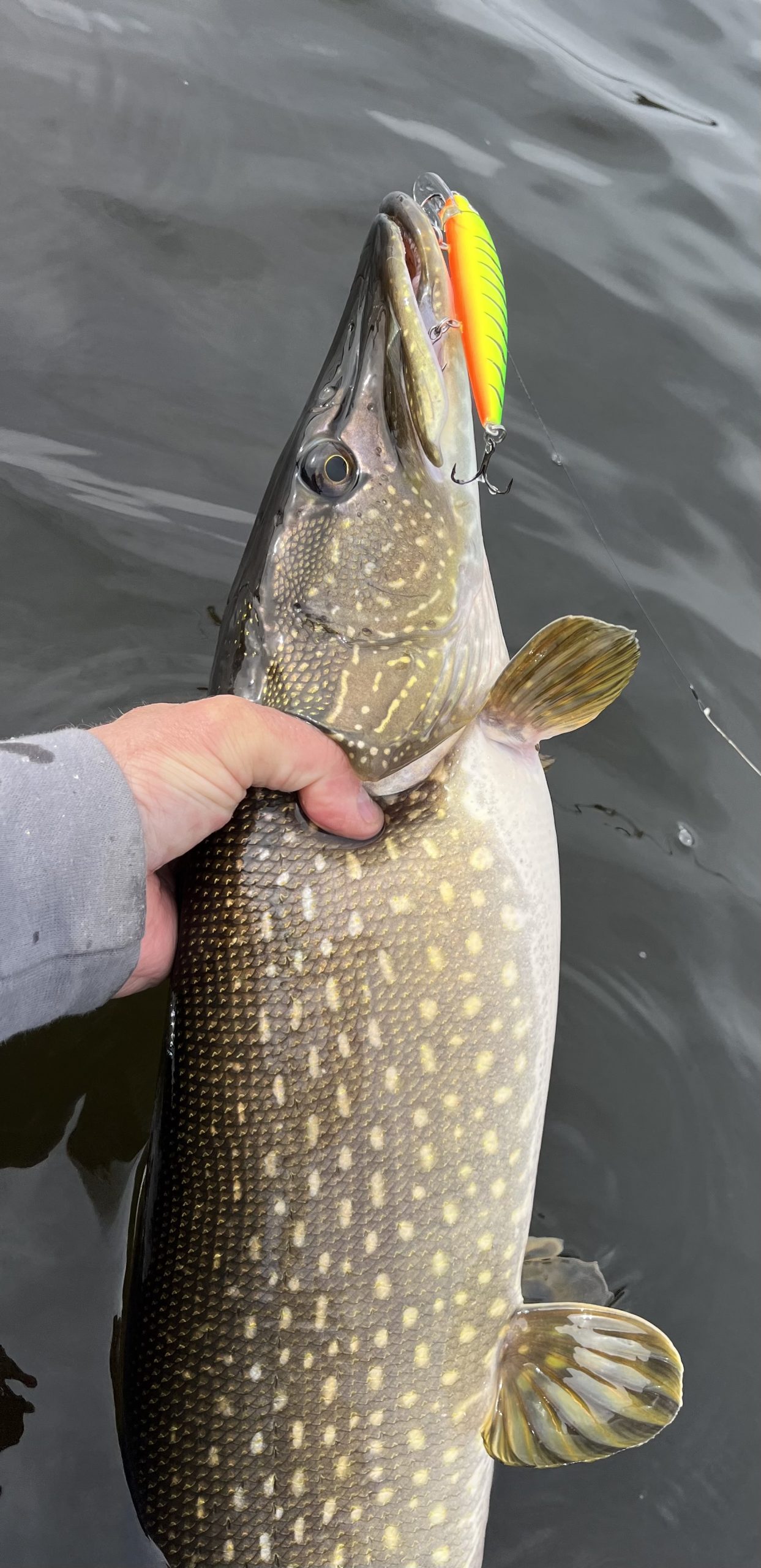
Pike display more activity than most species during winter, but all fish are cold-blooded creatures, with cold water requiring nowhere near the caloric needs of the rest of the season. So, it’s trying to present the easiest opportunity, the most nourishment for the least energy exertion. It’s probably why tip-ups work well ice fishing, even with dead baits.
I bring other offerings that work well on a slow retrieve at a consistent depth: Thin, salmon-type spoons; lightweight, in-line spinners, ideally with a larger fly-like bucktail section: and soft plastic jerk shad baits rigged weedless without added weight. However, changing to these at times has rarely matched the results of suspending minnow baits, for me at least.
Another part of the reason for the success of suspending baits is that you can cast them upstream of a key spot, say a log jam, and let them float down into the strike zone. Trying to hit it closely on a precise cast brings more snags and may disrupt a quiet lair too much with a loud “plunk” that pike usually don’t like in cold, serene waters. The other mentioned baits work well when retrieved slowly, but they still sink, so you must keep them going forward at least somewhat. They’re not as easy to get into the right position as a neutral-buoyancy bait coasting into the zone. As mentioned, there is a fun sense of anticipation to suspending bait suspense!
Well, there really isn’t a lot more to this “fun and simple” winter fishing alternative when the hard water season is stalled. Please release the better female pike—the future of our pike fisheries. But taking a couple eating-size fish, preferably males without the swollen torsos of the females in winter, doesn’t harm a good fishery, and they’re tough to beat for a fresh fish fry after a chilly day on the river. Be safe when you launch out after some river rockets this winter!
Did you enjoy this post?
You can be among the first to get the latest info on where to go, what to use and how to use it!
