
Up North Bassin’
You must be from Wisconsin if you know the term “Up North.” Up North is that northern half of the state that all of us fishermen here in Wisconsin gravitate to for fishing trips and vacations.
Unlike the southern half of the state, Up North has been the place to head to find the elusive walleye or tangle with our state fish, the muskellunge.
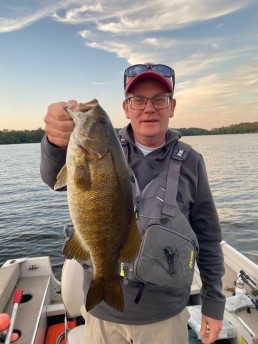
I started fishing and vacationing in northern Wisconsin somewhere around 1967. I was up there for 2 to 3 weeks, sometimes more, for let’s say 25 years. In those first 25 years, I probably caught a dozen bass. Not one was a largemouth. It just wasn’t widespread bass water up there. A few lakes were decent smallmouth fisheries, but in general, the lakes of Vilas, Oneida, Iron, Sawyer, Price and Forest counties were primarily walleye, muskie and perch fisheries. I think I spent most of my young life never catching a bluegill on the Eagle River Chain.
Well, things have changed—dramatically. I’m not a fisheries biologist, so I won’t try to explain why both largemouths and smallmouths are starting to thrive in Up North lakes. But I can tell you that there is a legit bass population in these northern counties, and it’s become a destination for a lot of bass fishermen in the state… and from out-of-state.
One of the nation’s biggest bass tournament trails, Major League Fishing (MLF), held its Team-Clash event in Minocqua last September where they fished Lake Minocqua, Big Arbor Vitae, and Tomahawk Lake. If you would have told me in 1980 that one day the best bass pros in the nation would be fishing a tournament in Minocqua, I would have laughed pretty hard. But it’s real. Up North bass fishing is real.
Oh, there are still some really great muskie and walleye fishing lakes up there, too, but we now have a solid third option in our Northwoods fishing adventures.
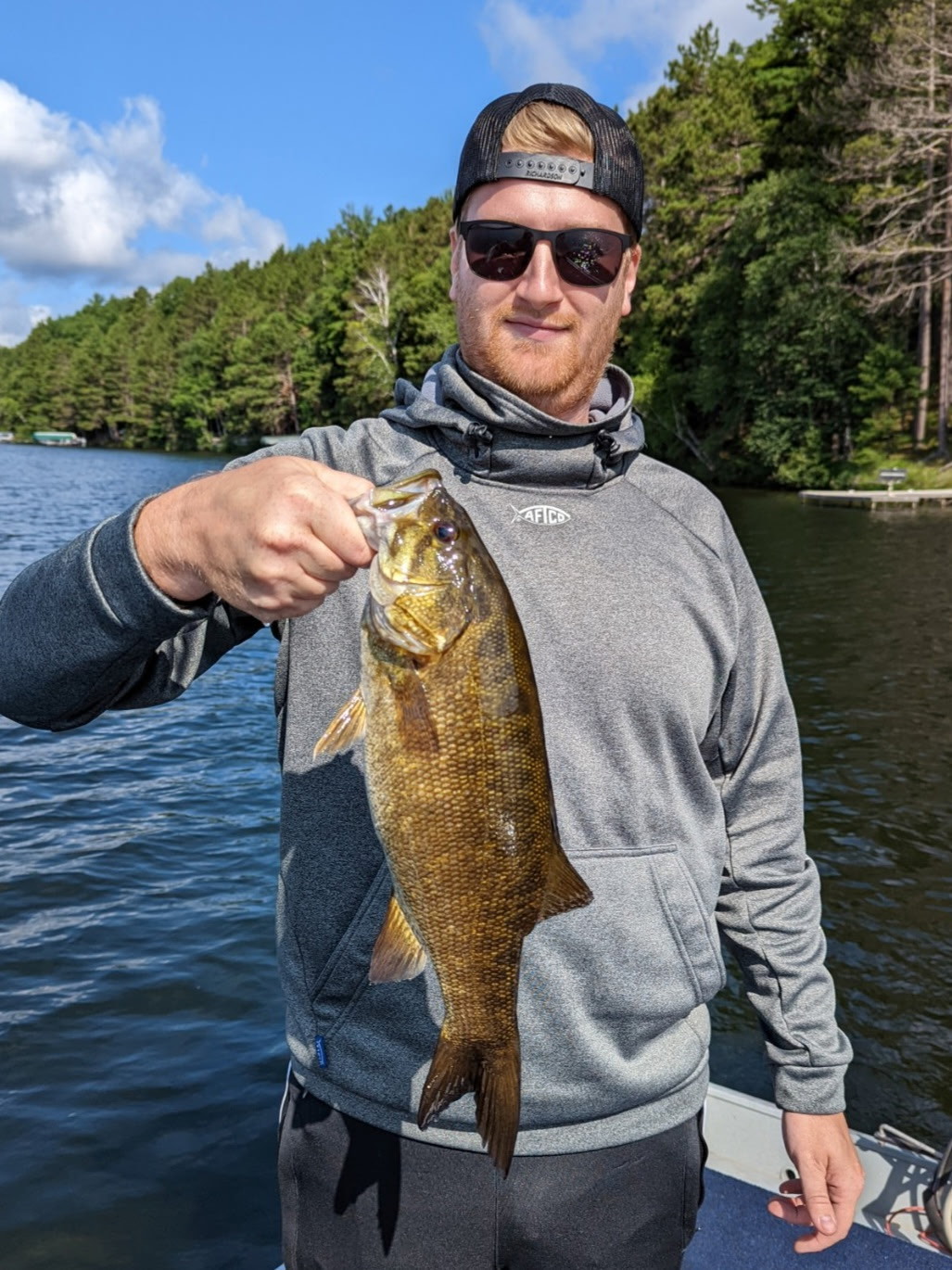
So, what are we looking for on these northern lakes? It’s not going to be too much different than in any other region. As a generalization, if you have a lake with a lot of weeds, it’s going to be primarily a largemouth fishery. Lakes with rock and hard bottom will be predominantly smallmouth lakes. The great part about many of these northern bodies of water is that a lot of them have both. You can fish a hollow-body frog in the pads for a big green one, then move 100 yards away and crack a tube on a rocky point for some brown ones.
You can be among the first to get the latest info on where to go, what to use and how to use it!
A couple lakes that come to mind are Minocqua and North/South Twin. South Twin has a great weed line with a lot of decent largemouths. Hop through the channel and you have the massive North Twin lake with virtually no weeds, but endless hard-bottom flats full of smallmouths. Minocqua is slightly different, but there are still clearly segregated areas for largemouths and smallmouths. But a lot of these lakes have both. So, if you want to pitch docks in 3 feet of water for largemouths one morning, and drop-shot in 20 feet of water on a rocky point for smallies that afternoon, you can do it on these lakes.
Beyond the well-known lakes, the Northwoods are chocked full of smaller lakes and ponds. Some could be 50 acres; some could be 15 acres. Have you ever been up north, driven past little lakes and asked yourself, “Hmm, I wonder if there are any fish in there?” I can assure you that probably half of them are full of nice largemouths. If you are willing to bushwack in and shore fish, or drag in a kayak or float tube, these are some real gems. Some of the best ones have no official name, and if you look on the DNR’s Find-A-Lake, they are listed as “unidentified.” Those are usually the hidden gems.
In general, bass presentations in the northern regions of the state will be a little smaller than you may use in the southern part of the Mississippi. Outside of midsummer, lures in the 3-inch range lend themselves best. Four-inch wacky worms will produce both species better than a 5-inch model.
It’s hard to beat a 2.5- to 3.0-inch paddle tail on a 5/16-ounce head for the trio of largemouths, smallmouths, and walleyes. If you find a good hard-bottom area, don’t be surprised if walleyes and smallies co-exist there. It’s also hard to beat a 3-inch crawfish or tube lure for all three species. Think finesse, rather than power fishing.
Up North largemouths love wacky worms. Four-inch watermelon, smoke with red glitter, and purple are a good place to start.
Largemouths can often be found in shallow shoreline areas with pads, fall-downs and submergent weeds. You won’t always see them on deep weed lines Up North because these prime, deep weed lines are often taken by muskies. Largemouths and muskies like the same type of habitat. Unfortunately for largemouths, the muskies are take the prime ambush spots, which force the bass shallower than you would expect in midsummer.
Jerkbaits like Shadow Raps and a small squarebill like a Big-O are good hardbait options. Both species will react to rotating tail topwater or a little popper like a Pop-R.
If you haven’t fished northern Wisconsin for the past 15 to 20 years, you will be amazed at what a great bass fishery we have up there: The Minocqua Chain, the Eagle River Chain, The Three lakes Chain, Twin, Round and Lost Land near Hayward, just to name a few. And don’t forget the ones that have no names! I love muskie fishing, and I still focus some time to them when I find myself Up North. But when the toothy critters won’t cooperate, don’t neglect the great bass fishing we have in northern Wisconsin. See you Up North!

Did you enjoy this post?
You can be among the first to get the latest info on where to go, what to use and how to use it!