
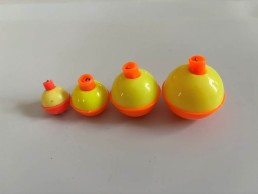
Trout Fishing with Bobbers
Few trout fishing books published before 1965 discussed fishing with bobbers. As a young man, I mistakenly began my trout fishing adventures without bobbers. Using bobbers today has greatly increased my catch while fishing in lakes and streams.
Like all varieties of tackle, judicious use of a bobber is necessary to best increase the chances of catching trout. Bobbers have two functions: bite detection and keeping a bait or lure at a specific depth. Considering the color, size, shape, and composition of the bobber is of utmost importance.
Bobber color
Bobber color is important on two fronts: The angler seeing the bobber, and the trout not detecting the bobber. A white or clear bobber is harder for trout to detect in flowing water as they see the bobber as a floating bubble, while the angler will have a hard time seeing it, as it blends into the water. Anglers need to be able to follow the bobber’s progress from its landing splash to its retrieval for best results.
In lakes, especially at long distances from shore, a fluorescent orange or fluorescent green bobber is best. A red-colored bobber is often sufficient for streams.
Bobber size
The size of the bobber is just as important as the color. A bobber needs to suspend the bait off the bottom without sinking. Too large a bobber will allow a savvy trout to take the bait without causing the bobber to react. Many anglers use a too large bobber. The ideal size suspends the bait and reacts instantly to a trout mouthing the bait. This means that a light bait requires a smaller bobber than a heavier bait.
Bobber shape
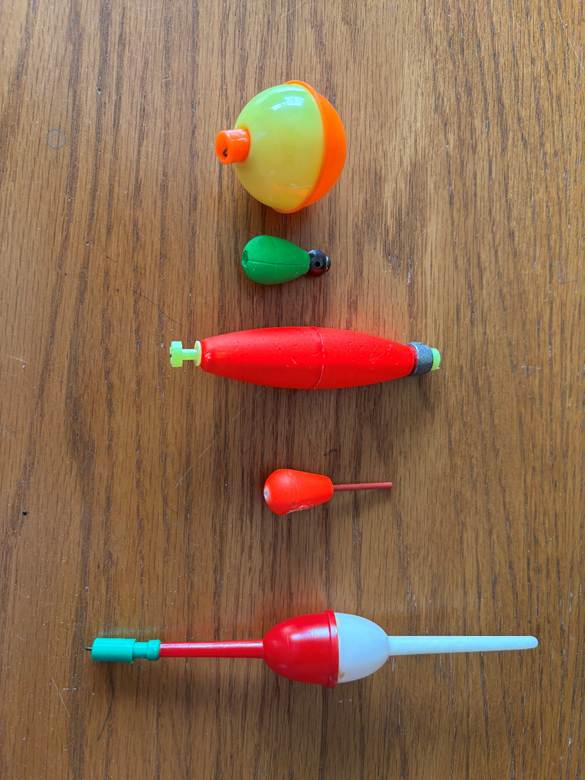
The shape of a bobber influences the sensitivity of a bobber to trout grabbing the bait. Perhaps the worst bobber shape that I have experience with is the common red-and-white spherical (ball). This is the hardest shape for trout to pull under and it does not react to a trout swimming toward the surface with the bait. Pencil bobbers (long, thin bobbers) react to a trout very quickly. These bobbers should be standing on end. Therefore, when a trout swims upward with your bait. the bobber will lay over on its side and stop moving on the surface of the water. If the trout swims away or downward, the bobber will submerge.
Thin bobbers, unfortunately, can be hard to see if far from shore or a boat. Inverted, pear-shaped bobbers with the pointed end toward the bottom, with an attached weight, submerge easily while their fat top is easier to see.
Bobber composition
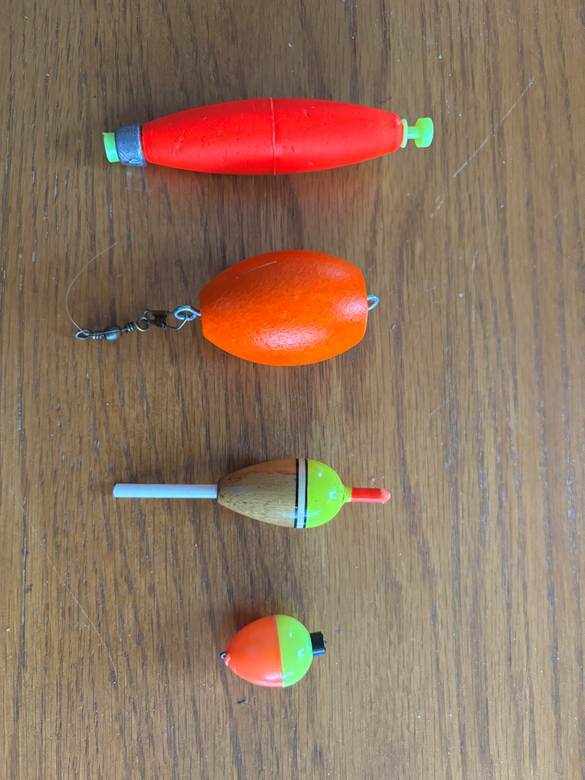
Bobbers can be made from hard plastic, soft foam, Styrofoam or wood. These materials have different densities to consider when deciding where to fish. A wooden bobber made from hardwood will be heavier than a similar-sized one made from balsa wood, hard plastic or Styrofoam. The wooden bobber, though, because of its weight, can be cast farther than all the other bobbers. This is important when fishing in lakes.
Bobber line attachments
Bobbers use different methods for attaching to the line. The simplest and most common method is a u-shaped metal wire attached to a spring. The wire is extended, and the line placed inside the u. Then the u is allowed to retreat into the bobber. Some bobbers use a tiny wooden dowel to hold the line in place. These bobbers either have a slit to insert the line or a hole through the bobber. Another method for attaching the line to pencil bobbers is to use tiny rubber bands. The rubber bands hold the line to the bobber stem. Finally, pencil bobbers can be attached to a horizontal slit by raising the spring to expose the slit. Once the line is in the slit, the spring is released.
You can be among the first to get the latest info on where to go, what to use and how to use it!
Bobber use in streams
I use different bobbers depending upon where I fish. In small streams, a pear-shaped, Styrofoam bobber is my first choice. The bobber has a lengthwise slit and a wooden peg. The peg is used to fasten the bobber to the line. A Styrofoam bobber is light, and a trout can easily submerge the bobber. In large streams, I use a hard plastic bobber.
Trout in streams frequently stay near the streambed where the current is the slowest. To catch these trout, your bait should drift near the streambed. Thus, the distance from your bait to the bobber needs to be considered relative to the speed of the current. Currents are not uniform at all locations or depths.
Bobbers provide anglers with vital information on how the water is flowing and where your bait is. The bobber should follow the current lane between fast water and slower water. This is where a trout will be stationed to grab drifting food. The bobber should drift at the same speed as a bubble in the current.
Typically, I start fishing by setting my bobber at 1 1/2 times the water depth. In other words, if the depth is 2 feet, I set the bobber at 3 feet. The water speed on the surface is faster than on the streambed, which causes the bobber to move faster than the bait. This will cause the bait to rise. The distance between the bait and bobber needs to be greater than the water depth. To get the bait to stay close to the bottom, I place a split shot about 6 inches above the bait.
If I do not feel a tick, my bait is not reaching the bottom. This indicates that I need to adjust my bobber after several casts. I increase the weight of the split shot or increase the distance between my bobber and bait. Faster currents require a greater distance between the bobber and the bait. The goal is to keep the bait near the streambed.
If I snag on the bottom, I decrease the distance between my bobber and bait until I occasionally tick bottom.
In slow pools, the bobber can be set at the water depth. Your bait hangs directly below the bobber, near the streambed. The water speed is nearly identical throughout the water column.
Bobber use in lakes
Lake fishing requires two different bobber types. For near-shore fishing, a hard-plastic pencil bobber is the best choice. This bobber reacts quickly to a trout grabbing the bait by either lying flat on the surface or submerging below the surface. The disadvantages of this bobber type are that it is usually too light to cast far into the lake, and is hard to see at a distance. To get the bobber to stand straight up, cinch a weight onto the line between the hook and bobber. The proper weight needs to be heavy enough to get the bobber to stand up without submerging.
A hardwood bobber is a great choice for fishing in lakes. Because of its weight, this bobber can be cast far. The bobber has an eye hook screwed into each end. At the end farthest from the hook, I use a ball bearing snap swivel attached to the eye hook. The swivel prevents line twist while retrieving the line.
In lakes, the distance between the bobber and the bait depends upon the depth of the trout. The bait is suspended directly below the bobber. There is no current to require a different distance between the bobber and the trout depth. Experiment with different distances between the bobber and the bait. After catching a trout, hold the distance between the bobber constant until the trout shut down. Then change the distance to find the level the trout are now using.
As you can see, bobbers are valuable fishing tackle. Selecting the correct bobber for the situation catches more trout.
M. P. Valoski fished and hunted for more than 50 years. After retiring, he became an author who wants to share his extensive experience regarding methods he learned the hard way to help young outdoors people be more successful.


Did you enjoy this post?
You can be among the first to get the latest info on where to go, what to use and how to use it!
