
Thinking Open-Water Panfish
Spring, and the open water season that follows in its footsteps, is always a welcome time of year for me. Although I do thoroughly enjoy ice fishing, early-season panfish angling is near the top of the list of my favorite fishing periods of the year.
There is always some equipment preparation involved in getting ready for the open-water season. That amounts to basic maintenance items like checking the line on the reels and changing slip bobber rigs over to fixed floats and tiny jigs.
My standard line is 6-pound-test mono, but I always carry at least one rod spooled with 4. Usually, the 4-pound-test is not necessary, but there are days when panfish are very fussy about what they decide to eat—or not eat. The lighter line can make a difference.
Spookiness is characteristic of springtime panfish. They don’t like to be disturbed too much when in shallow water. For this reason, I like longer rods that allow me to make casts far from the boat. Longer rods also allow me to pick up the slack in the line quicker when setting the hook.
I pay a lot of attention to water temperature when looking for early-season panfish. This time of the year, panfish are interested in finding on invertebrates for food. These bugs and worms are usually associated with soft-bottom areas, and not the harder bottom that panfish use for spawning.
Water temps in the 50s really get invertebrates active. Shallow, protected areas with soft mud bottoms warm the quickest and produce the most action. Afternoons or evenings are often better than mornings simply because the water is warmer after a day of solar heating.
You can be among the first to get the latest info on where to go, what to use and how to use it!
It is important to look in a little deeper water if the fish are not shallow. With the help of forward-facing sonar, finding these fish in deeper water, and staging to move shallow for food or spawning, has become much simpler. These deeper fish will roam, so be prepared to follow them.
As a general rule, early-season panfish take artificial lures quite readily. Although small crappie minnows will certainly catch fish, they are usually not needed. I take along waxworms. Sometimes, early panfish like a little extra scent—especially sunfish.
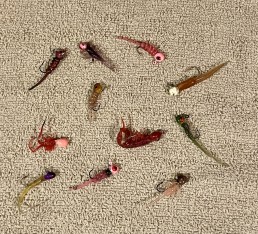
The type of jig used is important. Small feathered jigs will work, but I have much better success using small ice fishing jigs tipped with plastic tails. Today’s wide range of soft plastic offers many options to choose from. If the fish are eating invertebrates, give them something that looks like one.
One last thought: Because of the cold water, early-season panfish can be quite lethargic. Bites are often subtle, so your bite detection system must also be subtle. Being able to visualize finicky bites is important.
Early-season panfish options are readily available in most lakes. For this reason, it is a very popular period in the fishing calendar and is one of my favorite times of the year.

Did you enjoy this post?
You can be among the first to get the latest info on where to go, what to use and how to use it!
