
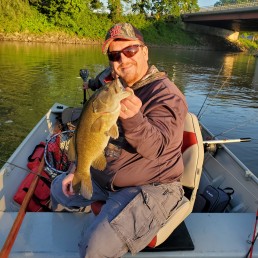
Stream Smallmouth Sweet Spots and Tempting Treats
As I slipped into the water and a cool feeling moved up my legs, I was grateful to have remembered my waders. It wasn’t cold outside, but there was enough difference between the water and air temperature moving up into the 60s. A little doubt crept in as I recalled that the smallmouths in this creek can be a bit fickle if the conditions and water temperatures weren’t ideal. Lack of rain for the past three days quickly swept those thoughts out of my head, and I decided to start with a jig and plastic presentation. A few casts in, I felt the line “jump” and then some pressure slowly moving away… bingo! Sweeping the rod tip from a 9 o’clock position back past my shoulder brought an instant jolt, followed by a line-peeling run across the current. We were engaged in the fight.
When April departs and welcomes in the month of May, smallmouth bass in a few of my favorite waters start showing up more consistently. No longer relegated to the safety of deeper-water pools to tough out harsh winter conditions in the Land of Lincoln, they begin to migrate. The warming temperatures signal feeding time and seek spawning locations for mature fish. In turn, these events present more opportunities for anglers to catch quality fish.
Accompanied by fall, this is a time of year when I look forward to getting out. Typically, it doesn’t require waking up at the crack of dawn as in the dog days of summer, with action often lasting into the late afternoon and early evening. In other words, the window of opportunity opens further with favorable weather and the emergence of spring.
While smallmouths may hit a variety of baits, choosing one over another, the ability to catch them rises at this time. We’ve had fish turn on a spinnerbait or crankbait and just follow, only to present them with a slower-moving soft plastic and hook the fish. Whether you’re fishing from a boat, kayak, wading or from shore, you can remain stealthy and catch fish.
Kankakee River guide and legend Matt Mullady once told us that if you want to learn how to stalk streams, start by watching herons. The grace by which they move, standing still, soft footsteps, and using available shade as ambush points all stuck with us.
As the month progresses closer to the spawning period, bass remain territorial and active. Spring is an excellent time of year to sharpen those skills. Longer casts through target areas will not only disclose the location of fish, but help you crack the code on the moods of bronzebacks. A fish that follows a bait indicates curiosity and a willingness to investigate, so repetitive casts with different lures can be profitable.
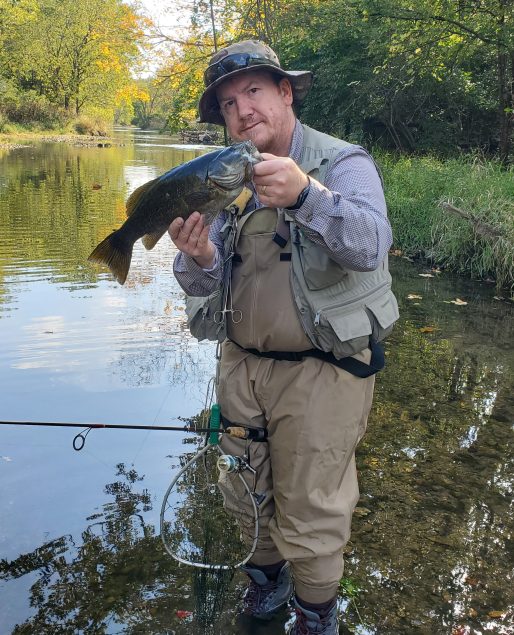


The correct gear can also positively affect the outcome. I’ll throw plastics, spinners, and topwaters on two types of spinning rods. The rods selected depend on the waters I’m fishing and are dictated by average catch size. For larger rivers, I have a 6’ 6”, medium-power, Shakespeare Ugly Stik Carbon fast-action rod matched to a 2500 or 3000 size Shimano Vanford reel spooled with 15-pound braided line. The actual 6-pound diameter helps to launch out those further casts and is typically used for plastics and mid-sized topwater. I like to use about two to three feet of 10-pound monofilament or fluorocarbon leader line. With topwater, it helps to prevent the supple braid from wrapping around the hooks and presents nicely, although mono will float, whereas fluorocarbon sinks.
That leads to the primary topwater and spinnerbait rod, a 6’ 6” medium-heavy power, fast-action, two-piece Shimano Clarus rod. The reel is a similar 2500/3000 size Shimano Nasci reel spooled with identical braided line diameter, but primarily a monofilament leader line. If topwater proves more consistent action, I use a crankbait snap for quick changes.
You can be among the first to get the latest info on where to go, what to use and how to use it!
When exploring the waters of smaller streams, my topwater rod drops down to an older 6-foot, light-power, moderate-action St. Croix Premier spinning rod, 1000 size reel and 10-pound strength braided line with a 10-pound monofilament leader. With the drag set correctly, it handles quality smallmouths that have latched onto size 60 to 75 plopping baits and smaller popper lures. The plastics rod becomes a 6’ 3” Ugly Stik Carbon medium-light-power, fast-action spinning rod paired with a Daiwa Fuego LT 2500 spooled with 15-pound braid.
When deciding on what plastics to carry (I’m wading, so it’s what fits into my vest and doesn’t feel like I’m storming the beaches of Normandy.), I have three basic types in two different color schemes. Crawfish and baitfish are good most anywhere for any given trip. Ned rigs are a typical small craw or the “nub” size stick worm. Craws and hellgrammite imitators are usually brown or green pumpkin with contrasting orange/red/blue or metal flake. These are thrown on a variety of jigs and weighted Mister Twister Keeper hooks. Fluke-style soft jerk baits are in white, or basic baitfish patterns, rigged on a wide-gap, 1/0 to 3/0 hook with a keeper spike. Plastics can be the primary bait choice, and also a good option to have ready to go on a follow-up presentation if smallmouth bass don’t accept a faster-moving presentation.
Faster-moving presentations may include buzzbaits and spinnerbaits in 1/8- up to 3/8-ounce where I fish. This is primarily dictated by water depth and clarity, as are the bait and blade choices. If the current is really pushing water or elevated, I like a heavier bait with a willow leaf primary blade and smaller Colorado one. You can go crazy with colors, but for weight-carrying considerations, I have three colors and two of each only for both styles of bait. Adding a plastic trailer can help with both buoyancy and hookups as it gives the fish more bulk to hit and inhale.
And let’s not forget a prop bait like the River2Sea Whopper Plopper, Berkley Choppo, Heddon Spinnin’ Image and other plopper-style lures. Here again we’re keeping it simple with either a baitfish color or black. There are plenty of those variants to match something similar to the prey in your home waters; for ours, the bass don’t appear that picky. The smaller offerings include 1/8-, 1/5- and 1/4-ounce spinners, buzzbaits, poppers, and 60- to 75-sized plopper lures. All are fished similarly, just in a different-sized profile.
Covering water for me means fancasting upstream, cross-stream, and quarter casting, bringing the lure back on about a 45-degree angle. This is the most consistent approach using any/all bait options. I can’t stress enough about changing up your presentation and experimenting with retrieve speed on topwater and fast-moving baits. A variety of presentations at different target points, with a varied retrieve, gives fish the greatest exposure to being caught.
Too many times, I’ve watched someone power fish through an area that typically holds fish, moving quickly and not changing anything they’re doing. Fishing behind them, we slow down, alter retrieve speeds and angles, and finish with plastics near fish-holding cover—usually producing results.
Kankakee River enthusiast Norm Minas once answered the question about casting and searching for fish like this: Where should we cast: upstream, downstream, across stream? He answered “Yes, yes, and yes.” Stereotypes and preconceived notions have derailed more than one angler’s trip over the years. Sometimes, smallmouth bass just don’t want to chase, but will hammer a 3- to 4-inch craw or boot-tailed grub pitched in front of them on a Weighted Keeper Hook.
As the mercury begins to rise in May, the time is upon us for renewed connections with the gamest fish that ever swam. Smallmouth bass become more accessible and worthy of the efforts to locate and catch them. With the right gear and a little planning, we’re off and running for another great bass fishing season. Warm days in February, before the Tinley Park Fishing Expo, had me dreaming already of getting out for time well spent fishing in the great outdoors.
Did you enjoy this post?
You can be among the first to get the latest info on where to go, what to use and how to use it!
