
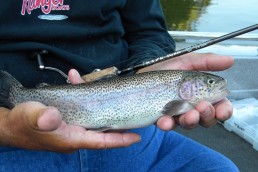
Spring Into Trout Fishing
Nothing is as exciting as watching a trout fly disappear in a splash. or a small float vanishing beneath the surface. For many anglers, spring means trout fishing. They flock to lakes, streams, and ponds throughout the Midwest to experience a battle with trout.
Trout do not reproduce well here, but most states have fish hatcheries that produce rainbows for stocking programs.
The fish are a supplement to preserve lakes as well as state parks. Other trout are stocked in the ponds of fee-fishing locations, as well as some RV parks.
Information about the trout stocking by public agencies is available on the websites of the respective state agencies.
Catching trout in these stocked lakes is not as simple as “shooting fish in a barrel.” It takes a little knowledge of the fish and some work on patterns.
Rainbows respond to water temperatures, the same as with all fish. They tend to prefer a little cooler water than do some of the Midwest’s warm-water species. They can be 12 inches below the surface, or as deep as possible in the body of water. The temperature range they prefer is between 56 degrees and 61 degrees. If the water temperature reaches into the 80s and trout can’t find deeper, colder water, the fish tend to die off in great numbers.
Trout prefer a pH level of from 5.8 (acidic) to 9.5 (highly alkaline).
The feeding habits of trout vary depending upon the amount of time they are in the water after stocking. In the first few days after stocking, trout maintain their habit of finding food near the surface. They grow up looking for the trout pellets sprinkled on the surface of rearing ponds.
You can be among the first to get the latest info on where to go, what to use and how to use it!
Biologists tell us that trout can taste salt, sweet, bitter, and sour the same as humans. They are the only fish to respond to sugar, and only in high concentrations. They also visually prefer the colors of red, orange and pink—perhaps because they feed on fish eggs in the wild.
Commercial trout baits seem to work well on one day and not so well on another. However, they have a long shelf life and can stay in the tackle box as a backup bait when all else fails.
During the early days after stocking takes place, trout will take spinners and marshmallows. Even Velveeta cheese spread on a small hook, suspended 18 inches below a small float, produces. These fish are aggressive feeders and tend to try to muscle out each other by attacking anything presented.
Once early anglers catch these aggressive fish, only the shy fish remain. They may take live baits such as maggots, waxworms, and pieces of nightcrawler.
The early-season fish are usually located in the top foot or two of the water. Later, the fish become suspenders or bottom huggers, depending on the environment, and are usually in groups. Slip-sinker rigs that allow the bait to float just off the bottom can tempt them: For instance, a piece of nightcrawler supplemented by a piece of marshmallow to keep it slightly off the bottom. Very small jigs, such as the Roadrunner line and the marabou jigs of Blakemore Fishing Group, will produce action when fish seem to have lockjaw.
Spring weather can be temperamental. On windy days, it is advisable to fish facing into the wind. Fishing structure, if available, such as drop-offs and points, in places where fish congregate.
Trout fishing in stocked areas is a fun way of easing into the full fishing season after ice-out.


Did you enjoy this post?
You can be among the first to get the latest info on where to go, what to use and how to use it!