
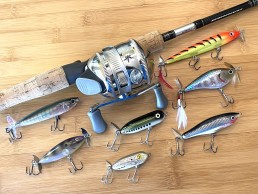
Small-Prop Revival, but First…Tackle Shaming!
Hey, two articles for the price of one!
I don’t get into all this social media nonsense, but “shaming” persists throughout many areas of social media. Basically, it’s when you put down certain aspects of people, or what they are doing or look like. on social media outlets. It’s being a jerk to others you probably don’t know, or to those you wouldn’t have the backbone to say something face-to-face, all while hiding behind the security of a keyboard. I don’t understand the need to do these things; if I don’t like something or don’t agree, I just move along. That doesn’t seem to be the way of the world today… sadly.
Getting to the point for this article, I was wandering through Facebook and saw the post of an acquaintance regarding a fishing outing he had been on. The pics from this trip were pretty amazing: multi-species catches, with quite a few fish pushing what I would consider trophy size. Then, I happened on down to the comments, some of which were disturbing Yes, there were a few congratulatory comments, but then most turned quite negative, all because his rod and reel choices were seen within the fish pics.
The reels of choice were spincast reels, and the comments were unmerciful, all directed at shaming the gear he was using, with little acknowledgement of the outstanding catches he had experienced. Really? I think that, as an angling society, we need to do a little better than that! Besides a simple congratulations, how about asking a few questions concerning water conditions, weather, depths, baits of choice, or anything that might allow anglers to gain a little knowledge about this person’s success, rather than tearing their accomplishment down? We all can learn from each other’s achievements; it doesn’t matter the gear used or even an angler’s experience level. Ee all started somewhere, and I’ll almost bet that, most of those “tackle shamers” made their first casts with spincast reels!
I know that fun, joking, and giving a little jab here and there between anglers is part of the camaraderie we enjoy. This makes fishing outings a bonding experience that we actually look forward to. But there is a difference between this and simply attacking others in a negative manner. There’s a whole lot out there in the world that tears our spirits down; let’s not bring that into our fishing world. Let fishing be our escape from the world’s noise and nonsense. Like my mom would say, “If you don’t have something nice to say, keep your mouth shut!”
That said, time to get back to fishing! Let’s talk topwaters! Specifically, prop baits!
The bass fishing world is inundated with big, loud, and obnoxious prop baits. It seems that the more a bait can spit and send a plume of water airborne, or create a wake wider than a ski boat, the better this topwater must be for attracting bass; and under certain circumstances, I would agree. But along with these surface-churning baits another form of prop bait features a subtler appearance while it’s making its way across the surface: tiny prop baits.
My first experience with these baits occurred as a kid, many years ago, while fishing in Tennessee at newly-formed Tims’s Ford Reservoir. There were two baits to throw back then: One was the Cotton Cordell Hot Spot, and the other, the Heddon Tiny Torpedo, Color? Well, there was no color. It was a clear plastic bait, and we tore the bass up on them. That should make us scratch our heads on why new need 37 different colors of topwaters today, but that’s a question for another day!
I’ve pretty much had a Torpedo in my topwater box since way back then. But not until recently have it made it to the end of my line; I’m not sure why. The Torpedo is just one example of some of the tiny-bladed topwaters out there. Basically, they’re rather elongated or minnow-bodied type baits, usually with a small, metal blade/prop attached to the rear. Some have front and rear blades, and some manufacturers have plastic blades as well.
You can be among the first to get the latest info on where to go, what to use and how to use it!
These blades create a much smaller wake and bubble trail as compared to Plopper-style lures or buzzbaits. My experience with these small props is that the subtler disturbance attracts bass under certain conditions. I’ve fished circumstances where large prop baits would actually spook bass; I could see them waking away from the bait rather than approaching it with interest. In clear water, for example, smaller prop baits have a more positive draw than the more intense action of large propped baits. On days when the surface is like glass, small prop baits sometimes draw more attention, in a good way!
Small prop baits also seem to stand out on small bodies of water. I’ve caught bass on Whopper Ploppers, for example, on small waters, but have had more consistency with small propped baits. I just feel that on these smaller waters, productive lures tend to be on the smaller side. They often resemble a single item of scurrying forage, rather than huge bait balls creating surface disturbances which, to me, is what large prop baits tend to imitate; small prop baits look more like single targets.
I’ve also had great success with small prop baits on small river systems. I’m not sure exactly why. It could be the lack of large bait schools, for the most part, on the rivers I’ve fished. But fishing these baits around eddy areas, river structures and bridge abutments, and cover such as log jams have produced well for me. Once again, do they simply resemble a single, fleeing bait?
Tiny-prop presentations make awesome search baits, and you can cover a lot of water with them. Retrieve-wise, you can just do a steady retrieve. But my favorite technique is a long pull, a slight hesitation to pick up line, and then pull again. Or you can do somewhat of a popping retrieve. All have their time and place, and you need to experiment on your waters.
I’ve already suggested a few spots on moving-water situations. On ponds and small lakes, work these prop baits along weed line edges, across open flats, or over the tops of vegetation that hasn’t quite made it to the surface yet. These baits often have two sets of trebles are not weed-friendly, so weed-free waters are your target areas.
Gear-wise, I throw these baits on medium-light to medium power, medium-action rods loaded with 10-pound braided line, which allows for incredible casting distances. But if you prefer mono, 10-pound is more than sufficient, as your primary fishing areas will be in open-water conditions; there’s little need for tackle geared to drag bass out of heavy cover.
This time of year, bait or forage seems to be on the smaller size, so the smaller disturbance created by these small prop baits seems to be another advantage, appealing to the bass’ draw to a smaller offering.
So, heading into the late-spring period, before your local waters become weed-choked, give these “old favorites” a try. And hey, if your reel of choice is the old, iconic Zebco 33, so much the better. Come to think of it, I just might blow the dust off a couple of my old 33s for a little retro bassin’ myself!
Did you enjoy this post?
You can be among the first to get the latest info on where to go, what to use and how to use it!